
Bloom Energy’s SOFC Servers Tap AI Data Center Demand Without New Equity
June 15, 2026Bloom Energy Corporation is really making waves lately, especially as the demand for power skyrockets in those gigantic hyperscale data centers driven by generative AI workloads. With the electric grid lagging behind and traditional diesel backup not cutting it in terms of emissions, operators are increasingly leaning toward modular fuel cells for reliable, low-carbon power right on-site. In a recent chat, CEO K.R. Sridhar mentioned that they’re poised to handle this surge in demand without tapping into new equity. Thanks to their improving cash flow, smart manufacturing practices, and a growing stack of long-term contracts, they’re feeling pretty confident about their trajectory.
Key Insights
- These hyperscale AI facilities can chew through hundreds of megawatts of electricity, which is creating some serious bottlenecks in the local grid.
- With the Bloom Energy Server, they’re utilizing solid oxide fuel cells that can convert natural gas, biogas, or hydrogen into electricity without any combustion happening.
- The company’s seen about a 130% jump in revenue year-over-year and even hit positive operating cash flow for the first time in their most recent quarter.
- Management says factory-level payback might happen in less than six months, though they’re still seeing how that plays out in reality.
- According to their own reports, Bloom has over 400 MW of its systems already serving data centers and digital operations.
Technology Spotlight
At the core of what Bloom brings to the table are solid oxide fuel cells (SOFCs). These high-temperature ceramic devices operate within a range of 600–1,000 °C. What happens is that oxygen from the air gets turned into ions at the cathode, passing through a solid electrolyte to the anode, where it reacts with a fuel stream—whether it’s natural gas, biogas, or pure hydrogen—to generate electricity. It’s a clean process without combustion, which helps keep those pesky NOx and SOx emissions in check, all while achieving electrical efficiencies over 50%.
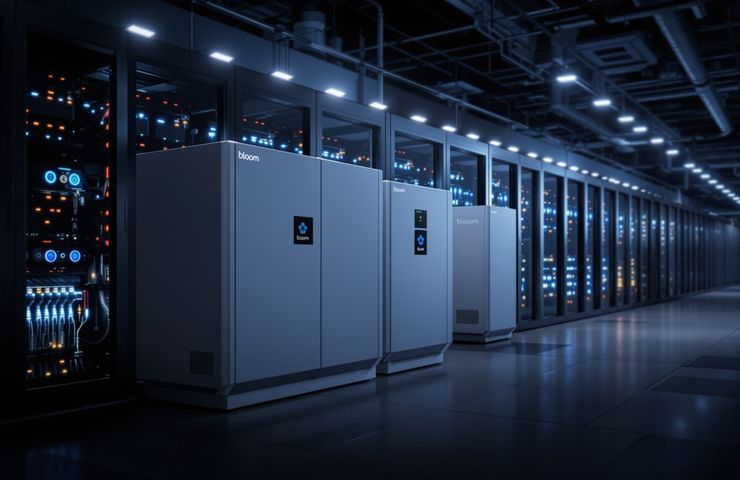
Bloom groups thousands of these SOFC cells into modular racks that are housed in container-like units. Each Bloom Energy Server can dish out a few megawatts of power, and by clustering multiple units together, they can easily meet the hefty power needs of big data centers. Plus, since the system doesn’t rely on water-intensive cooling loops and produces minimal local pollutants, it’s perfect for water-stressed areas or places with strict air quality standards. Customers can also gradually up the mix of hydrogen or biogas in their fuel, paving the way for a more sustainable carbon footprint over time.
Financial & Strategic Angle
Investors have been rewarding Bloom for their smart positioning, leading to a significant rise in their share price over the past year, fueled by the growing expectations of power demand from AI. In their latest earnings release, they reported a massive 130% revenue spike and more than doubled their earnings per share, plus they finally recorded positive operating cash flow for the first quarter—definitely a sign of better financial management.
K.R. Sridhar pointed out that their existing fuel-cell factories are operating on a capital-light model, partly funded by customer prepayments and investments from partners, which helps new production lines break even pretty quickly. While the six-month payback claim is still a bit anecdotal, it reflects their confidence in production efficiency and pricing. Bloom’s also keen on rapidly scaling up deployments, with modular servers that can be installed in a matter of months, rather than dragging their feet waiting years for transmission upgrades. This agility makes them an attractive partner for energy agreements with data center operators and utilities.
Market Implications
The rise of onsite SOFC power for AI clusters indicates a significant shift in electricity markets. Historically, data centers have relied on utility connections or diesel generators for backup power. But with growing grid constraints and sustainability goals in sight, there’s a whole new market opening up for distributed generation technologies. Of course, Bloom’s up against competition from gas turbines, reciprocating engines, battery storage providers, and even emerging options like small modular nuclear reactors.
How quickly fuel cells scale will depend a lot on policy and regulatory landscapes. Incentives for clean hydrogen and carbon capture could improve the climate footprint of SOFCs. Meanwhile, carbon pricing or tougher methane rules might bump up the costs of natural gas inputs. On the other hand, projects combining renewable energy and storage are gaining steam at the utility level; they could potentially offer more competitive costs as prices for electrolyzers and batteries keep dropping. Data center operators will need to weigh their options, balancing the certainty of modular SOFC deployments with the need for solid uptime.
For utilities, a steady move toward onsite power generation could shake up how they plan their grids and set rates. As more large customers gravitate toward distributed power solutions, we could see transmission and distribution revenues take a hit, pushing regulators to consider new cost-recovery strategies. Meanwhile, Bloom’s venture into microgrids and hybrid setups—pairing SOFCs with batteries or hydrogen storage—suggests they’re looking ahead to resilient and decarbonized energy systems that go beyond just serving data centers.
In a nutshell, fuel cell technology is carving out a significant role in this AI-driven era, acting as a crucial link between our current fossil-fuel infrastructure and the greener hydrogen future we all strive for. The big question is whether Bloom can keep up their rapid growth without diving into equity markets while also turning their optimistic payback estimates into tangible results. For now, their modular onsite power solution stands out as a solid answer to the energy demands of today’s data centers.


 With over 15 years of reporting hydrogen news, we are your premier source for the latest updates and insights in hydrogen and renewable energy.