Draft Hydrogen Shipping Route Plan Sets Course for Green Maritime Transport
April 7, 2026If you’re wandering along the Yokohama docks these days, you’ll notice more than just the scent of seawater and diesel. There’s a spark of excitement in the breeze—something that could totally reinvent how vessels slice through the surf. The Japan Hydrogen Association, a coalition of over 500 forward-thinking companies and local governments committed to a hydrogen-based society, has just rolled out a draft for a dedicated hydrogen shipping route. And trust us, this isn’t your average roadmap—it’s a serious leap forward in decarbonizing maritime transport and ushering in a new era of green shipping.
A Bold Vision in Japan’s Harbors
Imagine coast-to-coast voyages powered entirely by green hydrogen. That’s the big idea behind this proposed corridor, designed to kickstart zero-emission sailing along Japan’s shores—and maybe even beyond. By running ships on clean, renewable hydrogen, the plan dovetails perfectly with the national Basic Hydrogen Strategy and Tokyo’s goal of net-zero carbon emissions by 2050. And considering how much greenhouse gas the maritime sector belches out, swapping diesel for hydrogen could be a seismic shift.
With more than 500 members—from shipbuilders and marine engineers to port authorities and city halls—the Japan Hydrogen Association isn’t just talking about swapping fuels. They’re rethinking everything: overhauling dockside infrastructure, training captains and crews on new tech, and setting fresh safety and performance benchmarks for sustainable shipping.
From Global Pilots to Domestic Leadership
This isn’t Japan’s first rodeo with hydrogen at sea. Out in Norway, the MF Hydra made waves in 2021 as the world’s first liquid hydrogen ferry, proving Ballard’s fuel cells could handle the open water. In the U.S., the Sea Change ferry launched in 2022 with a 360 kW Cummins system, and Europe’s H2 Barge 1 wrapped up 2023 demonstrating inland navigation on green hydrogen. By studying those trailblazers, Japan can tailor its route to local currents—and aim even higher.
On top of that, feasibility studies from Sandia National Laboratories and DNV have already shown hydrogen propulsion can be as safe and reliable as traditional powertrains on short-sea trips. From advanced leak detection to fire-resistant materials, these insights will feed directly into Japan’s own technical standards.
How Hydrogen Fuel Cells Power Ships
At the heart of this plan? Hydrogen fuel cells. These ingenious devices combine hydrogen with oxygen to generate electricity, spitting out nothing but water vapor. Ships would carry hydrogen in either high-pressure cylinders or cryogenic tanks, then route it into fuel cell stacks that power electric motors. The result: smooth, silent cruising without a whiff of diesel exhaust.
Even better, the modular design of fuel cell stacks means you can scale capacity to fit everything from nimble passenger ferries to hulking coastal freighters. And because these systems give off useful waste heat, you can repurpose it to warm crew quarters or run onboard systems—tweaking efficiency even more.
Collaborations Driving Innovation
Pulling off a project of this scale takes teamwork on steroids. The Japan Hydrogen Association has become a true hub, uniting research labs, marine-equipment manufacturers, port operators and government agencies under one banner. That cross-sector camaraderie echoes the 2023 update to the Basic Hydrogen Strategy, which calls for partners in energy, industry and logistics to lock arms and build a robust hydrogen value chain.
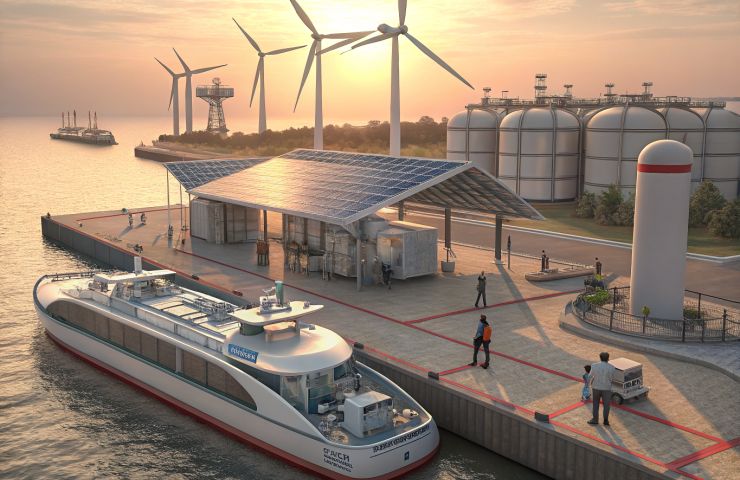
What’s more, the draft plan foresees hooking up offshore wind farms and solar parks to electrolyzers that churn out the green hydrogen for these vessels. It creates a closed-loop, fully renewable cycle that not only bolsters energy security but also opens fresh revenue streams for renewable developers eager to dive into the hydrogen market.
Phased Deployment and Scale-Up
Turning this vision into reality means moving in stages. First up are demonstration runs between a handful of ports, letting everyone test-drive fuel cell systems, bunkering logistics and crew training in real-world sea trials. Meanwhile, pilot bunkering stations—equipped with cryogenic storage and high-pressure pipelines—will pop up at key terminals to keep ships fueled up.
Rigorous training and safety drills for crews and dockworkers will go hand in hand with those trials. The plan even calls for coordinating with international bodies, like the IMO, to harmonize technical standards and make sure ships can sail seamlessly across borders. Once these early voyages prove themselves, Japan can ramp up to regular commercial services, weaving together a network of hydrogen-powered corridors that link major industrial hubs and island communities.
Opportunities and Challenges Ahead
The upside? Enormous. Zero-emission shipping lanes could slash thousands of tons of CO₂ every year, helping Japan meet its climate targets and attracting fresh investment in port upgrades. Fast refueling times and virtually unlimited range give shippers the flexibility they crave, while the green credentials of these routes shine on corporate sustainability reports.
But it’s not all smooth sailing. Green hydrogen still costs more than marine diesel, and its lower energy density means ships need extra tank space, potentially cutting into cargo capacity. Plus, hydrogen bunkering infrastructure is in its infancy, and cryogenic tanks call for specialized steel alloys, driving up costs. To tackle these hurdles, the Japan Hydrogen Association is in active talks with regulators, including the International Maritime Organization, to update rules and carve out clear guidelines for zero-emission shipping.
A Glimpse into the Future
Even though this draft is still on the drawing board, it paints an irresistible picture of maritime transport reimagined. Picture sleek ferries and freighters gliding almost silently along Japan’s coastline, pulling into ports powered by nothing but offshore wind and solar energy. It’s a vision of carbon-free trade routes knitting together island communities and industrial centers with minimal environmental impact.
This shift could also ignite fresh job growth across the hydrogen ecosystem—from electrolyzer fabricators and tank specialists to maintenance crews and station operators. Local economies around major ports might see new training programs and infrastructure investments, while global shipping giants explore partnerships to hop aboard these routes. In other words, the draft hydrogen shipping route is more than a set of plans—it’s a blueprint for a cleaner, quieter, more efficient maritime future.
At the end of the day, the Japan Hydrogen Association’s draft plan shows what happens when big-picture vision meets collaborative spirit. It offers a real glimpse of a world where hydrogen powers the waves, and the possibilities are truly boundless.


 With over 15 years of reporting hydrogen news, we are your premier source for the latest updates and insights in hydrogen and renewable energy.