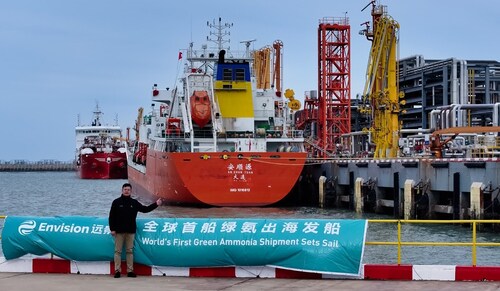
Green Ammonia: Envision Energy Ships First Commercial Cargo to South Korea
March 1, 2026It all kicked off on February 2026, when Envision Energy pulled off the world’s first commercial shipment of green ammonia. The cargo set sail from their flagship plant in Chifeng, Inner Mongolia and headed straight to LOTTE Fine Chemical in South Korea, marking a big leap from pilot tests to full-blown industrial supply.
The Chifeng complex runs entirely on renewable juice—wind turbines and solar panels scattered across the Gobi Desert feed power directly into electrolyzers. Thanks to their own Physical AI brain, they juggle variable inputs to keep hydrogen production smooth during electrolysis, producing high-purity green hydrogen for the Haber-Bosch synthesis and ensuring steady ammonia production. Right now, Phase 1 pumps out a solid 320,000 tons a year.
Market Impact
Why does this matter? Let’s break it down:
- Commercial viability: It proves you can stitch together wind, solar, electrolysis and shipping into a working green ammonia supply chain that meets real industrial needs.
- Regional positioning: This helps LOTTE Fine Chemical stake its claim as Asia’s go-to clean ammonia hub.
- Global benchmark: Teaming up with Marubeni Corporation taps into a massive trade network, setting a new standard for exporting green ammonia worldwide.
- Policy recognition: The project earned a shout-out in the World Economic Forum’s 2026 white paper, “From Blueprint to Reality,” underlining its role in industrial decarbonization.
Technical Snapshot
- Physical AI: Acts like a maestro, orchestrating wind, solar and storage to deliver steady power for electrolysis and synthesis.
- Flexible electrolysis: Can throttle back to 5–10% load, so you don’t need massive hydrogen storage.
- Green ammonia production: Uses a modern Haber-Bosch approach tucked inside a 100% renewable precinct.
- Integrated renewables: Direct coupling of turbines, panels and batteries wipes out dependency on the grid.
Historical Context
For decades, ammonia has been churned out by gas-fired Haber-Bosch plants, with CO₂ to match. Early green ammonia projects were cute pilots but tiny. Back in 2022, Envision Energy unveiled its Chifeng vision at World Hydrogen Week in Rotterdam. By early 2024, Phase 1 was online, and Q4 2025 saw the first export shipments—a dress rehearsal for today’s headline act.
Collateral Impacts
This commercial stride delivers wins on multiple fronts:
- Environmental: Replaces fossil-based ammonia, slashing CO₂ emissions in fertilizer and chemical supply chains.
- Economic: Opens new export avenues; the Marubeni tie-up expands global trade, while South Korea locks in green feedstock.
- Energy security: Diversifies ammonia sources, dialing down reliance on traditional imports.
- Technology transfer: Offers a blueprint for clean industrial hubs worldwide.
Of course, it’s not all smooth sailing—water demand for electrolysis, local resource quirks and closing the cost gap with conventional ammonia are hurdles to navigate.
Certifications and Marine Fuel Demo
When it comes to credentials, Chifeng’s green ammonia ticks every box: ISCC EU, ISCC PLUS and RFNBO certified. Meanwhile, at COSCO Shipping Heavy Industry’s Dalian terminal, the vessel Yuantuo 1 got bunkered with renewable ammonia, showcasing its chops as a marine fuel. And the story doesn’t stop there—Envision is pushing ahead with its H2 Cumbuco project at Brazil’s Pecém Port, further stretching its global footprint.
Industry Recognition
Envision Energy walked away with the Energy Transition Changemaker Award at COP28 and snagged a spot on Fortune’s Change the World list as an Energy Innovator in 2024—street cred that speaks volumes in the sustainable energy space.
Key Takeaways
- The first true end-to-end commercial delivery of green ammonia, proving performance beyond demos.
- Strategic partnerships with LOTTE Fine Chemical and Marubeni Corporation pave the way for regional and global markets.
- Plans to ramp up to 1.5 million tons per year by 2028 signal serious expansion ambitions.
Looking Ahead
At 320,000 tons a year, Chifeng covers roughly 0.2% of global ammonia demand—a small slice, but a pivotal proof point that green ammonia can scale. Replicating this success will hinge on local renewable resources, smart water management and supportive policy. Investors and regulators alike will be watching how costs evolve as volumes grow and supply chains mature. Bottom line: green ammonia is stepping out of the lab and into the real world, primed to become a cornerstone of industrial decarbonization and propel the sustainable energy transition forward.
 With over 15 years of reporting hydrogen news, we are your premier source for the latest updates and insights in hydrogen and renewable energy.