
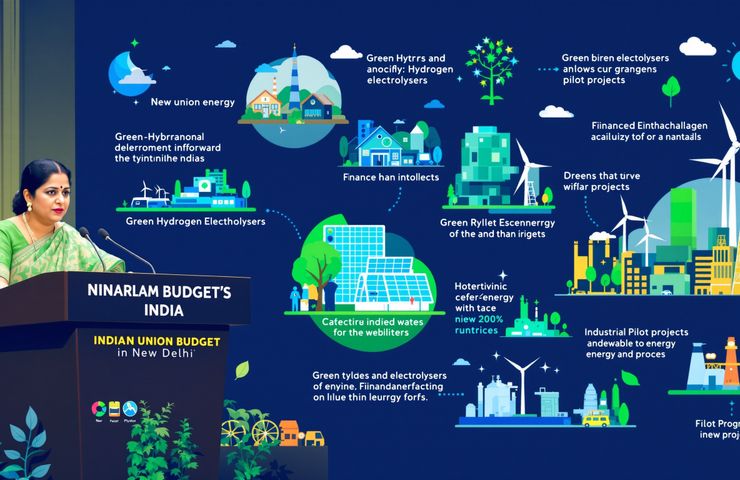
Green Hydrogen Mission Allocation in India’s Union Budget 2026
February 5, 2026You can almost feel the buzz on the streets of New Delhi these days—everywhere you look, conversations about policy, planning, and our cleaner-energy future are front and center. This month, as part of the Union Budget 2026, Finance Minister Nirmala Sitharaman stepped up to the mic and quietly confirmed that the National Green Hydrogen Mission will keep its fuel tank topped at ₹600 crore for the year ahead. It might seem like a drop in a colossal ocean when you’re talking about a multi-trillion-rupee budget, but for a sector still finding its feet, that steady backing is a real game-changer.
When the Ministry of New and Renewable Energy kicked off this mission in early 2023, they slapped on a grand total of ₹19,744 crore in funding through 2030—everything from big deployment plans to targeted research grants. The big goal? Cranking out 5 million metric tonnes of Green Hydrogen every year by 2030 and turning India into a hot spot for both production and export. So, while that ₹600 crore isn’t a fresh infusion, it’s exactly what keeps this engine humming along.
Mission Milestones and Investments
We’ve already chalked up some impressive wins since Day One. Remember how the allocation jumped from ₹300 crore in the 2025-26 revised estimates to ₹600 crore? That’s right—it doubled, and now it’s locked in. Under the SIGHT scheme (our clever nudge for electrolyser manufacturing), the MNRE has earmarked ₹17,490 crore to supercharge domestic production. By May 2025, no fewer than 15 firms scored the green light to add a combined 3,000 MW of electrolyser capacity to the grid.
On the production front, the mission has already carved out an annual capacity of 862,000 tonnes of green hydrogen across 19 companies. We’re running mobility pilots on 10 routes with a fleet of 37 vehicles, and sectors like steel, shipping, and transport have pocketed a sweet ₹1,466 crore for their testbeds. Research and development? That’s sitting pretty at ₹400 crore, backing 23 projects plus a ₹100 crore startup fund to spark fresh ideas in Renewable Energy India.
Driving Innovation with Electrolysers
At the technical heart of this revolution are Electrolysers. These clever machines split water into hydrogen and oxygen using solar or wind power, turning intermittent renewables into a storable, on-demand fuel. Across labs and workshops, researchers are tinkering with new materials, sleek designs, and scale-up tricks to drive costs down and performance up. Companies using lower-cost components can nab performance incentives, while academic teams push the envelope on efficiency and longevity.
To put it in context: each megawatt of electrolyser capacity can churn out around 40 tonnes of green hydrogen annually. Multiply that by the 3,000 MW we’ve approved, and you get a sneak peek at how we could decarbonize heavy hitters—think steelmaking and fertilizer plants that have been stuck on fossil fuels for decades.
Sector-Specific Pilots
It’s not just about buses and trucks. We’ve got pilots popping up in industries that have long leaned on grey hydrogen or straight-up fossil fuels. The steel sector snagged ₹455 crore to trial green hydrogen in direct reduced iron processes, while ports are hosting hydrogen-powered tugboats that hook up to shore-based refueling stations. Each of these setups is essentially a real-world lab, testing fuel quality, safety routines, and logistics hurdles.
On the research side, we’re backing advanced membranes, next-gen catalysts, and low-temperature electrolysis methods—all hot topics in Indian institutes, sometimes in partnership with labs abroad. These pilots will serve as blueprints, showing how big factories and deep-sea ports can retrofit for a zero-carbon future.
Broader Impact and Future Outlook
The stakes couldn’t be higher. Hit that 5 million metric tonnes target by 2030, and analysts reckon we’ll cut over 50 million tonnes of greenhouse gases every year—equivalent to taking more than 10 million cars off our roads. On the balance sheet, trimming fossil fuel imports by north of ₹1 lakh crore frees up serious capital for hospitals, schools, and roads.
And let’s not forget jobs. We’re talking about as many as 600,000 new positions in manufacturing, operations, logistics, and R&D. From plant floors to sun-drenched villages hosting solar arrays, local economies are in line for a boost. As India marches toward 125 GW of wind and solar by 2030, the synergy between cheap renewable power and Green Hydrogen will only get stronger.
Collaborations and Global Connections
This isn’t a solo performance. India’s green hydrogen push is knitting together partnerships at home and abroad. This year, the MNRE inked an MoU with Saudi Arabia to swap tech, co-develop projects, and explore joint ventures. Back home, schemes like PLI incentives and viability gap funding are lining up alongside the National Green Hydrogen Mission to close the cost gap.
Private players aren’t waiting around either. Startups and research outfits are teaming up with industrial veterans to try out cutting-edge electrolyser designs and integrated renewable-hydrogen systems. It’s a glimpse at a future where green hydrogen weaves its way into steel mills, chemical plants, and shipping corridors—building a resilient, low-carbon ecosystem.
Looking Ahead
With ₹600 crore locked in for Year One of Union Budget 2026, the National Green Hydrogen Mission is cruising in steady gear. There’s no dramatic leap, but that steady, disciplined push is exactly what we need. For India, this mission is about shoring up energy security, turbocharging economic growth, and staking our claim as a climate pioneer. Globally, it’s a blueprint for emerging economies eyeing clean fuels while keeping budgets in check.
So keep your eyes peeled: electrolyser factories are ramping up, pilot fleets are logging miles, and communities are seeing new jobs pop up. Each step gets us closer to a robust, scalable hydrogen economy. If all the pieces fall into place, we’re staring at a genuine game-changer for sustainable energy—one with footprints far beyond our borders.

 With over 15 years of reporting hydrogen news, we are your premier source for the latest updates and insights in hydrogen and renewable energy.