Green Hydrogen Partnership Propels Stargate Hydrogen into UK Market
March 10, 2026They turned heads across the UK energy scene when Stargate Hydrogen announced its first onshore collab with Seacht Group. For the Estonian deep-tech outfit, this is a major stepping stone in its Europe-wide growth plan. Their ceramic-based alkaline electrolysis tech isn’t just lab talk—it’s gearing up to feed real green hydrogen into the ever-hungry UK hydrogen market. This partnership is more than a handshake; it’s a statement that the UK is ripe for industrial-strength hydrogen solutions.
Breaking into the UK: Why It Matters
The UK is racing toward mid-century net-zero, and its national Hydrogen Strategy has set a target of more than 10 GW of electrolyser capacity by 2030. Pulling that off could create tens of thousands of jobs and unlock major investments in wind, solar, and other renewables. Industrial hubs from Teesside’s chemical parks to the Humber’s refineries are itching to swap out grey hydrogen for cleaner fuel. By jumping in now, Stargate Hydrogen and Seacht Group position themselves at the core of the UK’s energy transformation.
The Secret Sauce: Ceramic-Based Alkaline Electrolysis
Stargate Hydrogen’s edge comes from advanced ceramic membranes and electrodes built to withstand alkaline environments without breaking a sweat. These components far outlast standard polymer membranes, keeping performance steady at industrial currents and cutting downtime for replacements.
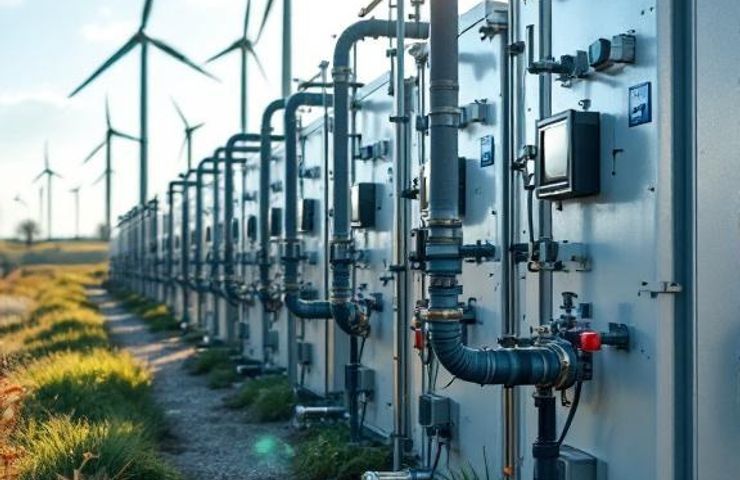
They’ve tailored a range of modules: pint-sized 0.5–1 MW stacks for pilots and demos, nimble 1 MW containerised units for rapid site rollouts, robust 5 MW “starbase” clusters for industrial parks, and high-capacity 10 MW “aurora” systems for utility-scale setups. Each is designed to pair seamlessly with offshore wind arrays, solar farms, or other renewables, turning intermittent power into dispatchable green hydrogen.
What Each Partner Brings to the Table
Stargate Hydrogen offers deep expertise in materials science, cell design, and stack assembly—its Tallinn R&D team has dialled in architectures that minimize electrolyte crossover and boost efficiency, so every stack meets exacting performance specs.
Seacht Group brings decades of UK-based engineering muscle: pressure vessel fabrication, pipeline integration, and renewables grid connections. From custom hydrogen storage tanks to balance-of-plant engineering, Seacht’s local presence smooths out permitting, site commissioning, and ongoing maintenance—critical for projects that can’t afford downtime.
Debut at Hydrogen UK Conference
Their first public outing was at the annual Hydrogen UK Conference in Birmingham, a hive of industry execs, government officials, and academic researchers. By sharing a booth, Stargate Hydrogen and Seacht Group sparked nonstop conversations with potential offtakers, EPC contractors, and policymakers, making it crystal clear: this alliance isn’t a side project—it’s a full-on commitment to shaping the UK hydrogen market.
Strategic Fit in a Growing Market
The UK’s industrial clusters—think steelworks in South Wales, petrochemical terminals on the Humber, and specialty-chemical plants in central Scotland—are all under carbon constraints. A domestic electrolyser supply chain cuts out import costs, speeds up delivery, and slashes logistical headaches. That’s a win for project developers and end-users alike.
For Stargate Hydrogen, teaming up with a well-known local player like Seacht Group fast-tracks market entry and builds trust. For Seacht, adding cutting-edge alkaline electrolysis tech to their toolkit broadens their renewable portfolio and cements long-term relationships with utilities and grid operators.
Collateral Impacts: Jobs, Supply Chains, and Emissions
Building and deploying electrolysers feeds straight into new jobs—from engineering and operations to quality control and project management—and lifts SMEs that supply ceramic parts, vessel fabrication, and installation services across the country. Plus, ramping up green hydrogen production can shave off millions of tonnes of CO₂ over a project’s lifetime, whether it’s powering low-emission industrial processes or blending into gas grids for heat.
Addressing Commercialisation Challenges
Scaling to multi-megawatt alkaline electrolysis stacks is no small feat: you need long-duration reliability, optimal replacement scheduling, and ultra-pure hydrogen output, all while navigating UK certifications, safety regulations, and supply-chain bottlenecks. Stargate Hydrogen has run lab and pilot trials in Estonia and Europe, but industrial-scale rollouts demand tight coordination on materials sourcing, manufacturing capacity, and final site commissioning to make it all seamless.
Future Outlook: More Alliances and Project Pipeline
Both companies stress this UK tie-up is only the beginning. Stargate Hydrogen is already in talks with additional EPC firms and potential offtakers in aviation, bio-refining, and maritime sectors. They’re lining up demonstration plants in industrial parks and gearing up for rapid scale-up, backed by the UK government’s evolving hydrogen framework and green hydrogen grant schemes—setting the stage for a steady pipeline of projects well into the next decade.
Bottom Line: A Real Push for Europe’s Hydrogen Economy
By pairing breakthrough ceramic alkaline electrolysis technology with solid local engineering expertise, Stargate Hydrogen and Seacht Group have crafted more than a partnership—they’ve drawn up a blueprint for market entry and industrial decarbonisation. It gives the UK hydrogen market a fresh jolt of momentum, gives Stargate Hydrogen a crucial foothold in one of Europe’s most ambitious green hydrogen arenas, and cements Seacht Group as a go-to leader in clean energy engineering. Innovation plus on-the-ground support is exactly what we need to hit net-zero and reimagine how we power our future.

 With over 15 years of reporting hydrogen news, we are your premier source for the latest updates and insights in hydrogen and renewable energy.