
Green Hydrogen US and Indian Mandates Propel Industrial Decarbonization
February 26, 2026As companies scramble to shrink their carbon footprints, we’re seeing two very different playbooks: India’s leaning into regulatory mandates paired with cost-offsets, while the U.S. is pouring money into supply-side incentives and hustling to lock in demand. It’s a fascinating case of how policy tweaks can shape the next wave of industrial decarbonization.
India’s Big Mandate for Green Hydrogen
The Confederation of Indian Industry (CII) just shook things up in its budget pitch: how about requiring 10–15% of all steel, ammonia and cement for public projects to come from green-hydrogen plants? It’s a bold ask, and though it’s still on paper, CII is betting these green hydrogen mandates will anchor demand and nudge down costs faster than any standalone subsidy. Lock in buyers first, then let economies of scale do the heavy lifting.
Chandrajit Banerjee, CII’s Director General, points out India’s non-fossil fuel capacity has climbed to 266.78 GW—a 22.6% jump from last year, with nearly 50 GW of fresh clean power added. That surge is the perfect backdrop for electrolysis, where renewables split water into hydrogen and oxygen. CII’s vision of industrial green hydrogen clusters—shared electrolyzers, pipelines and offtake contracts—could open the door for smaller players in ceramics, glass and chemicals, making the whole setup more cost-effective.
On the export front, CII is lobbying for ‘deemed export’ status for green hydrogen and pushing bilateral deals with Germany, the Netherlands, Japan and South Korea. Those partnerships could crack open overseas markets—though actual purchase commitments are still up in the air. It’s a smart way to court buyers before the first molecule ever flows.
U.S. Supply-Side Incentives Shine, Demand Lags
Over in the U.S., the U.S. Department of Energy (DOE) and Environmental Protection Agency (EPA) have funneled nearly $20 billion into hydrogen programs under the Bipartisan Infrastructure Law. That haul includes $8 billion for seven clean hydrogen hubs, another $8 billion for carbon-capture infrastructure and $2 billion for electrolyzer research. On top of that, the 45V tax credit can cover up to $3 per kilo of clean hydrogen (≤2 kg CO₂e/kg), while the 45Q credit pays up to $50 per ton of CO₂ captured.
But here’s the kicker: project delays cropped up when rules for the IRA breaks stayed murky and there were fresh jitters about how long those hydrogen incentives might stick around. Developers racing the clock need to break ground by 2028 to snag 45V benefits, so some are eyeing blue hydrogen—harnessing fossil gas plus capture—since the numbers often look stronger than pure green electrolysis. That dynamic risks nudging the market back toward fossil-based hydrogen with carbon capture rather than renewables-driven production.
To close the demand gap, the DOE tapped a consortium led by the EFI Foundation, S&P Global and the Intercontinental Exchange. Their mission? Roll out a dedicated demand-side support program that de-risks offtake agreements and gives producers the confidence that someone will actually buy the hydrogen they make.
Bridging the Demand Gap: Anchors and Clusters
It turns out cash alone won’t cut it—both India and the U.S. are learning you need anchored offtake to get projects off the ground. India’s recipe uses public procurement mandates, carbon-credit allocations, fertilizer cross-subsidies and viability-gap funding to guarantee a home for green hydrogen. In the U.S., it’s all about backstopping offtake through consortia and financial guarantees since there’s no formal blending rule yet. The endgame is the same: show investors there’s a buyer waiting.
At its core, hydrogen needs scale to drive costs down. CII reckons a 10–15% blend requirement in big infrastructure projects could trigger those cost savings, while U.S. clean hydrogen hubs aim to co-locate production and consumption—cutting transport costs and showcasing industrial and transport applications right where they’re needed.
Built for the Future: Tech and Collaboration
Under U.S. policy, green hydrogen is defined as having carbon intensity ≤2 kg CO₂e per kg. By contrast, grey hydrogen emits unabated CO₂, and blue hydrogen tacks on carbon capture to clean up the exhaust. By setting these standards and deadlines, regulators are drawing a line in the sand: either you go green before the cutoff, or you risk missing out on those juicy credits.
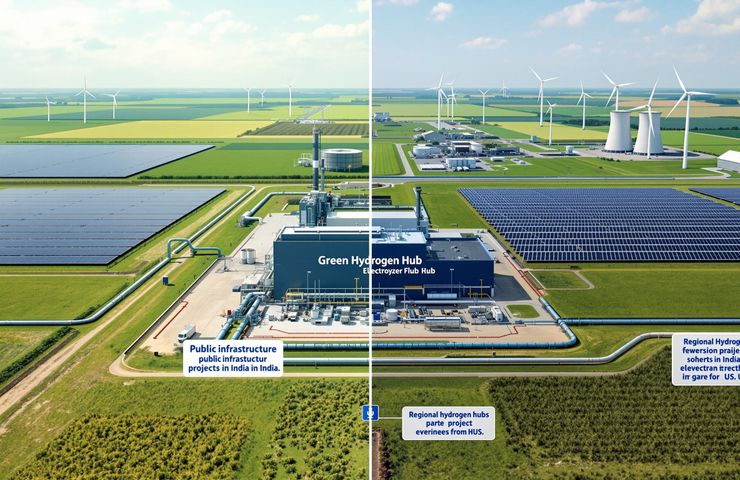
Both India’s industrial clusters and the U.S.’ regional hubs hinge on collaboration—pooling electrolyzer capacity, pipelines, storage and offtake into a single network. That not only spreads costs but also sends a clear message: green hydrogen isn’t a gamble, it’s a collective bet on our energy future.
The Real Kicker: Policy Clarity
At the end of the day, none of this works without predictable rules. India needs clear-cut mandates and fiscal support geared toward green electrolysis, while the U.S. must finalize IRA implementation guidelines and consider tweaking or extending the 45V and 45Q timelines. Without that certainty, investors will stay on the sidelines, and green hydrogen will struggle to outshine its grey and blue rivals.
Bottom line: we’re at a crossroads. India’s mandate-driven model and the U.S.’ incentive-heavy approach share one truth—anchored demand is the secret sauce for scaling green hydrogen. If policymakers sharpen their tools and give companies the confidence to commit, industries around the world stand to gain from an energy solution that cuts carbon and boosts energy security.

 With over 15 years of reporting hydrogen news, we are your premier source for the latest updates and insights in hydrogen and renewable energy.