Horizon’s 5MW AEM electrolyser at Tianjin steel plant
HET Hydrogen installs the first 5MW AEM electrolyser at Rockcheck Steel’s Tianjin plant, marking a landmark in on-site green hydrogen production for industrial decarbonization.
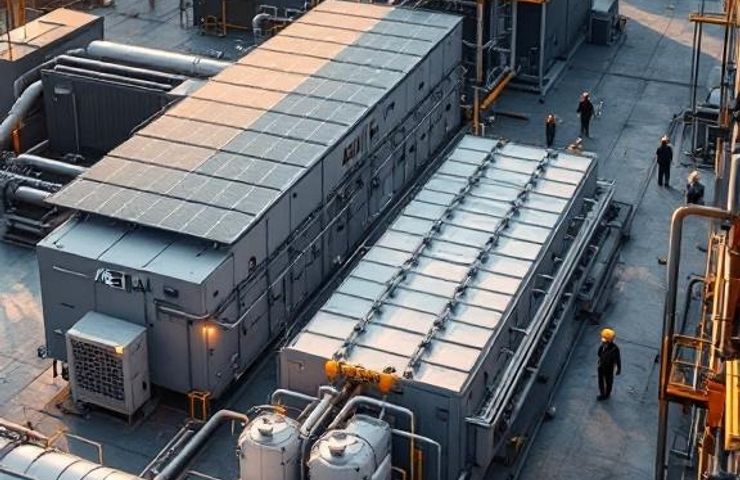
When most folks picture a steel mill, they imagine rivers of molten metal and mountains of coal. Now, swap that image for one powered by nothing but wind and sun. That’s exactly what’s happening at the Rockcheck Steel plant in Tianjin’s Jinnan District, where Horizon Fuel Cell Technologies subsidiary HET Hydrogen has just rolled out the world’s first working 5 MW AEM electrolyser. Hooked up to a 17 MW building-integrated photovoltaic (BIPV) array—half of a 10 MW solar installation—this setup can split water into up to 1,000 Nm³/h of green hydrogen. That hydrogen heads straight into direct reduced iron (DRI) lines and blast furnaces, pushing coal out of the picture and slashing CO₂ emissions in an industry behind roughly 7–10 percent of global greenhouse gases.
A new chapter in electrolysis
If alkaline and premium PEM systems felt like bookends, AEM electrolysis steps in as the cozy middle chapter. Instead of bulky, corrosive liquids, an anion exchange membrane shuttles hydroxide ions between electrodes—no pricey iridium catalysts required. Horizon’s 500 kW modular stacks snap together into multi-megawatt units and can ramp output on the fly, making them a perfect match for erratic sustainable energy sources like solar. After a pilot megawatt-scale AEM unit in Foshan last year, this 5 MW milestone proves the concept at real industrial scale. Horizon claims its AEM approach can cut power demands by up to 20 percent versus alkaline electrolysers, though independent tests to hit a sub-$2/kg levelised cost of hydrogen production are still in the works.
From lab to megawatts
Electrolysis dates back to 1800, but only recently has green hydrogen taken off at commercial volumes. Alkaline electrolysers led the charge for decades, followed by PEM systems around 2015—until catalyst shortages cranked the price tag sky-high. The AEM idea popped up in the mid-2010s with a handful of sub-10 kW pilots. Horizon’s 1 MW stack in Foshan was already one of the biggest; jumping to 5 MW is a real statement that AEM can scale. China’s pipeline now tops eight million tonnes of annual electrolyser capacity, and projects like Rockcheck’s 10 MW build a backbone for a global hydrogen economy.
Decarbonising steel in Tianjin
Tianjin, once a humble Qing dynasty port, has grown into a beating industrial heart—and now it’s pivoting to cleaner processes. Rockcheck Steel, founded in 2001, runs blast furnace (BF), basic oxygen furnace (BOF) and electric arc furnace (EAF) lines at its Gegu plant. With over 8,000 employees, it’s one of China’s private steel champions. Early in 2025, Rockcheck locked in a green hydrogen deal with Horizon: two 5 MW AEM electrolysers powered by a 17 MW BIPV array. This month saw the first 5 MW stack arrive, feeding hydrogen into existing furnaces and syncing up with Tianjin’s zero-carbon industrial park plans and the nation’s carbon trading scheme.
Bridging tech and strategy
For Horizon Fuel Cell Technologies, this 5 MW delivery is more than a headline—it marks a shift from small-scale science kits to heavyweight industrial applications. Founded in 2003 in Singapore as a PEM fuel cell specialist, the company spun off HET Hydrogen to pioneer AEM tech. By ditching platinum group metals, operating at lower pressures and designing compact stacks, Horizon undercuts established electrolyser makers. Landing Rockcheck’s mill not only proves lab-to-field scalability but also positions the firm to ride China’s green hydrogen wave—already the world’s largest, with over 220,000 tonnes of capacity by 2025.
Economic and environmental payoffs
On paper, tying solar-powered electrolysis to hydrogen production at roughly 50 kWh per kilogram slashes costs compared to grid-tied or fossil-fuel routes. Industry analysts reckon green hydrogen at $2–4/kg could shave up to 29 percent off steelmaking premiums versus grey hydrogen. At Rockcheck, the 17 MW BIPV array not only locks in cheap power but also eases grid curtailment headaches common in northern China. The local air quality wins are real too: every tonne of green hydrogen in a BF-BOF line can avoid up to ten tonnes of CO₂, giving port cities like Tianjin some much-needed breathing room.
Policy, market and global ripple effects
China’s “Dual Carbon” roadmap—which aims for peak emissions by 2030 and neutrality by 2060—has turned plants like Rockcheck into live testbeds. Hydrogen production projects now score pilot city programs, grants and carbon market incentives. With China amassing over half of global green hydrogen developments, Western firms face a choice: innovate or cede ground. If follow-up data from Tianjin confirms sub-$2/kg costs and a 50,000-hour stack life, expect copycat decarbonisation hubs to spring up in Europe, North America and Australia.
Challenges and future directions
Of course, scaling any new tech carries hurdles. AEM membranes have shown wear under constant voltage, and long-term durability data is thin. Horizon’s goal of a 50,000-hour stack lifetime will be under the microscope as Tianjin’s units weather daily thermal swings and feedstock quirks. On-site hydrogen production also raises fresh puzzles around storage, piping and safety standards—areas begging for further investment, regulation and industry know-how.
Still, the first 5 MW AEM electrolyser at Rockcheck is far more than a proof-of-concept—it’s a milestone in industrial decarbonization and hydrogen infrastructure. As the second stack flips on and operational data rolls in, we’ll finally see if AEM can deliver on its promise of low-cost, high-volume green hydrogen. If it does, this Tianjin steel plant might just write the blueprint for zero-emission steelmaking around the globe.