
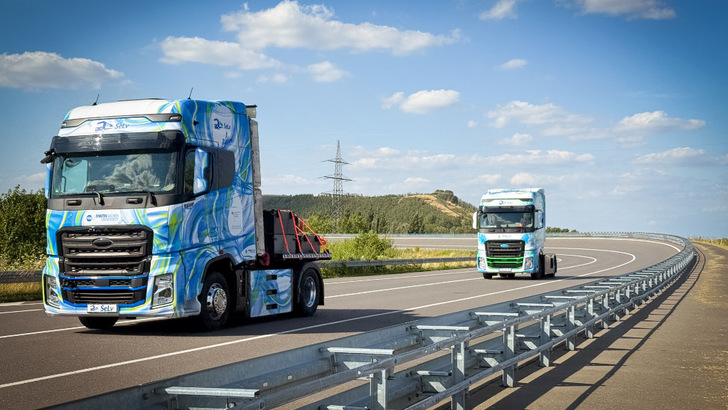
Hydrogen Fuel Cells Drive New Modular Powertrain Kit for 41-Tonne Trucks
January 27, 2026Ever wondered what it takes to turn a 41-tonne diesel truck into a zero-emission beast? That’s the challenge the Production Engineering of E-Mobility Components (PEM) chair at RWTH Aachen University tackled head-on with their five-year SeLv project. The result is a road-approved, modular powertrain kit that swaps in a 368 kWh lithium-iron-phosphate battery and a 170 kW hydrogen fuel cells range extender—thanks to €16.9 million in government funding. Smart, predictive energy management stitches it all together, stretching your run to 750–1,000 km on a single charge and a hydrogen fill-up. It’s a big leap for getting zero-emission technology into the long-haul game.
- Pre-assembled, bolt-on design slashes integration headaches
- Smart energy management that flips between battery and fuel cell technology, feeding regen power straight into the pack
- Brings up to 470 kW at peak, holds 400 kW continuously, and handles 250 kW DC charging
- Your pick of 35 kg @ 350 bar for about 750 km, or 70 kg @ 700 bar for north of 1,000 km
- Three-speed automatic gearbox that smooths out both hill climbs and open-road cruising
- Predictive navigation weaving in route profiles and the latest hydrogen infrastructure data
- Fully homologated prototypes, road-ready after major showcase fairs
Integration on your schedule
The beauty of SeLv is its plug-and-play vibe. Everything arrives mostly pre-wired and pre-assembled—battery packs, hydrogen tanks, thermal loops and software modules—so you don’t have to re-engineer the chassis from scratch. Just bolt it to standard mounting points, hook up the software APIs, and you’re off. OEMs and retrofitters (yes, even in construction machinery) can shave months off development cycles. Plus, this modular fuel cell technology licensing means suppliers can drop in their own bits without breaking a sweat.
Hydrogen and battery, better together
The 368 kWh battery covers your bursts of power—think acceleration and regenerative braking sending energy right back into the pack, no resistor banks wasted. Then, when you’re cruising, the 170 kW fuel cell technology module takes over, humming along at peak efficiency. Charge up at 250 kW DC stations or let the fuel cell top off the battery as you drive. The whole shebang runs on Android Automotive OS, juggling power demands and tapping a real-time map of charging stations and hydrogen infrastructure, so surprise refueling stops become a thing of the past.
Prototypes under scrutiny
SeLv kicked off in 2021 under Professor Achim Kampker, fueled by €16.9 million in federal grants for R&D, test rigs and close-knit industry partnerships. By late 2022, the first rolling prototype hit the track, proving the basics. Then came lab sessions—fine-tuning fuel cell control loops and battery management algorithms. The second study vehicle earned full homologation, clearing hydrogen tanks and high-voltage wiring for public roads. And by the 2025 NUFAM fair in Karlsruhe, the third prototype strutted its stuff with predictive navigation and a fully industrial shell. Along the way, Michael Betz and Michael Demming tackled every durability curve to nail automotive-grade reliability.
From R&D to the real world
Europe’s heavy-duty trucks punch way above their weight in CO₂ emissions, yet battery-only solutions have stalled on range and weight. SeLv bridges that gap, offering retrofit-friendly modules that pack decades of battery know-how and fuel cell technology into a turnkey kit. Fleets can hit the road faster and start ticking off industrial decarbonization targets without waiting years for a custom build.
Scaling from lab to line
Mass-producing high-voltage, high-pressure systems isn’t a walk in the park. You need standardized interfaces—from busbars to coolant loops—and automated assembly lines that lock in just-in-time supplier deliveries. PEM’s industrialization roadmap zeroes in on these volume-driven cost cuts. A planned spin-off, moion GmbH, will champion commercialization, even as PEM focuses on licensing the kit concept and teaming up with truck makers to adapt it to different chassis and payloads.
The bigger climate play
Heavy-duty vehicles are responsible for roughly a quarter of Europe’s road CO₂, and tightening EU rules are ratcheting up the pressure. While battery-electric trucks work wonders in city centers, long-haul routes demand a mix of battery power and hydrogen fuel cells. SeLv’s hybrid architecture offers that transitional pathway, perfectly timed with the surge in green hydrogen via electrolysis and the roll-out of hydrogen infrastructure.
Planning for real-world operations
SeLv’s predictive navigation doesn’t just dodge traffic jams—it maps out hydrogen refuel points and fast-charging hubs, nudging drivers toward optimal pit-stops to keep uptime high. Hook it into your telematics platform, and fleet managers get real-time insights on state-of-charge, future hydrogen needs, and upcoming service windows. It’s the kind of digital wizardry you need to nail your zero-emission technology goals in logistics.
Broader ripples
And it’s not just long-haul trucks that stand to benefit. The SeLv kit’s modular nature unlocks all sorts of niche segments—think refuse trucks, mobile cranes, specialty carriers—that face tight local emissions rules. Operators can mix and match battery sizes, hydrogen tank capacities, and software features to fit any mission profile. It’s a secret weapon for scaling up fuel cell technology across the commercial-vehicle world.
Stepping stones to a cleaner fleet
PEM’s SeLv project shows that a focused R&D sprint can turn lab-scale stacks into real-world powertrains. Slapping a kit onto a 40-tonne hauler and clocking industrial miles is where the rubber meets the road. With road approval locked down, modular packaging in place, and a clear route to series production, the SeLv powertrain kit proves that hydrogen fuel cells are ready to shoulder the load in Europe’s push for industrial decarbonization, bringing us one step closer to fully zero-emission technology in heavy logistics.

 With over 15 years of reporting hydrogen news, we are your premier source for the latest updates and insights in hydrogen and renewable energy.
