
Hydrogen fuel cells retrofit planned for 800 TEU feeder vessel
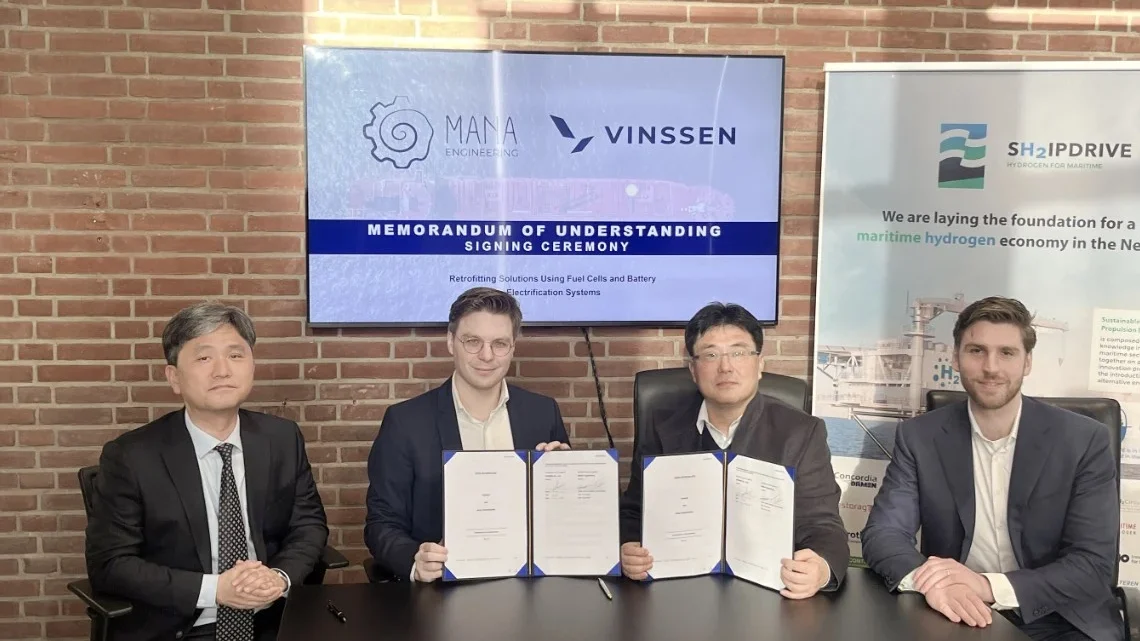
February 26, 2026Short-sea shipping around Northern Europe’s coasts and rivers is under growing pressure to slash greenhouse gases. Retrofitting existing feeder vessels with hydrogen fuel cells is starting to look like a no-brainer—offering a practical, cost-savvy route to compliance without shelling out for brand-new ships. Instead of pouring millions into new hulls, this approach lets you swap out power modules and still hit both FuelEU Maritime and EU ETS targets. Now, South Korea’s VINSSEN Co., Ltd. and the Netherlands’ MANA Engineering have teamed up, signing an MOU to retrofit an 800 TEU container ship, blending VINSSEN’s PEMFC prowess with European engineering grit.
Core partnership details
Under the MOU, VINSSEN Co., Ltd. contributes its deep know-how in Proton Exchange Membrane Fuel Cell (PEMFC) solutions for maritime use, while MANA Engineering brings its engineering savvy and on-the-ground connections across Northern Europe and the Baltic Sea. The pair will dive into a comprehensive feasibility study—plotting out system layouts, hydrogen storage designs, control integration schemes, and real-world operating scenarios. They’ll also map installation timelines, cost estimates, and potential downtime windows to keep disruptions to a minimum. Fueling an 800 TEU feeder vessel that shuttles between Rotterdam, Hamburg, and key Baltic ports aligns perfectly with the EU’s corridor approach under FuelEU Maritime. A major early win is snagging an Approval in Principle from Lloyd’s Register, which clears the way for compliance with both FuelEU Maritime and the EU Emissions Trading System. As Dennis Lensing, MANA’s Managing Director, puts it, this joint effort will pinpoint technical risks and chart a roadmap for a pilot installation. Meanwhile, Chil-Han Lee, VINSSEN’s CEO, calls the alliance “a pragmatic step toward decarbonizing existing fleets instead of waiting around for new ship designs.”
Technical innovation
At its heart, this retrofit hinges on a hybrid mash-up of fuel cell technology—specifically hydrogen fuel cells—and batteries to replace a vessel’s auxiliary power units and hotel loads. Hydrogen is tucked into swappable storage modules and fed into VINSSEN’s high-performance PEMFC stacks, producing electricity through a clean electrochemical reaction that emits only water. A battery buffer kicks in during peak load demands, and an integrated control system smartly toggles between fuel cells, the ship’s existing diesel generators, or shore power when it’s available. The team will run simulations of dynamic operating profiles—covering everything from tight manoeuvres in port to long-haul cruising—to make sure the system adapts smoothly. They’re designing it with modularity in mind, so various vessel types can get a facelift with minimal structural work. Safety features include redundant stacks, automatic leak detection, and compliance with IMO’s ship rules. The retrofit not only aims to slash CO₂ emissions and boost a ship’s Carbon Intensity Indicator (CII) rating but also to reduce reliance on onshore power supply—offering true flexibility for ports still rolling out hydrogen infrastructure.
Strategic implications
Picking retrofits over newbuilds is a clear sign the industry is steering toward smarter spending. With over 90% of today’s fleet projected to still be in service by 2050, retrofits let operators squeeze more life out of existing hulls, trimming CapEx while lower operating costs kick in fast. For shipowners eyeing EU decarbonization deadlines, this MOU offers a halfway house—meeting stringent emissions rules without absorbing the full sticker price of zero-emission vessels. It also underscores the rising importance of industrial decarbonization through hydrogen fuel cells, fueled by cross-border collaboration: a South Korean tech supplier teaming up with a Dutch engineering firm. Beyond cutting CO₂, this retrofit could catalyze demand for hydrogen bunkering services, spur public-private partnerships to upgrade port infrastructure, and generate new training programs—creating a ripple effect of jobs and economic activity in European shipyards and supply chains. If the pilot sails through and secures LR’s AIP, it could set a regulatory gold standard, paving the way for similar projects across short-sea routes from the English Channel to the Baltic Sea.
Industry context
The race to green the maritime sector has intensified ever since the IMO dropped its 2050 net-zero gauntlet and the EU rolled out FuelEU Maritime, pushing vessels on key routes to curb carbon intensity. While newbuilds running on ammonia or battery hybrids often steal headlines, retrofitting existing ships has quietly turned into a cost-efficient stopgap. Consider this: Europe’s short-sea network handles roughly half of the continent’s cargo by volume, with smaller feeder vessels clocking thousands of port calls annually. VINSSEN’s recent alliances with India’s HSL Shipyard and LWT under ‘Make in India’ and ‘Green India’ show its ambition to scale both retrofit kits and fresh designs. On the Dutch side, MANA Engineering has been rolling out projects that slash bunker fuel use and extend vessel lifecycles. Despite the promise, the business case hinges on the price of green hydrogen—currently hovering above $5/kg in many regions—and the pace at which electrolysis capacity scales up. Fuel cell manufacturing costs must also come down through economies of scale. Partnerships like VINSSEN and MANA’s offer a live demonstration of how to juggle these variables, but obstacles remain—chiefly, expanding the hydrogen infrastructure and securing financing for those initial hydrogen fuel cells.
Looking ahead
From here, all eyes will be on the feasibility study—due later this year—which will lay out technical specs, cost projections, and a timeline aiming for a demo retrofit by Q3 next year. Success isn’t just about ticking technical boxes; it hinges on forging reliable hydrogen supply chains in key ports, training crews on new systems, and proving that uptime can rival diesel-only operations. If the pilot ship delivers on promised CO₂ cuts and operational reliability, expect a stampede of interest from other shipowners, classification societies, and port authorities. Securing LR’s Approval in Principle will fast-track detailed engineering, pilot installations, and full-scale sea trials in the next shipping season. This roadmap aligns squarely with Europe’s broader push toward a sustainable energy economy, knitting together production, transport, and end-use of green hydrogen. For the short-sea sector, VINSSEN and MANA’s test case could be the blueprint for decarbonization—one retrofit at a time, with real-world proof that hydrogen fuel cells are more than just a future promise.

 With over 15 years of reporting hydrogen news, we are your premier source for the latest updates and insights in hydrogen and renewable energy.