
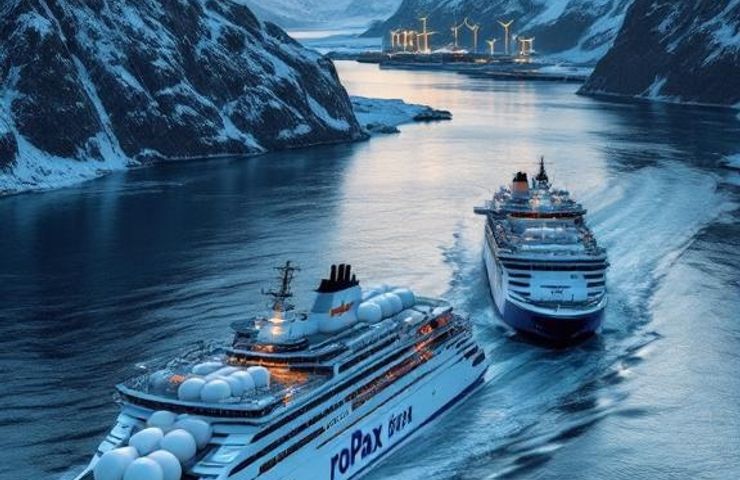
Hydrogen fuels zero-emission Bodø-Lofoten ferry project
March 17, 2026There’s nothing quite like seeing a ferry slice through Vestfjorden’s icy waves. It’s a serious test for any vessel. But come Torghatten Nord AS is gearing up to flip the script with two shiny new ferries powered by hydrogen fuel cells, backed by their very own green hydrogen plant. As with all trailblazing projects, though, expect a few twists and turns—technical puzzles, budget puzzles, scheduling hiccups—you name it.
Project overview
Under a NOK 4.98 billion contract from the Norwegian Public Roads Administration, Torghatten Nord AS will run a pair of nearly identical RoPax ferries on the Bodø–Værøy–Røst–Moskenes line from 2025 through 2040. These 120-meter double-enders, dreamed up by the Norwegian Ship Design Company, can haul 120 cars and 599 passengers. Powering them are two 6 MW PowerCellution Marine System 200 stacks per boat, integrated by SEAM, showcasing cutting-edge fuel cell technology.
Greening the hydrogen supply chain
These ferries will sip about 5–6 tonnes of hydrogen daily. To keep things topped up, GreenH AS has locked in a 15-year supply deal from a new 20 MW electrolyzer at Langstranda in Bodø. Running solely on renewable power, this plant aims to churn out around 3,100 tonnes of green hydrogen each year. Final investment decisions land in early 2025, big equipment contracts get signed by January 2026, and full commissioning wraps up by late 2026. Backers like Luxcara have thrown in roughly €85 million, and the site will draw about 175 GWh annually—roughly 60 % of Bodø’s local grid use—just for electrolysis. It’s a bold bet on sustainable energy and next-level hydrogen production.
How fuel cell propulsion works
Here’s the rundown: onboard tanks store hydrogen compressed to 350 bar. When that fuel feeds into the fuel cell stacks, the hydrogen molecules split and release electrons that flow through an electric circuit. The upshot? Electricity for the drives, plus water and some waste heat. Unlike battery systems that might have you tethered for hours at a fast charger, refilling hydrogen takes just a couple of hours. These ferries are built to run on hydrogen about 85 % of the time, with a small diesel or biofuel backup if things get dicey.
Engineering trade-offs: hydrogen vs batteries
Norway’s already operating over 70 battery-electric ferries coast to coast. Batteries are great for short hops with predictable charging windows. But throw a 90–100 km crossing, plus gale-force winds and icy spray, into the mix and you’d need battery banks the size of cargo containers—heavy, complex, and wallet-busting. That’s where hydrogen fuel cells swoop in: their higher energy density keeps the vessel lighter, but you’re signing up for brand-new bunkering stations and robust safety systems. A CleanTechnica deep dive even pegged potential electricity costs at around €28 per km and wondered if massive shore-side buffer batteries with rapid chargers might have been the leaner, meaner choice.
Schedule delays and cost scrutiny
Originally, these ferries were slated to hit the water in late 2025, but supply chain snags and engineering fine-tuning have pushed delivery into 2026. That extra year adds up in financing costs and cranks up the pressure on Torghatten Nord AS to rein in overruns. Industry watchers love to point out that hydrogen projects can face curveballs—from construction delays to volatile power tariffs. There’s also chatter about PowerCell Sweden AB’s delivery timelines and integration hurdles, though nothing’s been officially confirmed yet.
Local impact and wider industry pull
For Nordland, the benefits are already clear. Building and operating that hydrogen plant will create dozens of jobs, while ferry maintenance stays anchored in Tromsø. In Lofoten, tourism operators are gearing up—zero-emission crossings under the midnight sun are a big draw. On the regulatory front, Lloyd’s Register is drafting new marine hydrogen safety standards, and what they learn from Bodø could shape rules for ships worldwide, pushing the envelope on sustainable energy in maritime transport.
Comparisons and implications
Back in 2021, Norled’s MF Hydra gave hydrogen propulsion a spin on a short Stavanger route. The Bodø–Lofoten duo is a whole different beast: larger ships, longer legs, and total reliance on an electrolyzer supply chain. If it pays off, hydrogen could become the go-to solution for other exposed shipping lanes. If it doesn’t, operators might pivot back to beefed-up battery arrays with industrial-scale shore power or hybrid setups mixing H₂ and batteries.
Concluding perspective
At its heart, this project sits at the crossroads of sustainable energy and maritime decarbonization. It’s a floating lab, stress-testing hydrogen production, storage, and fuel cell technology on one of the harshest ferry routes out there. Come late 2026, we’ll finally know if hydrogen can replace diesel—and even batteries—on these storm-whipped fjord crossings, or if it’s best suited for shorter runs. Either way, the Bodø–Lofoten service is laying down the blueprint for the next wave of zero-emission shipping.
 With over 15 years of reporting hydrogen news, we are your premier source for the latest updates and insights in hydrogen and renewable energy.
