
Hydrogen infrastructure: German operators launch coordinated capacity reservations
March 25, 2026Coordinated Capacity Reservations Kick Off
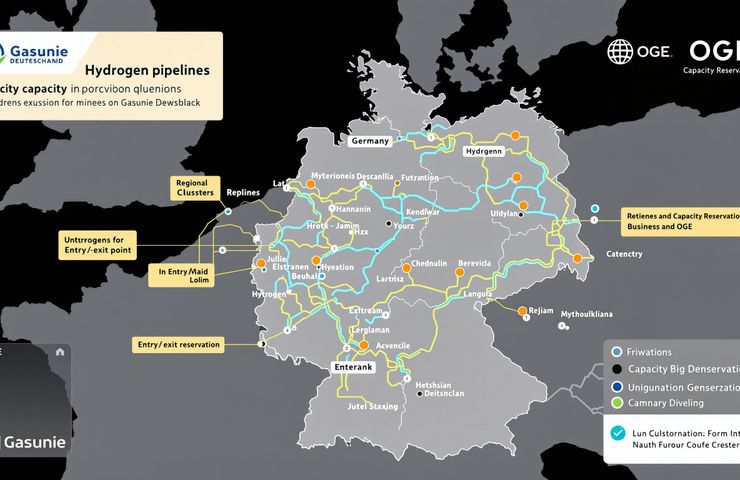
Earlier this month, a group of Hydrogen Core Network Operators—led by Gasunie Deutschland Transport Services GmbH and OGE—launched a unified process for reserving transport slots on Germany’s repurposed pipelines. It’s the first time you can snag both entry and exit rights across these corridors for the 2026–2030 window, giving a major boost to hydrogen infrastructure and making life easier for anyone eyeing sustainable energy or industrial decarbonization.
- Who: A coalition of Hydrogen Core Network Operators, including Gasunie Deutschland and OGE.
- What: A joint capacity reservation system with a standardized application form and model contract.
- Where: Nationwide—covering the entire German hydrogen pipeline network.
- When: Reservations opened earlier this month.
- Why: To lock in investment certainty, speed up market ramp-up and foster cross-border trade.
From Gas Grids to H2 Highways
Since 2010, Germany’s Energiewende has flipped its power sector on its head—phasing out coal and nuclear in favor of renewables. Riding that wave, the 2020 National Hydrogen Strategy set ambitious goals: install up to 10 GW of electrolyzer capacity by 2030 and convert roughly 9,000 km of existing pipelines for 100% hydrogen service by 2032.
To hit those targets, operators are turning former Dutch gas and North Sea supply routes into dedicated H2 arteries. The vision is to link North Sea offshore wind farms and Bavarian solar parks with industrial powerhouses like the Ruhr, Stuttgart and Chemelot in the Netherlands. It’s a cross-border play that cements Germany as the hub of a north-west European hydrogen ecosystem.
In 2023, the Bundesnetzagentur signed off on detailed core network plans, greenlighting about 4,600 km of pipeline under Gasunie Deutschland’s management. Together with OGE and others, they’re building a modular, scalable network to handle both domestic green hydrogen production and imports.
Meanwhile, the Federal Ministry of Economics and Climate Action is rolling out grants and low-interest loans to cover technical assessments, pipeline retrofits and upstream electrolyzer projects. It’s a policy mix designed to sync transport capacity with production ramp-up.
How the Reservation Process Works
Reserving capacity is pretty straightforward, with a few key steps. First up is a non-binding pre-registration so operators know who’s in. They’ve published a market info pack full of cluster maps, seasonal volume forecasts and tariff ranges. Then you:
- Download the standardized application form and industry-approved model contract (PDF or Excel).
- Choose your entry and exit points for the 2026–2030 period.
- Submit your reservation request via the online portal or email.
- Once your slots are confirmed, pay a nominal fee (around 5% of the ramp-up tariff).
After the deadline, operators review bids, allocate capacity pro rata if demand exceeds supply, and publish results within six weeks. Successful applicants receive a five-year capacity certificate, letting them negotiate connection deals and plan operations.
Cluster-Based Booking and Tariffs
The network’s split into regional clusters—import hubs up north, the Ruhr industrial belt, southern production zones and eastern consumer corridors. The market pack lays out volume forecasts and tariff bands for each cluster so you can align bookings with actual demand.
Tariffs start with a ramp-up phase to cover initial investments before settling into a steady long-term rate. There’s even an interactive web map that lets you eyeball pipeline routes, check interconnections and spot potential bottlenecks, making your planning crystal clear.
Regulatory & Technical Preparations
Following the EU hydrogen network code, the Bundesnetzagentur is overseeing technical integrity studies on the converted pipelines—covering material compatibility, leak tests and hydrogen purity standards. These checks ensure every line meets safety and performance benchmarks before going live.
Strategic Implications and Market Impact
Here’s what makes this coordinated booking approach so appealing:
- Greater investment certainty for green hydrogen producers and importers.
- Accelerates industrial decarbonization in heavy sectors like steel and chemicals.
- Boosts cross-border trade, linking Germany to Dutch and broader European markets.
- May drive down costs as transparent tariffs and cluster allocation push clearing prices lower.
Early reservation data should feed straight into price discovery, giving everyone a real-time snapshot of where hydrogen storage and pipeline capacity are in highest demand—and where new segments are needed.
Risks and Caveats
Of course, it’s not without its challenges. Reservation fees are due upfront, and your allocations hinge on accurate demand forecasts. Any hiccups—whether delayed material upgrades or permitting holdups—could push timelines and impact reserved capacities. Operators have pledged to update offers in future network development plans to keep pace with evolving market needs.
Looking Beyond 2030
This first booking window covers the ramp-up phase through 2030, but planners are already eyeing the next rounds through 2032—aiming for that full 9,000 km pipeline network. Down the road, they envision a secondary market where unused long-term rights can be traded, boosting capacity utilization and flexibility.
Alignment with EU Strategy
All of this dovetails neatly with the European Commission’s REPowerEU objectives for diversified hydrogen supply chains and rapid renewables growth. Once the EU Hydrogen Bank kicks in, it should underwrite offtake agreements and first-of-a-kind projects, complementing the national reservation scheme.
What to Watch Next
Key things to follow include the first technical integration studies, confirmed net volumes per cluster and new operators joining the framework. Also, watch whether blending hydrogen into existing gas flows emerges as a handy interim solution—because that could shake up market dynamics on the road to a zero-emission future.
About the Companies
Gasunie Deutschland Transport Services GmbH, based in Hanover, manages and grows a 4,600 km long-distance pipeline network in Germany. It’s part of the Gasunie group, which oversees over 17,000 km across Germany and the Netherlands, anchoring the region as a key gas—and soon, hydrogen infrastructure—hub in north-west Europe.
OGE is one of Germany’s leading gas transmission system operators and a central force behind the rollout of the Hydrogen Core Network, helping steer the nation toward a sustainable energy future.
 With over 15 years of reporting hydrogen news, we are your premier source for the latest updates and insights in hydrogen and renewable energy.