
Hydrogen Pipeline Contracts Fuel Germany’s Green Steel Ambitions
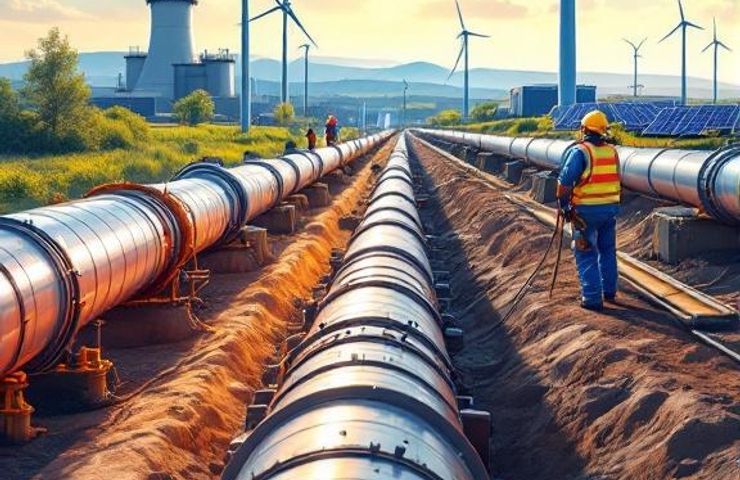
March 6, 2026ONTRAS Gastransport GmbH, the Leipzig-based energy operator, just inked supply deals with Mannesmann Grossrohr GmbH (MGR) and Mannesmann Line Pipe GmbH (MLP) for roughly 108.8 kilometers of top-tier, hydrogen-ready pipeline. This milestone marks a key link in the new FGL 702 corridor connecting the chemical clusters around Wefensleben and Angersdorf to Salzgitter’s giant steelworks. The payoff? These lines will carry green hydrogen straight into Salzgitter AG’s SALCOS program, powering hydrogen-based direct reduced iron (DRI) to replace carbon-heavy blast furnace steps—and hack away significant CO2. It’s a clear signal that Germany’s upping the ante on a full-scale hydrogen pipeline push and proving you can decarbonize heavy industry with the right infrastructure.
Problem Meets Solution
Here’s the scoop: steelmaking pumps out close to 7% of global CO2, and those towering blast furnaces aren’t exactly climate-friendly. The secret sauce for low-carbon steel? Hydrogen-based DRI. But you can’t get there without a leak-tight, embrittlement-resistant hydrogen pipeline network—and retrofitting old gas lines is a snail’s pace. Hauling compressed hydrogen by truck? Wallet-busting and barely scalable. Enter FGL 702: purpose-built steel pipes engineered from scratch for hydrogen service, delivering green hydrogen straight to Salzgitter’s plant so they can kick coal to the curb.
The Magic Ingredient: FGL 702
Let’s unpack it: the FGL 702 corridor splits into two main legs. First, you’ve got 70.6 kilometers of 813 mm-diameter mainline from MGR. Next, there’s 38.2 kilometers of 610 mm secondary line from MLP. These aren’t your run-of-the-mill gas pipes—they come in 18 m segments, wrapped in a three-layer polyethylene jacket for bulletproof external protection. Inside, a slick epoxy Flowcoat lining keeps hydrogen flowing smoothly without embrittling the steel. In about 4.5 to 6 km where ground conditions get feisty, a GRP overlay kicks in for extra corrosion defense. Every seam and weld gets ultrasonic scans, pressure cycling tests, laser surface mapping—only flawless sections move forward.
Rolling Out Deliveries
As winter gives way to spring, the first pre-fab pipe bundles will roll into staging areas around Wefensleben and Preußlitz. Heavy-lift cranes and modular spool yards will line up those 18 m lengths like giant matchsticks. Expert welders stitch them together, then safety teams ramp up the pressure to 1.5 × operating levels to sniff out any weak spots. From there, the pipes tie into compressor stations, pressure regulation skids, and underground storage caverns. On top of that, a web of fiber-optic sensors and wall-thickness gauges gets embedded along the route, streaming live data back to control centers. When green hydrogen finally starts flowing, engineers will know every inch is battle-ready.
Upgrading the Network
Dig deeper, and you’ll see the FGL 702 pipes are just one piece of a 600 km puzzle. ONTRAS aims to have a fully operational hydrogen core network by 2032, converting about 80% from repurposed gas lines and laying fresh pipe for the rest. The corridor kicks off near Leuna and Halle-Leipzig, weaves through Magdeburg’s chemical parks, loops in North Sea import points via Benelux, and now anchors at Salzgitter. Under the EU’s Green Octopus Mitteldeutschland IPCEI banner, this network marries energy security with serious decarbonization investments.
Strategic Angle
On the money side, it’s a textbook public–private partnership. Germany’s Federal Ministry for Economic Affairs funnels national hydrogen funds into core routes like FGL 702, while the EU’s IPCEI framework co-funds tech upgrades, environmental assessments, and cross-border links. ONTRAS boots its own budget into pipe manufacturing and installation, and Salzgitter AG locks in demand via a long-term hydrogen purchase agreement. Blend government grants, EU funds, and corporate capital, and you’ve got a cocktail that accelerates progress and trims expansion risk.
Voices in the Room
Andreas Betzler, who heads both MGR and MLP, says this contract isn’t just about pipes—it’s a lifeline for SALCOS. He stresses that green hydrogen feedstock is the linchpin for shifting from coal-fired blast furnaces to direct reduced iron. By securing a large-scale, high-pressure transport system, Salzgitter can ramp up hydrogen without worrying about supply hiccups or safety headaches.
Zooming Out
Step back, and you’ll spot how these corridors plug into Europe’s grand vision for a continental hydrogen backbone. The FGL 702 link ties into routes reaching the Netherlands and Belgium, feeding import terminals supplied by North Sea electrolysers—or even future solar-to-hydrogen projects in North Africa. Closer to home, it dovetails with Germany’s chemical triangle—Leuna, Halle-Leipzig, Bitterfeld—where giants like BASF and Covestro are gearing up for hydrogen inputs. It’s industrial symbiosis on steroids.
Collateral Gains
Beyond the big players, hundreds of SMEs in pipe coating, welding tech, and digital monitoring software are gearing up. Technical colleges in Saxony-Anhalt have rolled out specialized training for hydrogen pipeline welding and QA. Support-yard municipalities expect up to 200 direct hires in construction, safety oversight, and data analysis. That know-how stays local, seeding future projects—from hydrogen fueling stations to ammonia cracking units.
What’s Next?
Permit approvals, environmental green lights, and final tie-ins at compressor stations are in the home stretch. In months, earthworks crews will shift to tie-in operations, and the first hydrogen molecules will hum through the new lines. Once operational, FGL 702 will set a baseline throughput that can scale as electrolysis capacity grows. Salzgitter’s plant will start swapping natural gas for hydrogen, moving closer to shaving off thousands of tons of CO2 every year. And the playbook? It’s a template for other regions and industries. Stick around—Germany’s making low-carbon steel look downright achievable.
 With over 15 years of reporting hydrogen news, we are your premier source for the latest updates and insights in hydrogen and renewable energy.
