Hydrogen Production Advances with Kawasaki’s Centrifugal Compressor Demo
March 25, 2026Ever wondered how you could squeeze the punch of a hydrogen compressor into a space you could cross in less than a minute on foot, all while trimming your wiring bill and footprint? That’s the kind of head-scratcher Kawasaki Heavy Industries is taking on at its Harima Works plant in Hyogo Prefecture. Earlier this year, they kicked off demos of the KM Comp-H2, the world’s first centrifugal compressor designed specifically for hydrogen liquefaction. Backed by NEDO’s Green Innovation Fund, this project is about proving that compact equipment can also champion green hydrogen, support robust hydrogen production and hydrogen storage, and help usher in a new era of sustainable energy.
From Blueprints to Loud Pumps
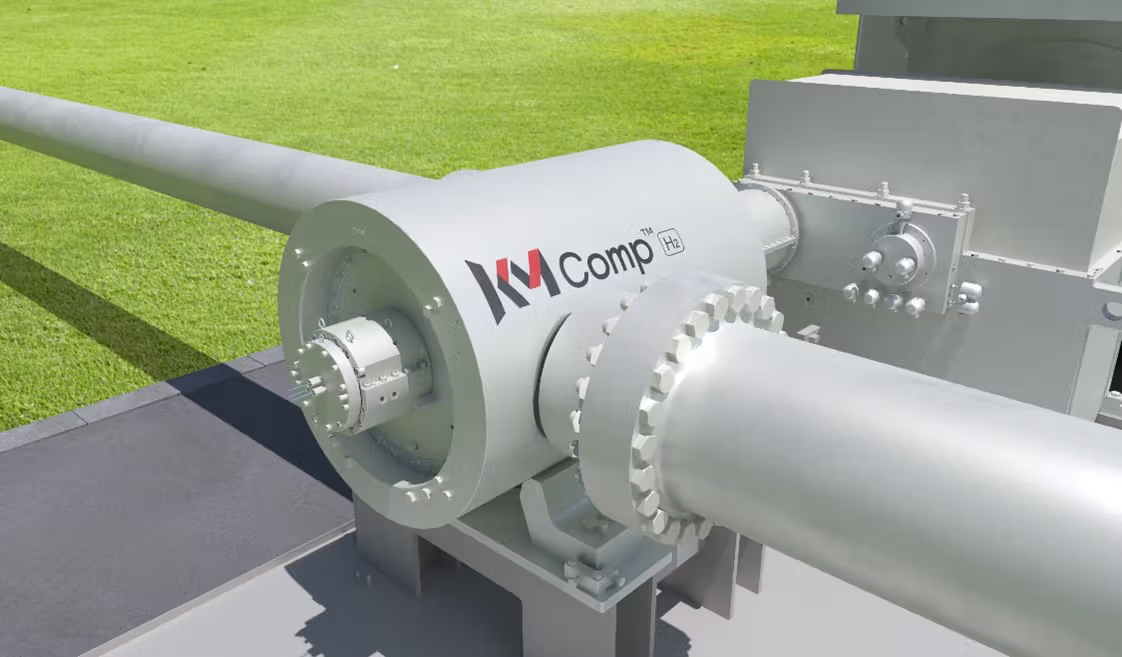
They started plotting this out in early 2025, when Kawasaki announced they’d carve out a testbed right at Harima Works. Drawing on over a century of compressor know-how, the engineers mapped out high-speed impellers capable of handling pure hydrogen. Over the next few months, they assembled everything into a neat 150-square-meter footprint: a speed-increasing gearbox, an electric motor, fancy gas seals, lubrication modules, even cooling loops—basically every nut and bolt needed to get a hyper-fast compressor humming under real-world conditions.
Once all the pieces were in place, they didn’t just hit the throttle. Instead, the team eased into a meticulous phase of calibration and safety tests. They tweaked bearing clearances, put gas seals through their paces at different loads, and fine-tuned the control logic for silky-smooth start-ups and shutdowns. It may feel like going at a snail’s pace, but in Kawasaki’s world, nailing reliability—especially for a pioneering centrifugal system in hydrogen liquefaction—isn’t an afterthought; it’s the whole point.
Why Size and Efficiency Matter
It isn’t just about reclaiming a chunk of floor space (though swapping out big, clunky compressors for a device that takes up one-seventh of the room will sure get plant designers cheering). By packing all the hardware into a tighter package, the KM Comp-H2 frees up valuable real estate—so operators can bolt on extra capacity rather than start building a whole new hall. In an industry chasing economies of scale, that’s a big win.
Then there’s energy consumption. Kawasaki’s early tests hint that their centrifugal approach can whittle down electricity use by three to four percent versus traditional piston-style compressors. It might not sound earth-shattering, but when you’ve got a fleet of compressors humming 24/7 for hydrogen production and hydrogen storage tasks, even a few percentage points can translate into megawatt-hours saved and real cash chopped off operational budgets over the long haul.
Inside the KM Comp-H2
At its core, the KM Comp-H2 leans on blistering rotational speeds and next-level impeller geometry to squeeze hydrogen up to roughly three times its inlet pressure, all at flow rates flirting with 35,000 cubic meters per hour. In plain English: it spins so darn fast that hydrogen molecules get rammed into higher pressures smoother than you’d see with slower, back-and-forth piston machines. The payoff? A continuous, vibration-free flow that dovetails perfectly with the cooling stages of a liquefaction train.
But the magic doesn’t stop at the rotor. Kawasaki has wrapped that impeller in an integrated support package: a beefy electric motor to keep the turbine whirling, a sleek speed-up gearbox to bridge the rpm gap, and super-tight gas seals to nip leaks in the bud. Even the cooling circuits got a makeover—no massive external chillers here—so everything tucks neatly into a compact 150-square-meter footprint that’s as tidy as it is efficient.
How It Integrates into Japan’s Hydrogen Ambitions
Japan hasn’t been shy about betting on hydrogen for its net-zero goals, and Kawasaki finds itself playing multiple critical roles—compressor builder, turbine supplier, even a partner in marine carriers. The KM Comp-H2 demo is their way of showing the world that Japanese hardware can anchor every link in a global hydrogen chain, from liquefaction plants to shipping decks. It’s not just a compressor; it’s a proof point that homegrown tech can drive sustainable energy breakthroughs.
This showcase is bankrolled by NEDO’s Green Innovation Fund, which funnels cash into large-scale gear for a hydrogen-powered future. Watching Kawasaki juggle compressors, vessels, and power systems is a bit like seeing a relay team in action: every handoff needs to be flawless if you want to hit that decarbonization finish line.
Parallels and Potential Ripple Effects
Centrifugal hydrogen compressors in liquefaction service are about as common as a quiet bar in downtown Tokyo—most plants stick with piston or diaphragm setups. That’s what makes Kawasaki’s jump particularly eye-catching. If their KM Comp-H2 plays ball, we might see a fast-follow of centrifugal solutions popping up in every corner of the energy sector—from ammonia synthesis loops to refinery hydrogen recovery and pipeline boosting stations handling pure hydrogen streams.
And scale matters. A few points of extra efficiency can ripple out into megawatts saved and millions lopped off operating and capital expenses. In an arena where the price per kilogram of hydrogen can make or break competitive edge, tech shifts like this could nudge green hydrogen ever closer to parity with fossil fuels, giving a real jolt to the broader push for sustainable energy.
As Kawasaki spins up its first batch of 100% hydrogen trials, the big question is how far those gains will spread. Could we see clusters of compact compressors in far-flung sites? Might engineers start retrofitting legacy plants with centrifugal units instead of overhauling entire systems? If the answer’s yes, we’re looking at a sea change in how the world approaches hydrogen liquefaction, hydrogen storage, and distribution.
For now, Harima Works is the only stage where the KM Comp-H2 is stealing the spotlight, but Kawasaki isn’t stopping at demos. They’ve signaled plans to commercialize the unit and mesh it with their full suite of energy tech—turbines, engines, and carriers alike. In short, they’re building an ecosystem where everything speaks the same language of efficiency and reliability, all centered around this new centrifugal heart.
About Kawasaki Heavy Industries
Founded in 1896, Kawasaki Heavy Industries draws on over 125 years of experience making heavy machinery—from compressors and turbines to ships and cutting-edge hydrogen tech. Today, they’re pushing the boundaries of the global hydrogen supply chain with innovations like the KM Comp-H2 under the banner of NEDO’s Green Innovation Fund, driving forward the vision of a cleaner, more sustainable energy future.


 With over 15 years of reporting hydrogen news, we are your premier source for the latest updates and insights in hydrogen and renewable energy.