
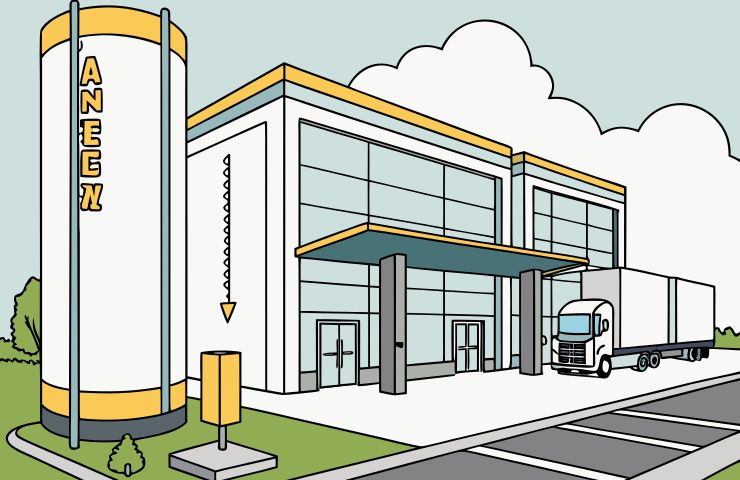
Hydrogen Takes Center Stage at Amazon’s New Planned Visalia Warehouse
January 9, 2026Picture this: forklifts humming around a dock, but instead of plugging into bulky chargers, they line up at a slick hydrogen refueling station. That’s exactly what Amazon is rolling out in Visalia, California. This month, they announced a third warehouse in partnership with Plug Power. It’s a clear sign that e-commerce giants and energy-tech firms are teaming up to drive industrial decarbonization forward.
CapRock’s Central Point III: A Modern Logistics Complex
The new Amazon digs will sit inside CapRock Partners’ Central Point park. The latest block, Central Point III, covers 2.7 million square feet across four speculative buildings, all targeting LEED Silver. Building 1 alone is roughly 1.27 million square feet, featuring 274 dock-high doors, two ground-level ramps, and 40-foot clear heights. With ESFR sprinklers, nearly 890 car stalls, a 6,600-square-foot office lounge, and ample trailer parking, it screams Class A. Even before it’s finished, Fortune 100 logistics players are circling—proof that well-connected, cost-efficient space is hot in the Central Valley.
Anchored by UPS for Seamless Connectivity
Right next door, United Parcel Service (UPS) snapped up 88 acres to build a 450,000-square-foot facility—one of its biggest on the West Coast. By tapping into UPS’s massive parcel network, tenants can reach 95% of Californians within a day’s drive and serve over 50 million customers with next-day ground shipping. This high-density logistics cluster supercharges both inbound and outbound flows for everyone in the park.
Fuel Cell Technology Powers Efficiency
Inside the warehouse, fuel cell–powered forklifts and pallet jacks replace diesel or battery-only models. They refuel in minutes, keeping multi-shift ops humming without the downtime of battery swaps or slow charging. That consistent power—no voltage sag, no efficiency dip—fits perfectly with Amazon’s lightning-fast delivery playbook.
Sizing Up the Project
Building 1 sprawls across roughly 75 acres of the Central Point III site, laid out for smooth truck circulation and rapid turnaround. CapRock’s blueprint includes advanced HVAC controls, skylights to slash lighting loads, water-wise landscaping, and EV charging stalls prepped for future fleet electrification. Permits for Buildings 2 through 4 are already locked in, so they’ll pop up fast as demand climbs.
Strategic and Environmental Upsides
Onsite hydrogen infrastructure isn’t just about cutting fuel costs. It also boosts energy resilience by cutting reliance on delivered fuels—huge when storms or supply hiccups hit. Environmentally, swapping out diesel for hydrogen fuel cells brings clean energy right into the warehouse and slashes local NOx and particulate emissions. Hook the electrolyzer to a low-carbon grid, and the setup could even qualify for credits under California’s Low Carbon Fuel Standard.
Visalia’s Shifting Economic Landscape
Long known for crops and cattle, Visalia is reinventing itself as a logistics hotspot thanks to its central Valley location and major highways like SR 99 and 198. The City of Visalia has been rolling out the red carpet—expedited permits, infrastructure incentives—all to diversify tax revenues and spur job growth. Together, these projects could spawn hundreds of construction gigs and dozens of permanent warehouse roles in Tulare County.
Community and Regulatory Considerations
Of course, adding a hydrogen plant stirs up planning talk. Water for electrolysis, power needs, extra truck traffic, and strict safety codes for high-pressure storage all demand careful oversight. City planners are juggling economic benefits with land-use, health, and safety concerns, especially as more companies set their sights on Central Point.
State and Federal Support on the Horizon
Local leaders are also eyeing state and federal funding for clean-energy infrastructure. Subsidies for electrolyzers and storage could offset upfront costs for onsite hydrogen gear. Agencies on both sides have signaled they’re game to back these moves. Early engagement could help Visalia’s project tap into emerging incentives and shape future hydrogen infrastructure policy.
From CapRock I & II to a Hydrogen-Enabled Future
Central Point’s journey kicked off in 2021 with Buildings I and II—build-to-suit hubs for a Fortune 100 e-commerce giant, widely believed to be Amazon. Those early wins cemented Visalia’s logistics cred. Now, the region’s pairing that momentum with next-level, zero-emission tech.
As CapRock Central Point III takes shape, Amazon’s hydrogen-powered warehouse sets a new bar for sustainable distribution. In a world where speed, flexibility, and decarbonization must coexist, Visalia’s experiment offers a front-row seat to the future of clean energy logistics.
 With over 15 years of reporting hydrogen news, we are your premier source for the latest updates and insights in hydrogen and renewable energy.
Yes, so impressive. The cattle are also producing hydrogen via methane capture in the area as dairy farms.