
Hydrogen Sensor Innovation: Interfacial Stress Decoupling Enhances Palladium-Based Detection
February 23, 2026As green hydrogen production and fuel cell technology race ahead, having a reliable hydrogen sensor is more critical than ever. A fresh study in Nature Communications (February 2026) introduces a clever way to stabilize a palladium-based sensor: they mechanically decouple the sensing film from its substrate. This neat trick could help hit the U.S. Department of Energy’s tough requirement of sub-second response at 0.1 vol% H₂—unlocking new possibilities for safety and real-time hydrogen detection in infrastructure systems.
Breakthrough in Palladium Hydrogen Sensing
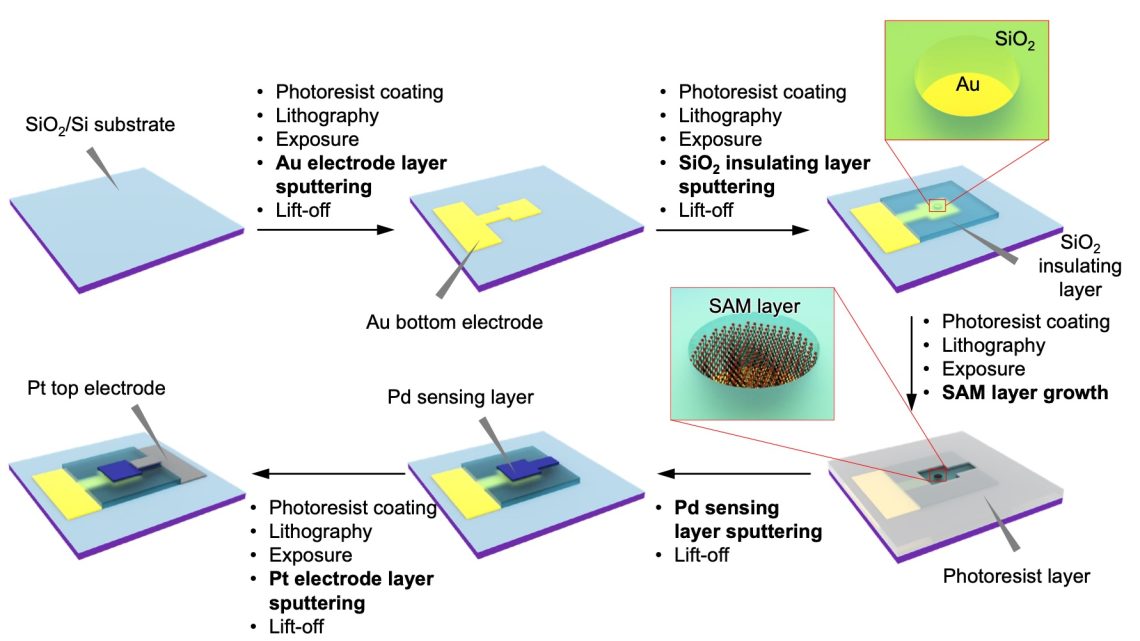
The team slipped an ultrathin dithiol-based self-assembled monolayer (SAM) between the palladium sensing layer and its support. Think of it as a tiny, flexible buffer that soaks up stress when hydrogen atoms move into the palladium’s subsurface. This “interfacial stress decoupling” approach tackles the mechanical wear-and-tear that has long plagued nanoscale sensors, keeping the baseline stable and the readings reliable.
Historical Context and Persistent Challenges
Palladium has always been the go-to material for hydrogen detection because it’s selective and can respond quickly. Back in the day, optical sensors at cryogenic temperatures took minutes to pick up H₂. Then nanostructured palladium—think nanoparticles and thin films—peed response times down to a few seconds. For instance, Lee et al. clocked 4.5 s and Zhang et al. hit 2 s at 20–100 ppm H₂. But those tests didn’t quite hit the DOE’s 0.1 vol% (1,000 ppm) target. Real-world factors like CO adsorption and humidity still slow things down, and repeated cycling warps the lattice, causing drift over time.
Stress Decoupling via Self-Assembled Monolayer
The new paper zeroes in on that last headache. The dithiol SAM bonds to both the metal and the support, creating a compliant interface that flexes as palladium expands and contracts with hydrogen uptake. The result? A steady baseline and consistent response, even after dozens of cycles. While the full performance data live in the published article, the concept builds on well-known thermodynamics: subsurface hydrogen induces lattice strain, and managing that stress is key—especially in thin films and nanoparticles.
Meeting DOE Targets and Beyond
The DOE wants sensors that respond in under one second at 0.1 vol% H₂—for everything from on-board vehicle systems to stationary leak detectors. Mechanical drift and poisoning have made that a tough nut to crack. By decoupling interfacial stress, this design could finally deliver the fast, dependable detection we need at realistic concentrations.
Broader Industry Implications
Fast, stable hydrogen sensors are a game-changer across the emerging hydrogen economy:
- Hydrogen infrastructure: Enables safer refueling stations and more reliable leak detection for fuel cell vehicles.
- Industrial safety: Keeps a close eye on hydrogen in production, storage and transport facilities.
- Renewable integration: Supports power-to-gas setups by ensuring precise process control in electrolyzer plants.
- Materials science: The stress-management trick could be applied to other metal-based gas sensors, boosting stability across the board.
- Regulation and standards: Consistent hydrogen detection paves the way for unified protocols and safety codes.
- Economic impact: Cuts downtime, maintenance and insurance costs tied to sensor drift—accelerating the rollout of hydrogen solutions.
Of course, fully validating the interfacial stress decoupling approach means diving into the complete Nature Communications article. But by tackling the mechanical root cause of performance loss, researchers are a big step closer to sensors that can keep up with the split-second response times and long-term durability today’s hydrogen economy demands.
As hydrogen scales up—in transportation, power generation and industrial processes—smart designs like stress-decoupled palladium sensors will be essential. The next hurdle? Proving they hit sub-second response targets in real-world settings—a breakthrough that could kick open the door to zero-emission technologies worldwide.

 With over 15 years of reporting hydrogen news, we are your premier source for the latest updates and insights in hydrogen and renewable energy.