Hydrogen Storage: China’s First Type IV Composite MEGC Debuts in Hebei
February 10, 2026Earlier this year, we saw a joint venture led by CIMC-Hexagon Hydrogen Energy Development (Hebei) Co., Ltd. unveil China’s first homegrown 20-foot Type IV Composite Cylinder Multi-Element Gas Container at their sprawling Shijiazhuang plant in Hebei. It’s a big deal—switching from niche imports to domestic mass production of hydrogen storage gear. With national goals locked on carbon peak and neutrality, bolstering our hydrogen infrastructure isn’t just smart, it’s essential.
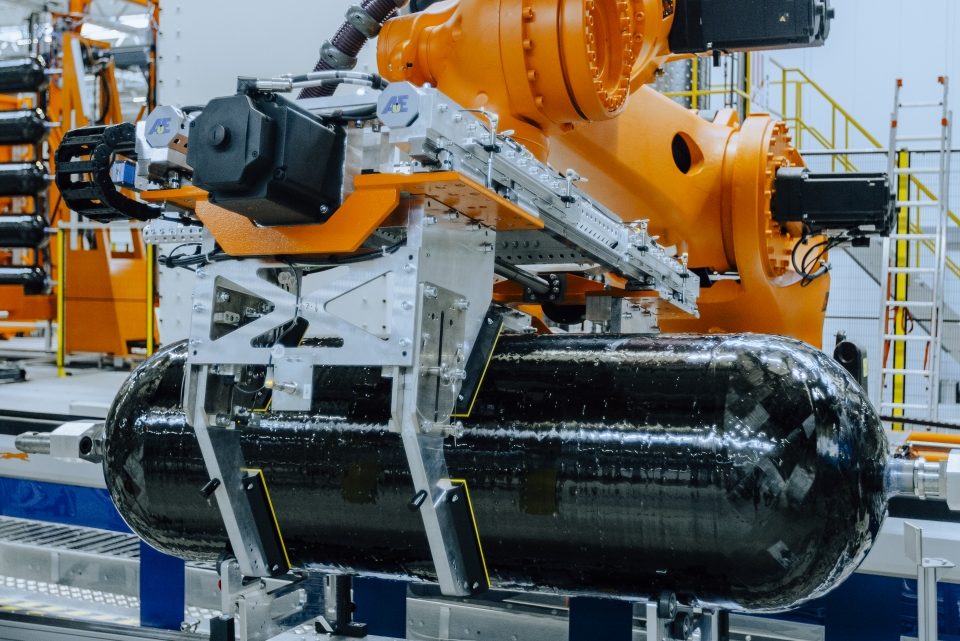
What’s New? Picture a 20-foot frame loaded with multiple carbon-fiber–wrapped cylinders, each rated for 38 MPa. In a standard 40-foot equivalent unit, you’re looking at over one metric ton of hydrogen—about four times what those old Type I tube trailers could carry. Until now, Chinese operators had to wait months (and shell out big bucks) for imported MEGCs. Localizing production slashes lead times and costs, clearing the way for wide-scale rollout.
Key Specifications
- Operating Pressure: 38 MPa with fully composite Type IV cylinders.
- Capacity: More than 1 metric ton of hydrogen per 40-foot equivalent container.
- Weight Savings: Roughly 40% lighter than Type III designs—hello, better volumetric efficiency.
- Payload Advantage: Up to 4× the hydrogen per trip versus Type I tube trailers.
- Modularity: Options from 10 to 45 feet, compliant with ADR 6.8 and TPED (2010/35/EU).
- Production Scale: Hebei facility is Asia’s largest site for Type IV composite cylinder manufacturing, primed for rapid ramp-up.
Why It Matters Strategically
Cutting procurement time from months to weeks and slashing logistics costs is a game-changer if you’re rolling out regional refueling networks or feeding hydrogen into industrial parks. As sustainable energy gains traction, affordable hydrogen storage and transport become linchpins for decarbonizing steel, chemicals, and heavy haul.
Fewer trips, lighter containers, and higher capacity directly translate to lower emissions compared to diesel haulage—and a stronger business case for hydrogen fuel cells in trucks, ships, and stationary power. In short: better total cost of ownership for big hydrogen users.
Technology Evolution
Hydrogen transport has come a long way. The early Type I steel tubes were heavy and prone to fatigue. Type II and III added a composite wrap around steel or aluminum liners—an improvement, but still heftier than you’d like. Now the fully plastic and carbon-fiber–lined Type IV composite cylinder nails the best strength-to-weight ratio, zero corrosion worries, and a stellar cycle life. That leap is crucial for moving bulk hydrogen cost-effectively.
Joint Venture Dynamics
Hexagon Purus brings six decades of composite storage expertise and validation from over 700 MEGC deployments worldwide. CIMC ENRIC offers end-to-end industrial chain integration in hydrogen equipment and decades of manufacturing scale. Together, they’ve sketched a blueprint for rapid localization—one we’ll likely see replicated in electrolyzer and fuel cell ventures across Asia.
Comparative Context
Sure, pilots in Japan and Europe are testing Type IV trailers and containers. But China’s sheer manufacturing heft, local certification know-how, and cost advantages give it the upper hand. Chinese-made MEGCs can undercut imports on both price and delivery time, positioning domestic suppliers for home-market sales and exports to Southeast Asia.
Industry Implications
With hardware bottlenecks easing, the commercial rollout of hydrogen networks can really take off. Logistics firms tell us imported containers took up to six months to arrive—local production could shrink that to a few weeks. Regulators have flagged hydrogen transport as strategic, and CIMC-Hexagon is already helping shape domestic safety and performance standards.
Economically, the Hebei site will create roles for composite technicians, engineers, and integration specialists. Downstream, it supports growth in refueling stations, fuel cell fleets, and industrial hydrogen users—driving the ecosystem forward.
Environmental & Policy Angle
Hydrogen logistics feature prominently in China’s clean energy roadmap. While precise incentive schemes for MEGCs are still emerging, local governments are backing hydrogen corridor pilots and low-carbon transport demos. By collaborating with regulators, CIMC-Hexagon ensures its containers align with evolving policy frameworks for robust hydrogen infrastructure.
Forward Look
We’ll be watching production ramp rates, export orders, and new high-pressure variants that could extend applications from small on-site storage to ultra-high-pressure long-haul shipments. If volumes climb as planned, expect steeper cost declines for green hydrogen production and stronger incentives for heavy industries to switch fuels.
Bottom line: China’s first domestically produced 20-foot Type IV MEGC isn’t just a container—it’s a cornerstone for a self-sufficient, cost-effective hydrogen storage network. The supply chain’s shorter, delivery’s faster, and the path to decarbonization is clearer than ever.

 With over 15 years of reporting hydrogen news, we are your premier source for the latest updates and insights in hydrogen and renewable energy.