
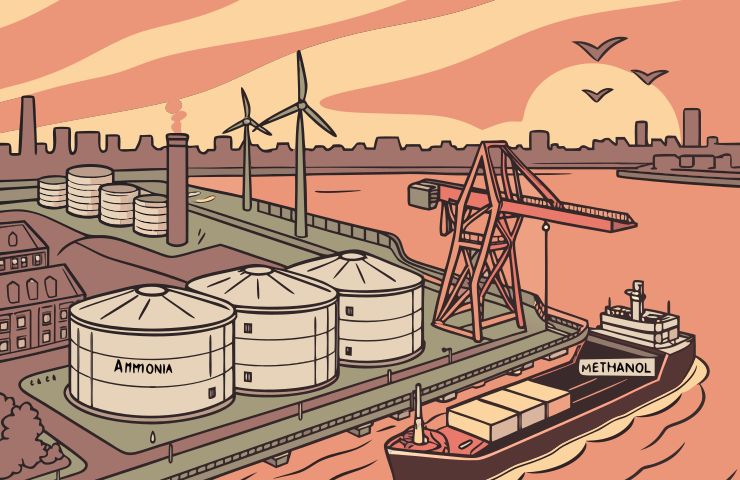
Hydrogen Storage Investments Stalled at Port of Rotterdam Amid High Costs and Demand Uncertainty
March 23, 2026If Europe’s busiest port can’t lock down demand for its hydrogen infrastructure plans, where does that leave the rest of the continent? A recent market consultation by the Port of Rotterdam Authority lays bare why several multi-hundred-million-euro hydrogen storage terminal projects have been pushed out past 2030. Investors are tapping the brakes over fuzzy policy signals, grid congestion and slow permitting. It’s a wake-up call: scaling up hydrogen carriers at this level means getting the whole chain—from production to offtake—spot on.
Key Findings from the Market Consultation
- At least nine players have put their plans for hydrogen carrier import terminals on hold.
- Each proposed terminal—for clean ammonia, methanol, liquid hydrogen (LH2) or liquid organic hydrogen carriers (LOHC)—carries a price tag in the low- to mid-hundreds of millions of euros.
- The biggest snag? No one’s ready to sign firm offtake deals. Without guaranteed buyers, financiers won’t commit multi-hundred-million-euro checks.
- Other hurdles include policy uncertainty around green hydrogen incentives, local grid capacity crunches, delayed pipeline rollouts and snail-paced permitting.
Those takeaways come straight from the Authority’s survey, which closed this month and reflects candid feedback from market participants.
Why It Matters for Europe’s Energy Transition
Under the EU Hydrogen Strategy, Brussels aims for 10 million tonnes of imports by 2030. Rotterdam, Europe’s top port by cargo throughput, is supposed to be the continent’s main sustainable energy gateway. If it can’t lock in investment for critical import terminals, every downstream plan—from industrial decarbonization to zero-emission shipping fuels—loses momentum. Look at clean ammonia for shipping: crack those terminals, and shipowners can finally swap heavy fuel oil for a cleaner marine fuel. Delay them, and vessels stay stuck on the old stuff. Even worse, billions in stranded capex could freeze electrolyzer farms, refineries converting to hydrogen feedstock and new pipelines branching into the German and Belgian hinterlands.
Historical Context
Rotterdam has been a trading hub since medieval times, exploding into the world’s busiest container port by the 1960s. Its modern edge came from LNG imports and massive petrochemical clusters. Since launching the H2Hub Rotterdam initiative in 2020, the Port of Rotterdam Authority has been in the spotlight championing imported green hydrogen. But enthusiasm alone doesn’t cover financing gaps or clear technical bottlenecks.
Technical Snapshot: How Hydrogen Carriers Work
Shipping pure H₂ is a headache—low density and expensive to liquefy—so importers turn to carriers. They bring in ammonia, methanol, liquid hydrogen (LH2) or LOHC, then crack or dehydrogenate them on site to recover pure hydrogen. Here’s the quick version:
- Ammonia Cracking: A high-temperature catalytic reaction splits NH₃ into 3 H₂ and 0.5 N₂. It demands tough reactors, heavy-duty utilities and top-notch safety systems.
- LOHC Dehydrogenation: Liquid organic carriers absorb H₂ under pressure and heat, then release it on demand. You need precise temperature control to avoid degrading the carrier.
- LH2 Handling: Liquefied hydrogen stays at a frosty –253 °C. You need cryogenic tanks, insulation tech and boil-off management to keep losses in check, which hikes both capex and operational complexity.
Challenges on the Ground
The report makes it clear: until you guarantee grid connections strong enough for electrolyzer farms and cracking units, you can’t nail down OPEX or returns. Grid operator TenneT is already grappling with congestion around Rotterdam, and planned hydrogen pipelines to inland users have slipped into the next decade. On top of that, permitting for high-pressure equipment and ammonia handling is so slow most investors won’t touch it.
Collateral Impacts of the Delays
These aren’t isolated hiccups. Freezing terminal projects translates into over a billion euros in stalled investments, by rough estimates. Jobs in construction, operations and services stay on ice. Adjacent industries—from steelmaking to chemicals—lose a potential source of green feedstock. For shipping, delayed ammonia bunkering forces vessels to stick with heavy fuel oil. And on the macro level, every month of delay pushes Europe further from its 2030 climate milestones.
Strategic Implications and Authority’s Response
The Port of Rotterdam Authority isn’t standing still. It’s teaming up with public and private partners to craft risk-sharing frameworks—think anchor-tenant offtake deals backed by government guarantees—to de-risk projects enough to placate banks and corporate finance teams. They’re also lobbying to fast-track environmental and safety approvals. But as the consultation underscores, policy makers and market players need to get in sync—fast—to keep Europe’s hydrogen roadmap credible.
Policy Pathways Forward
To break the logjam, Brussels and The Hague need to sharpen subsidy schemes, hold capacity auctions for electrolyzers and carve out dedicated hydrogen port zones with pre-approved permits. Germany’s new hydrogen law—with regulated tariffs and cost-sharing rules for network operators—is a solid blueprint. The Netherlands could mirror that model around Rotterdam, giving investors a transparent roadmap instead of dragging them through ad hoc consultations.
Global Echoes
This isn’t just Rotterdam’s headache. After the 2022 energy crisis, appetite for big bets shrank worldwide. Hydrogen hub proposals in Australia, the Middle East and North America face the same “wait-and-see” vibe. Without rock-solid policy clarity and binding offtake guarantees, the global supply chain for green hydrogen risks stalling just when Europe, East Asia and other regions need it most.
The Maverick Take
We’ve seen this movie before: ambitious plans launch amid fanfare, only to trip over execution details. Policy ambiguity is the elephant in the room—if you expect companies to commit hundreds of millions in capex, you need binding offtake agreements and regulatory rules that don’t flip every election cycle. Right now, buyers want bigger subsidies, banks demand guarantees, regulators seek proof of market uptake. Meanwhile, the only real winners are procrastinators.
Looking Ahead
Rotterdam’s next moves will be the ultimate litmus test for Europe’s hydrogen ecosystem. Can the Authority stitch together binding deals, grid upgrades and rapid-fire permits before the decade’s out? Or will the import terminals drift farther into the 2030s, leaving Europe’s hydrogen ambitions in limbo? Either way, the clock is ticking.
About the Port of Rotterdam Authority
Since 2004, the Port of Rotterdam Authority has managed Europe’s largest seaport, overseeing daily operations, maintenance and strategic planning. In recent years, it’s pivoted from traditional logistics to become a leader in sustainable energy and industrial decarbonization, with hydrogen infrastructure and hydrogen storage at the heart of its strategy.

 With over 15 years of reporting hydrogen news, we are your premier source for the latest updates and insights in hydrogen and renewable energy.
