Industrial Decarbonization: Porthos CCS Project in Rotterdam
February 16, 2026Walking into Europe’s biggest port—Rotterdam—you’d think it’s business as usual: towering cranes, humming refineries, endless rows of containers. But under the surface, a quieter revolution is brewing. A web of pipelines and wells is gearing up to trap carbon instead of letting it drift skyward. That’s Porthos, a game‐changer in industrial decarbonization that keeps factories humming while cutting emissions.
Porthos—short for Port of Rotterdam CO2 Transport Hub and Offshore Storage—joins the port’s largest CO₂ emitters with tired North Sea gas fields. Launched by Port of Rotterdam Authority, Gasunie, and EBN (Energie Beheer Nederland), and backed by Shell, ExxonMobil, Air Liquide, and Air Products, it’s already turned four legacy wells on the P18-A platform into CO₂ injection points. After final investment greenlights in autumn 2023, shovels hit the ground in early 2024; first injection is set for autumn 2026.
Project Overview
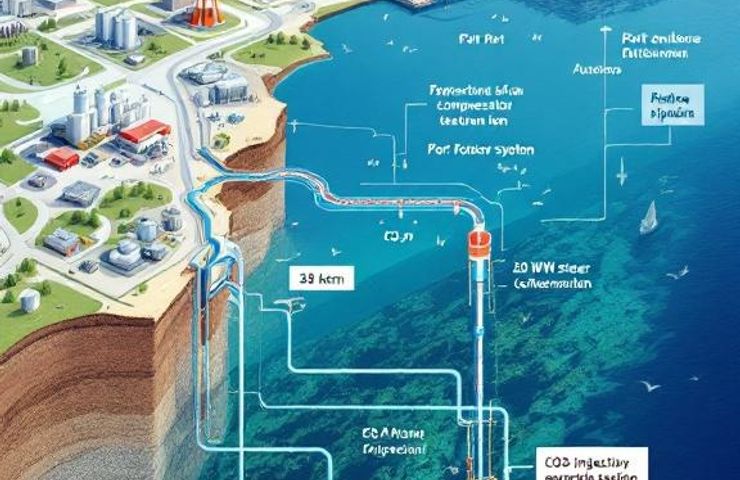
Imagine captured CO₂ from refineries, petrochemical plants, and hydrogen production facilities flowing through a 33-km onshore pipeline that snakes around container terminals and chemical parks. It arrives at a 20 MW compressor station on Aziëweg, where it’s pressurized and cooled. From there, a 20-km subsea CO2 pipeline ferries it out to P18-A, roughly 20 km offshore. Deep beneath the North Sea—3–4 km under the seabed—porous sandstone reservoirs capped by tight rock trap CO₂ for good.
The founding trio brings port operations, pipeline know-how, and subsurface storage chops. On the emitters’ side, Shell and ExxonMobil feed in refining and chemical streams, while Air Liquide and Air Products contribute emissions from hydrogen plants. Over 15 years, Porthos aims to lock away 2.5 million tonnes of CO₂ per year—a grand total of about 37 million tonnes—pushing industrial decarbonization into high gear.
Technical Infrastructure
Putting this network in place meant pulling out all the stops: horizontal drilling under waterways and roads, open trench digs where space allowed, and precision crossings around busy terminals. The result? Top‐tier carbon capture and storage lines that barely interrupt port life.
At Aziëweg, CO₂ is put through a three‐phase pressurization dance: a free‐flow stage using initial reservoir pressure, a gas‐phase push up to roughly 75 bar, then a dense‐phase seal at colder temps and up to 135 bar. That stepwise approach optimizes injectivity and guarantees permanent trapping.
Shared Infrastructure Model
Instead of each company building its own CCS train, Porthos offers an open‐access backbone—shared pipelines, compression, and storage that slash per-tonne costs. Funding comes via the Dutch SDE++ scheme, which bridges the gap between EU ETS carbon prices and CCS expenses. Plus, it lays groundwork for future hydrogen infrastructure by showing how bulk gases can be handled safely and cost‐effectively.
Europe’s CINEA pitched in €6.5 million for feasibility studies and over €102 million for the build. And the Port of Rotterdam Authority made headlines by issuing the first carbon capture and storage bond—proving CO₂ storage can be a solid, creditworthy asset.
Strategic Implications
Porthos sits at the core of the Dutch Climate Agreement, which labels CCS essential, and aligns with the EU’s 2030 and 2050 targets. Industries around Rotterdam—tough nuts to crack when it comes to electrification—can now slash carbon footprints. Hydrogen plants at Air Liquide and Air Products using steam methane reforming step into “blue” hydrogen territory by capturing CO₂ instead of venting it.
Repurposing North Sea platforms and depleted fields also tackles stranded‐asset risk. Rather than mothballing offshore rigs, we’re giving them a second life—protecting specialized jobs in engineering, drilling, and subsea operations. During construction, hundreds of roles popped up; during operations, a dedicated team will monitor injection rates, pressures, and reservoir health for decades.
Regulatory and Policy Framework
In the Netherlands, CCS is enshrined in national climate policy—no wonder, since some sectors simply can’t achieve deep cuts any other way. Under the European Green Deal and Fit for 55, projects like Porthos earn PCI status, fast-tracking permits and fostering cross-border collaboration. That backing is crucial given the complexity of subsea CO2 pipeline work and the long lead times for planning major infrastructure.
Environmental Safeguards and Monitoring
Before the first trench was dug, thorough environmental assessments scoped out seabed impacts and marine life concerns. Each well got multi‐layer steel casings and cement sheaths for watertight integrity. Once live, seismic surveys, pressure logs, and tracer tests will keep tabs on any stray CO₂. Spot an odd pressure dip or seismic blip? Onboard shutoff valves on P18-A can isolate wells in seconds. It’s a layered defense to keep leakage and induced seismicity at bay.
Broader Context and Future Prospects
Porthos is Europe’s first large-scale integrated CCS infrastructure and the Netherlands’ debut offshore CCS project. It’s the blueprint for the EU’s CO₂ TransPorts PCI, linking Rotterdam with Antwerp and Ghent. With its 37 million-tonne capacity fully snapped up, expansion studies are already in motion to meet rising demand.
Since North Sea oil and gas kicked off in the 1960s, Rotterdam has been a petrochemical powerhouse. As fields mature and decline, talk of decommissioning grew—but Porthos flips that story. Rather than scrapping platforms, we’re turning legacy infrastructure into climate solutions. Its PCI status unlocks cross-border CO₂ corridors, letting Northern Europe share storage capacity and balance regional capture and storage strengths.
Looking ahead, advanced monitoring—fiber‐optic well sensors, real-time seismic imaging, automated pressure controls—will bolster confidence in long-term storage. If Porthos delivers on storing millions of tonnes of CO₂, it will cement carbon capture and storage as a core pillar of future industrial decarbonization.
With first injection due autumn 2026, a new chapter is about to begin: where fossil fuel heritage fuels climate progress. If all goes as planned, Porthos will prove that shared subsea CO2 pipeline networks and cutting‐edge CCS can pave the way to a cleaner, more sustainable industrial future.
source: porthosco2.nl

 With over 15 years of reporting hydrogen news, we are your premier source for the latest updates and insights in hydrogen and renewable energy.