
Japan Plans Domestic Hydrogen Production from Geologic Sources by 2040
April 9, 2026You might not think to look under your feet for the next big energy breakthrough, but Japan is doing just that. They’re planning to tap naturally occurring hydrogen trapped in underground rock formations, with an eye on kicking off domestic hydrogen production by 2040.
This idea hit the headlines when Yomiuri Shimbun reported that the Government of Japan has officially greenlit a commercial-scale push into geologic hydrogen. It’s all part of a broader drive for energy security and decarbonization, as leaders scramble to wean the country off imported fuels and ramp up their green hydrogen game. With Sanae Takaichi stepping up as the new head of the LDP and a likely next prime minister, innovation in sustainable energy is front and center—tying national security to cutting-edge energy projects.
The rough roadmap is straightforward: spend the next decade on surveys and evaluations, then move into pilot wells before flipping the switch on full-scale production around 2040. That timeline lines up nicely with Japan’s mid-century net-zero targets and medium-term carbon cuts. We’re still waiting on numbers—how big these underground pockets are or what it’ll cost to bring them to market—but early signals say teaming up with universities and industry groups will be key to working out the kinks.
Extracting Geologic Hydrogen
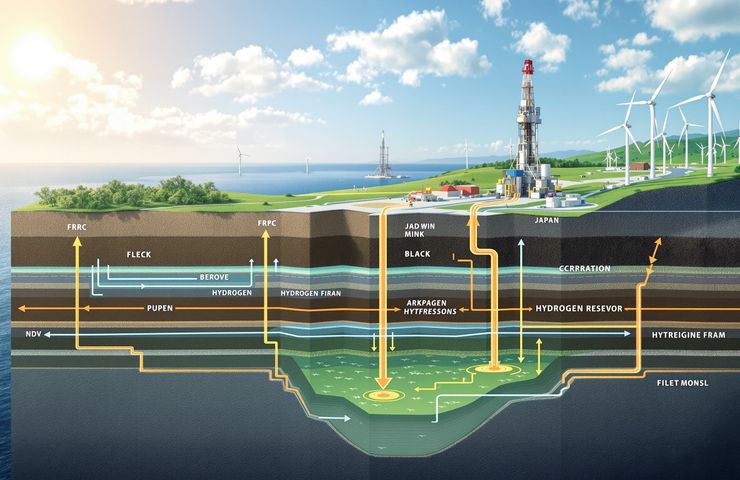
When we talk about geologic hydrogen, we mean H₂ that’s naturally brewed underground through processes like serpentinization—think water meeting rock at just the right temperature and pressure. Unlike hydrogen from electrolysis or steam methane reforming, this is pure, “white” hydrogen that bubbles up with virtually zero upfront emissions. To tap it, companies are borrowing the playbook from natural gas drillers: mapping the subsurface with seismic scans, magnetotelluric imaging and rock sampling, then drilling test wells to measure pressure, temperature and gas mix.
Once hydrogen seeps up to the surface, it passes through separators, compressors and dryers to clean it for pipeline transport or liquefaction. Then comes the tricky part: plugging it into Japan’s existing hydrogen infrastructure—everything from fuel stations for cars and stationary fuel cells to industrial feedstock lines. The goal? A co-optimized network that marries this new source with renewable power, carbon capture and storage, and other elements of a robust, resilient energy system.
Aligning Energy Security and Decarbonization
Right now, Japan imports almost every drop of its hydrogen—mostly as liquefied shipments from Australia and the Middle East. That sounds diverse, but it also leaves Tokyo exposed to price swings, shipping delays and the whims of a weak yen. Drilling at home taps local geologic reservoirs, giving Japan more control over a key energy vector. Domestic H₂ production could help shrink the trade gap and inject investment into rural regions hosting exploration sites.
From a climate standpoint, geologic hydrogen could be a real game-changer. It sidesteps the CO₂ burden of “gray hydrogen” made from fossil gas, and it doesn’t demand the heavy-duty hardware or costs of “blue hydrogen” paired with CCS. If these underground reserves pan out, Japan might have a legit low-carbon, zero-emission technology to call its own—and a big win for sustainable energy. Mixing supplies—renewable-powered electrolysis, blue hydrogen and geologic hydrogen—gives policymakers flexibility and hedges against supply hiccups.
From Fukushima to a Hydrogen Society
Japan’s vision of a true hydrogen society actually traces back to the aftermath of the 2011 Fukushima nuclear crisis. In 2017, the government rolled out the Basic Hydrogen Strategy, betting on fuel-cell cars, hydrogen-powered homes and industrial uses. An update in 2023 doubled down on scaling electrolysis and boosting import capacity. So far, most domestic H₂ has fueled oil refining and ammonia plants, but fuel-cell vehicles are slowly gaining ground. As of last year, Japan boasted one of the world’s largest fleets of hydrogen cars and a growing network of public refueling stations.
Geologic hydrogen exploration feels like the next chapter. Japan’s complex underground makeup—shaped over eons—could hide pockets of untapped H₂ just waiting to be discovered. While the concept is still in its infancy globally, similar projects in Australia and Europe are already offering clues on reservoir size and flow dynamics.
Economic and Geopolitical Implications
Economists point out that drilling for geologic hydrogen could generate thousands of jobs—from seismic surveys and well drilling to plant construction and maintenance. Prefectures sitting atop promising reservoirs might see an influx of revenue and skilled-labor opportunities. But let’s be honest: getting this off the ground won’t come cheap. Specialized exploration tools, hydrogen-resistant piping to prevent embrittlement and new processing facilities will demand significant upfront investment.
On the geopolitical front, cutting back on Middle Eastern and Australian H₂ imports dovetails with Tokyo’s national security agenda. With regional tensions simmering and shipping lanes vulnerable, homegrown energy sources become a strategic advantage. Plus, by pioneering geologic hydrogen tech, Japan could export expertise, equipment and intellectual property to other nations exploring their own subterranean stores.
Navigating Technical and Regulatory Challenges
The truth is, tapping a resource that’s never been produced commercially comes with hurdles. We still don’t know exactly how much H₂ lurks underground, and the industry lacks long-term performance benchmarks. Safety protocols must address hydrogen’s high diffusivity and the risk of induced seismicity from deep drilling. Regulators will need to define ownership of subsurface gases, set rigorous environmental review standards and update pipeline codes to handle ultra-pure hydrogen.
And let’s not overlook public perception. Japan has wrestled with unconventional resource projects before—shale gas disputes, for instance—and communities expect transparency. Open dialogue, thorough impact studies and clear communication will be essential to earn social license for geologic hydrogen developments.
There are still plenty of unknowns—reserve sizes, extraction costs, regulatory frameworks—but Japan’s venture into geologic hydrogen feels like a bold next step in its energy evolution. By diversifying its mix with this underground H₂, the country hopes to bolster energy security and chart a more resilient path to net-zero. As geologic hydrogen and other clean tech like green hydrogen and electrolysis advance side by side, it’ll be fascinating to see if Japan’s subterranean strategy pays off.


 With over 15 years of reporting hydrogen news, we are your premier source for the latest updates and insights in hydrogen and renewable energy.