
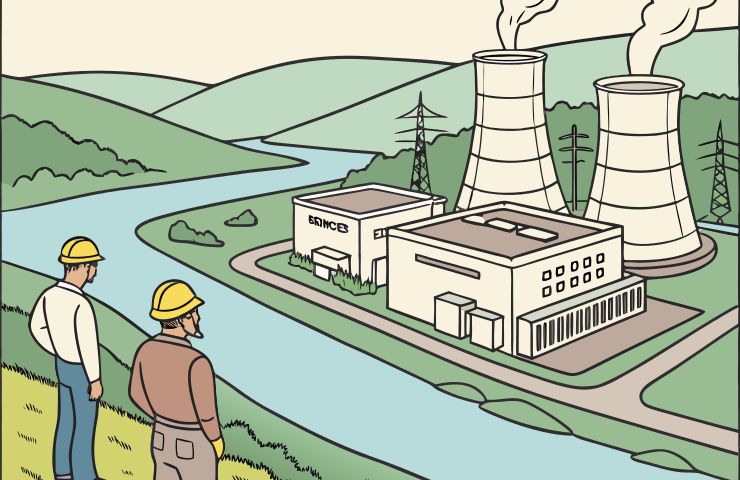
Pleasants Power Station Validates OQR® Technology
March 3, 2026Quantum Pleasants, a licensee of California-based innovator Omnis Energy, just hit a major milestone in hydrogen production technology by wrapping up a year-long validation of its Omnis Quantum Reformer® (OQR®) at the Pleasants Power Station in West Virginia. The pilot kicked off in late 2024, and since then, a steady stream of observers from the National Energy Technology Laboratory (NETL), the U.S. Department of Energy (DOE), regional academic partners, and state legislators have been peeking in. Good news? They didn’t flag any major safety or reliability hiccups during continuous testing. Under the watchful eye of Chairman Simon Hodson and with expert advice from Dr. Nansen Saleri, the team blended corporate savvy with scientific rigor every step of the way.
Key Highlights
- For twelve months, a single OQR® module ran alongside existing coal-fired equipment, producing hydrogen on-site from a coal and natural gas blend.
- Early-stage loan financing from the State of West Virginia Economic Development Authority got the ball rolling, showing the state’s commitment to advanced energy jobs.
- Independent reviewers confirmed the tech hit its safety, commercial readiness, and economic targets.
- Company data hint at up to a 50% drop in production costs compared to traditional methods—though third-party audits will be the ultimate judge.
- The next phase? A full retrofit of every generating unit for hydrogen firing in the next two years, putting this plant on track to be the first major facility running purely on hydrogen.
It’s that mix of academic, federal, and state oversight that gives this demo a credibility boost most pilot projects can only dream of.
Validation Results and Oversight
From September 2024 through February, the OQR® module operated under full load, slicing hydrocarbons into hydrogen via ultra-high-temperature pyrolysis. NETL engineers and DOE representatives ran safety drills, pored over performance data, and conducted surprise spot checks. Meanwhile, university labs double-checked the gas composition and cataloged the solid carbon byproduct. According to company reports, the system stayed rock-solid, with barely any unplanned downtime. On the cost front, Quantum Pleasants pegs production at about $100 per ton versus an industry norm near $2,000 per ton—a claim pending independent, peer-reviewed verification.
Roadmap to Full Hydrogen Operation
With validation in the rearview mirror, Quantum Pleasants is gearing up to scale from one pilot unit to a lineup of 32—or possibly 36—reformers, depending on final engineering specs. Site modifications and module installations kick off this year, followed by commissioning, turbine integration, and grid synchronization. The goal is to fire up the entire 1,300 MW capacity on hydrogen alone within 24 months, shooting for a late-2028 finish. On top of that, they’re in talks with strategic partners to hand over daily operations, freeing up the team to focus on licensing the tech and pushing R&D further.
Economic and Regional Impact
Pleasants County—long tied to coal mining and coal-fired generation—is poised to reap major benefits. Hundreds of local technicians and engineers could land roles in module construction, plant operations, and feedstock logistics throughout the conversion and beyond. By repurposing an existing power plant instead of building from scratch, the project preserves prior investments in grid connections, permitting, and site services. Plus, it checks all the boxes for the state’s push toward sustainable energy and economic development.
Technical Deep-Dive into OQR®
Here’s the tech scoop: the OQR® cranks up hydrocarbon molecules to ultra-high temperatures, breaking them down into pure hydrogen gas and solid carbon residue. Unlike steam methane reforming—which churns out CO₂ that then needs capturing—this process produces carbon in solid form up front, potentially streamlining downstream carbon management. You feed it coal and natural gas, tap the hydrogen for turbine firing, and collect carbon solids for storage or eventual commercial use (though markets for the byproduct are still being mapped out). Its modular design means you can link multiple units for gigawatt-scale output, a big win for hydrogen infrastructure.
Industry Context and Business Positioning
Historically, hydrogen production has been pricey—think around $2,000 per ton for standard processes. Advances in electrolysis and steam methane reforming have chipped away at costs, but they often lean heavily on subsidies. Strong policy support from the federal DOE and incentives baked into recent infrastructure legislation have opened the door for higher-risk pilots. By targeting production near $100 per ton and slotting into existing plants, Omnis Energy and Quantum Pleasants are shaking up that paradigm, positioning hydrogen as a linchpin for industrial decarbonization and zero-emission technology strategies.
Considerations and Next Steps
Of course, there are still a few curveballs to watch for. Full lifecycle analyses of coal-based hydrogen via pyrolysis are needed to nail down the real carbon footprint, including emissions tied to feedstock extraction. Locking in long-term coal and gas contracts at stable prices will be vital to the project’s economics. The team also needs clear pathways for marketing or storing the graphite byproduct to avoid waste and maximize resource use. Scaling up from a single unit to dozens could uncover fresh engineering challenges around reliability. And regulatory standards for large-scale hydrogen firing and grid interconnection are still evolving, so close coordination with regulators will be a must. Bottom line: an independent, peer-reviewed cost study will be key to winning broader industry buy-in.
Historical Significance in Appalachia
Pleasants County’s energy story is deeply rooted in coal, so it’s fitting that instead of shutting down the plant, this project gives the old infrastructure a new lease on life. It preserves legacy jobs and the local tax base, while positioning Appalachia at the forefront of emerging hydrogen markets. In many ways, it’s a blueprint for other coal-dependent regions navigating the shift toward cleaner power sources.
Global Replicability Potential
If Pleasants pulls this off, expect a ripple effect at aging coal and gas plants around the world. With thousands of gigawatts facing early retirement under tightening emissions rules, modular hydrogen reformers that slot into existing sites could offer a practical path to sustainable energy and extended asset lifespans. Energy companies in Europe, Asia, and other U.S. regions are already watching closely.
Looking Ahead
The next two years are make-or-break: can Pleasants move from a promising pilot to a full-scale, hydrogen-fired powerhouse? Stakeholders will be poring over safety logs, economic reports, and audited cost studies as the project moves forward. For West Virginia, it’s a chance to redefine its energy identity around cutting-edge hydrogen production; for the broader sector, it could be a pivotal step toward global adoption of low-carbon power generation.
About the Company
Quantum Pleasants is a West Virginia-based licensee of Omnis Energy, rolling out the OQR® platform to deliver commercially scalable hydrogen solutions for power generation.

 With over 15 years of reporting hydrogen news, we are your premier source for the latest updates and insights in hydrogen and renewable energy.
