Power-to-Liquids Project Advances in Chile’s Biobío with INERATEC and Local Partners
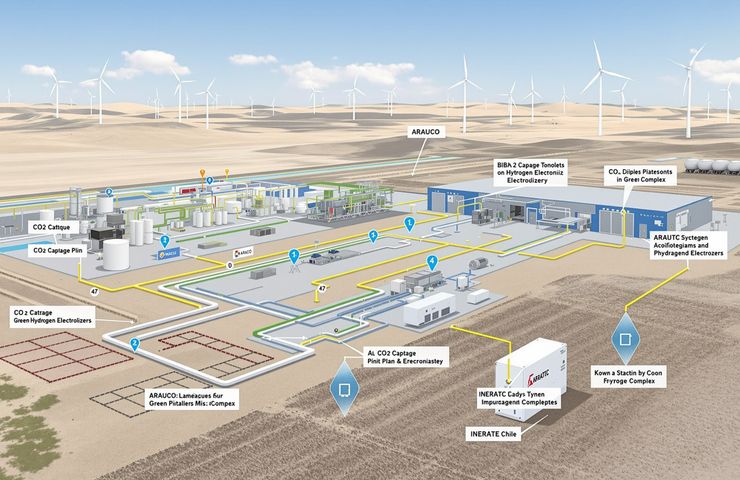
February 23, 2026This February, INERATEC—the German trailblazer in modular Power-to-Liquids (PtL) systems—handed over its basic engineering study for a pilot e-fuel plant tucked inside the ARAUCO industrial complex in Chile’s Biobío region. Thanks to a hefty CORFO grant and a strategic investment from Copec Wind Ventures, the study spells out how biogenic CO₂ from ARAUCO’s forestry and pulp operations will pair with green hydrogen from Abastible to churn out sustainable e-fuels. It marks the kickoff of a four-way collaboration—ARAUCO, Abastible, Copec, Copec Wind Ventures—teamed up with INERATEC’s two-step syngas and fuel synthesis know-how to explore low-carbon transport, specialty chemicals and beyond.
Strategic Collaboration in Biobío
Right in the heart of Biobío—home to over 1.4 million people and one of Latin America’s biggest forestry hubs—this partnership finds the perfect playground for a PtL demo. ARAUCO will channel its biogenic CO₂ straight from the pulp mills, while Abastible brings in locally produced hydrogen via renewable-powered electrolysis, showcasing next-level hydrogen production. Copec, Chile’s fuel logistics heavyweight, and its venture arm, Copec Wind Ventures, have backed INERATEC to nail down the engineering and project rollout. Together, they’re on a mission to cut back on imported fossil fuels by turning emissions and renewables into valuable feedstocks.
Building on Early Concepts and Feasibility Studies
The blueprint builds on ideas from the Energy Challenge 2023 in Biobío and the follow-up H2Uppp feasibility study. Back then, the team scouted ideal sites on ARAUCO’s estate, mapped CO₂ and H₂ supply lines and defined each partner’s role. With CORFO covering the basic engineering tab, INERATEC has now dropped the detailed study—complete with modular layouts, material flows and utility needs. As CEO Tim Böltken says, “We’re marrying local CO₂ streams with green hydrogen to prove an integrated PtL value chain can thrive right here in Chile.”
Understanding the PtL Technology
Power-to-Liquids shifts CO₂ and H₂ into synthetic fuels in two key steps. First, CO₂ from ARAUCO links up with green hydrogen from Abastible in a reformer to produce syngas. Next, that syngas heads to INERATEC’s modular Fischer-Tropsch reactors to become drop-in fuels—think kerosene, diesel or naphtha. These skid-mounted units are plug-and-play, so they flex to whatever feedstock supply you’ve got.
Roles and Contributions
Each partner brings its A-game. ARAUCO’s pulp and paper mills have been venting biogenic CO₂ that’s ripe for capture. Abastible, a leader in hydrogen production in Chile, supplies the green H₂. Copec, the country’s top fuel distributor, handles downstream integration and logistics—so any pilot output can slot right into real-world distribution. And Copec Wind Ventures’s investment in INERATEC not only bankrolls the engineering but also shows PtL has serious commercial legs in Chile.
Market and Strategic Implications
Put it all together, and Biobío could emerge as Latin America’s next big e-fuel hub. By turning industrial CO₂ into a usable fuel alongside green hydrogen, the consortium is opening doors for low-carbon energy in sectors that usually dodge the green spotlight—aviation, heavy transport and more. If the pilot proves its mettle, this model could scale up fast, drawing fresh investment and cementing Chile’s role in the global hydrogen economy—and turbocharging industrial decarbonization along the way.
Economic and Environmental Benefits
There’s plenty to like here. Using biogenic CO₂ on-site means you dodge long-haul transport costs and complexities. Keeping feedstocks local keeps value—and jobs—in Chile, from engineering to operations and maintenance. Environmentally, swapping fossil fuels for e-fuels made from renewable hydrogen and captured CO₂ can slash lifecycle greenhouse gas emissions by up to 80% compared to conventional options, according to industry benchmarks.
Challenges and Considerations
Of course, it’s not without hurdles. Green hydrogen is still pricier than its fossil-based rival, and scaling up electrolysis depends on a steady supply of renewable power. The modular reactors have to prove they can handle the daily grind, and Chile’s regulatory framework for e-fuels and offtake agreements is still coming together. Still, with CORFO funding support and private investors on board, the policy winds are blowing in the right direction.
Key Takeaways
- INERATEC delivered the basic engineering design for a PtL pilot plant at ARAUCO’s Biobío complex, thanks in part to CORFO.
- ARAUCO provides biogenic CO₂ and Abastible supplies green hydrogen; Copec handles downstream logistics.
- This project builds on the Energy Challenge 2023 and H2Uppp studies, validating a modular two-step syngas-to-fuel process.
- Success could position Chile as a regional e-fuel leader, leveraging abundant renewables and industrial CO₂ streams.
- Main hurdles include hydrogen costs, reliable renewable power and evolving e-fuel regulations.
As the world doubles down on decarbonizing transport and industry, this push in Biobío offers a concrete example of industrial decarbonization in action. We’ll be watching closely as the project moves from blueprints to boots-on-the-ground—marking a pivotal step for renewable hydrogen production, CO₂ utilization and Chile’s energy transition.


 With over 15 years of reporting hydrogen news, we are your premier source for the latest updates and insights in hydrogen and renewable energy.