
Replacing iridium: Green Hydrogen Catalyst Advance with High-Throughput Screening
March 3, 2026Imagine this: a group of scientists at Northwestern University, led by Chad A. Mirkin and teaming up with the Toyota Research Institute and Joseph Montoya, just pulled off something pretty remarkable. They’ve tackled one of the biggest roadblocks in making green hydrogen truly scalable—those insanely expensive iridium catalysts that power proton exchange membrane electrolysis. Their secret weapon? A microfluidic data factory chip that runs on high-throughput screening, letting them test 156 million nanoparticle mixes in the time it usually takes to brew a pot of coffee. The payoff: a breakthrough RuCoMnCr catalyst (formally Ru52Co33Mn9Cr6 oxide) that matches—or even beats—iridium in a PEM electrolyzer. In plain English, this could seriously slash costs and speed up the shift to industrial-scale decarbonization.
High-Throughput Screening: A Data Factory Chip
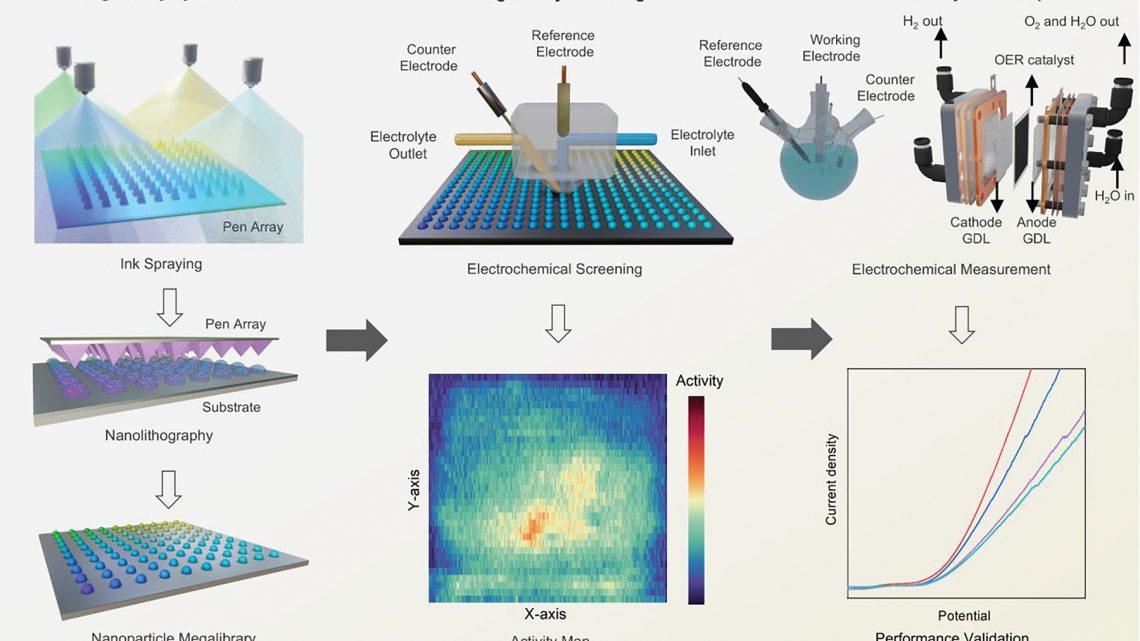
Here’s the fun part: instead of the old one-at-a-time approach, this microfluidic “lab-on-a-chip” shoves chemical precursors through tiny channels, whipping up nanoparticles with different metal ratios on the fly. A robotic optical scanner then gauges each particle’s oxygen evolution reaction (OER) performance—measuring current output and stability—while AI and advanced analytics crunch the numbers in real time. It’s like having a thousand mini-labs working around the clock, automatically flagging the most promising candidates.
Traditionally, cooking up and testing a single catalyst could eat up weeks. With this data factory chip, millions of variations go under the microscope in parallel, trimming discovery cycles from years down to mere weeks. Materials science, meet warp speed.
RuCoMnCr Catalyst: A Game-Changer for PEM Electrolyzers
After sifting through that mountain of data, the team zeroed in on a mixed-metal oxide made of ruthenium, cobalt, manganese, and chromium in a 52:33:9:6 ratio. Dubbed the RuCoMnCr catalyst, it not only rivals iridium’s activity and stability but does so with metals that are far more abundant—and a lot cheaper. To put it in perspective, iridium can cost upwards of €125 per gram (yes, more than gold), whereas this new blend taps into more common elements.
On the nanoscale, these particles create a synergy: ruthenium brings the active OER sites, while cobalt, manganese, and chromium shore up the structure and fend off corrosion. In accelerated tests, the RuCoMnCr catalyst held on to over 90% of its initial performance after a few hundred hours—outperforming commercial iridium under the same stress. Of course, true industrial validation means pushing it through 1,000-hour endurance runs, but the early signs are super encouraging.
Built for PEM Electrolyzers
PEM electrolyzers are prized for their compact size, high current densities, and ability to flex with variable renewable power. They’re ideal companions for wind and solar farms—but that iridium anode always drove up costs and left supply chains twitchy. Swapping in this stable, budget-friendly mixed oxide could unlock economies of scale, making it easier to plug PEM units into projects around the globe.
Historical Context & Energy Transition
Believe it or not, electrolytic hydrogen has roots in the 1800s, and PEM cells flew on space missions in the 1960s. By the 2000s, they were commercial staples for hydrogen fueling and small power-to-gas plants. Iridium became the go-to due to its acid resilience, but its scarcity has always been a drag. Fast-forward to today’s post-Paris Agreement world, where scaling green hydrogen is mission-critical for cutting industrial emissions. This breakthrough—with its AI-fueled, high-throughput screening flair—rides that wave, much like recent leaps in battery and solar research.
Collateral Impacts & Future Outlook
Kick iridium to the curb, and you’re looking at significantly lower electrolyzer capital costs, stronger supply chains, and a cleaner mining footprint. That could supercharge gigawatt-scale deployments, feeding low-carbon hydrogen into power plants, factories, and fuel cell transport. Of course, the big next step is industrial-scale trials to prove out multi-thousand-hour durability. Still, the signs are promising:
- Sharper cost curves for PEM systems, closing the gap with fossil-derived hydrogen
- Greater resilience in the supply chain, leaning on more common metals
- Expanded markets for renewable hydrogen—everything from chemicals to heavy transport
- Reduced environmental toll from rare metal extraction
Having Toyota Research Institute on board shows automakers mean business about hydrogen fuel cell vehicles, too. Their input on scalable catalyst testing helps bridge the gap from lab bench to factory floor.
At the end of the day, the real headline is speed. This data factory chip approach lets teams scan millions of samples in one go, rewriting how we hunt for next-gen energy materials. As green hydrogen gears up to power our low-carbon future, innovations like this mixed-metal oxide catalyst and its rapid screening pipeline are exactly the kind of breakthroughs we need to turn promise into reality.

 With over 15 years of reporting hydrogen news, we are your premier source for the latest updates and insights in hydrogen and renewable energy.
