Seawater Electrolysis Advances with Dual-Electrode System for Stable Green Hydrogen Production
March 20, 2026Freshwater’s running out, and the race to cut carbon emissions is full throttle. So when the team at Korea Institute of Energy Research (KIER), led by Dr. Han Ji-hyung, unveiled a clever spin on seawater electrolysis, it turned heads. They’ve built a dual-electrode system that switches every 48 hours between making hydrogen and scrubbing itself clean—no pricey pretreatment, no constant tinkering. This means seaside plants could keep pumping out steady, high-efficiency hydrogen production rain or shine, and it’s a big step toward real-world sustainable energy.
Core Innovation
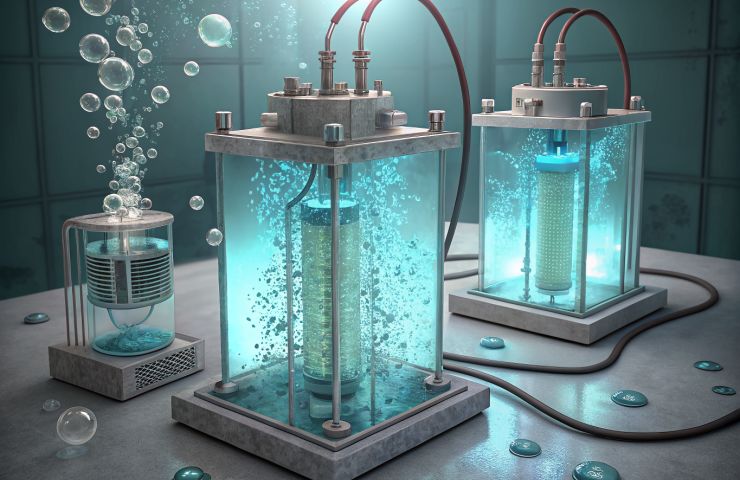
At the heart of KIER’s design are two cathodes that tag-team like clockwork. One handles the hydrogen evolution reaction (HER), while the other spends its turn soaking in acidified seawater to dissolve pesky magnesium and calcium deposits. In a typical single-electrode setup, energy consumption can spike by as much as 27% after 200 hours of operation due to crusty build-up. With this dual-electrode arrangement, energy demand only creeps up 1.8% over 400+ hours, and catalyst loss stays around 20% instead of 53%. It’s the kind of reliability industrial operators dream about, and since energy use barely budges, it stays efficient even after hundreds of hours of nonstop electrolysis.
Technical Insights
On top of that self-recovery trick, the team supercharged their catalyst support with an acid-treated carbon cloth. By dunking the cloth in nitric acid at 100°C, they boost its hydrophilicity so the CoMo catalyst—doped with just 1% ruthenium—spreads perfectly. That tweak slashes overpotential by about 25% and cranks up HER efficiency by 30%, maintaining steady performance for over 800 hours at 500 mA/cm². Balancing low precious-metal loading with maximum surface interaction is key if you want green hydrogen to move beyond the lab and into large-scale reality.
Strategic Implications
With freshwater shortages tightening the global squeeze, turning to the ocean for hydrogen production could be a genuine game-changer—after all, 97% of our planet’s water is salty. KIER’s dual-electrode method cuts operational costs by reducing energy penalties and slashing maintenance downtime, paving the way for gigawatt-scale green hydrogen hubs. Of course, scaling up means tackling hurdles like uniform current distribution in big cells, marine permitting, and supportive regulatory frameworks. Meanwhile, rivals are exploring bipolar-membrane designs or single-electrode acid-wash tricks. What the field really needs now are pilot demonstrations that prove these approaches work out in the real world.
Context and Next Steps
Since 1977, KIER has been at the forefront of clean-energy R&D under South Korea’s Ministry of Science and ICT. This dual-electrode breakthrough builds on last year’s carbon cloth electrode, which first cracked the 800-hour stability barrier in real seawater. Next up: extended runs pushing past 1,000 hours, large-area stack modules, and tests under varying temperatures and salinity. If those demos mirror the lab results, we could see pre-commercial prototypes rolling into coastal facilities—churning out hydrogen for industrial feedstocks, power generation, or even zero-carbon ammonia production.
By combining deposit-free operation with low precious-metal loading and rock-solid longevity, KIER’s approach moves us from stop-and-clean cycles to true continuous hydrogen production. As the globe races toward carbon neutrality, breakthroughs like this could tip the scales in favor of emissions-free fuel. For developers, investors, and policymakers eyeing the hydrogen production landscape, it’s a tangible leap toward a zero-emission future and a major win for genuine sustainable energy.
Source: sciencedirect.com

 With over 15 years of reporting hydrogen news, we are your premier source for the latest updates and insights in hydrogen and renewable energy.