Toyota Files Patent for Hydrogen-Powered Scooter
Toyota files a patent for a hydrogen-powered scooter similar to Suzuki’s Burgman prototype, extending its hydrogen fuel cell strategy into urban two-wheelers.
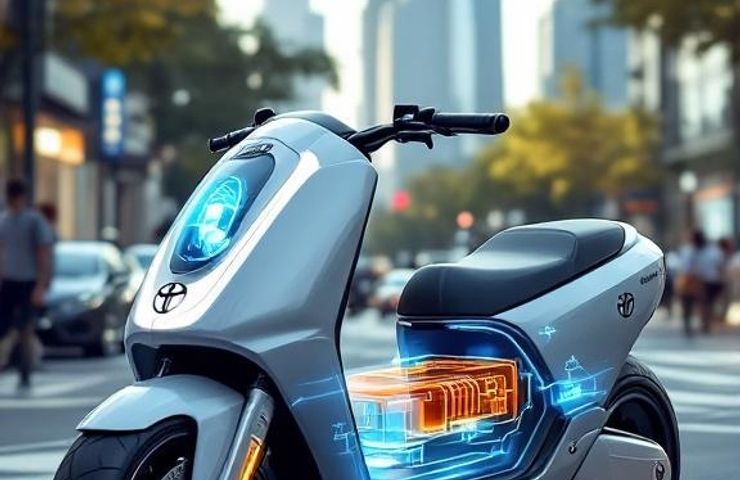
In a bold shift that takes the spotlight off four wheels, Toyota Motor Corporation has quietly filed a Toyota patent for a hydrogen-powered scooter—and its silhouette might give early-2000s fans a case of déjà vu, recalling Suzuki’s Burgman FC prototype. Announced this month, the move underscores Toyota’s drive to weave its hydrogen fuel cells expertise into the hustle and bustle of urban mobility.
Patent Outline and Technical Approach
The sketch attached to the patent is deceptively simple: imagine a scooter with a compact proton exchange membrane (PEM) fuel cell tucked neatly under your feet, sipping hydrogen from a high-pressure tank slung just below the seat. While Toyota’s kept the exact specs under wraps, the drawing hints at next-gen membrane materials and a super-light bipolar plate structure designed to jack up power density. Even better, cooling channels snake through the cell stack, pointing to a modular thermal management system that could do away with bulky radiators—nice for keeping weight down.
The magic inside is classic fuel cell science: hydrogen splits into protons and electrons at the anode, protons seep through the membrane to the cathode, and electrons power the motor before teaming up with oxygen to form water. No smog, no carbon—but plenty of torque when you pull the throttle.
Hybrid Power Management
The patent drawings also tease an onboard power management unit that fuses fuel cell output with a small lithium-ion buffer battery. Think of it as a tag-team: the battery smooths out sudden acceleration surges and captures energy during regenerative braking. It’s essentially Toyota’s tried-and-true automotive fuel cell architecture, now shrunk down to scooter size—proof that lessons learned from cars can ride shotgun on two wheels.
Urban Air Quality and Mobility Strategy
In many Asian and European cities, scooters weave through traffic like water through a sieve—but their little engines often skip the sophisticated emission controls you find in cars. Swapping in a hydrogen-powered scooter means ditching NOx and particulates at the tailpipe without sacrificing the seconds-it-takes-to-refuel convenience that riders love. Picture narrow side streets, less smog hanging in the air, and a quieter buzz from the city’s two-wheel army.
Analysts note that filling up with hydrogen is surprisingly fast—rivaling petrol pumps—and performance stays rock-solid even in freezing or sweltering conditions. With government targets under the Paris Agreement and the EU–Japan Clean Energy Partnership pushing for more zero-emission options, hydrogen scooters could be a neat addition to the hydrogen infrastructure puzzle. Plus, by pumping refueling demand into off-peak hours, they can help balance local power grids—another win for congested urban districts.
Building on Past Patent Moves
This patent comes about ten years after Toyota threw open its hydrogen playbook—releasing 5,680 fuel cell patents royalty-free back in 2015. That library covered 1,970 stack designs, 290 high-pressure tank layouts, and 3,350 control‐and‐auxiliary system concepts. The goal? Jump-start an entire industry, especially in regions where hydrogen infrastructure was just getting off the ground.
Since then, Toyota’s R&D teams have piled on more innovations: tank venting solutions for extreme climates, slick injector flow-control algorithms, plus catalyst-layer tweaks that use less platinum. Although the royalty-free window on vehicle patents closed in 2020, many upstream patents on hydrogen production and supply remain open—showing Toyota still wants to nurture the fuel side of the ecosystem even as it locks down next-gen hardware designs.
Regulatory and Safety Considerations
Rolling out a new hydrogen scooter design isn’t just engineering—it’s a regulatory maze. High-pressure tanks must clear ISO 19881 standards and survive crash and leak tests. Fuel dispensers will need retooling to handle lower-volume fills without overpressurizing or risking backflow. In markets like Japan, Europe, and select Asian hubs, regulators are still drafting the playbook for two-wheeler hydrogen vehicles, so Toyota’s patent could end up shaping new safety codes or tank-crashworthiness benchmarks.
Challenges on the Road Ahead
Still, shoehorning hydrogen into a scooter brings its own headaches. Storing gas at 70 MPa (that’s about 10,000 psi) means bolting on a hefty composite tank—translating to extra weight and extra cost. Sure, every kilogram of hydrogen holds roughly twice the energy of a similarly sized lithium-ion pack, but whipping up those tanks and sourcing platinum-group catalysts doesn’t come cheap. Meanwhile, battery-powered scooters keep getting cheaper and more convenient as charging networks multiply.
On the hydrogen infrastructure front, very few stations have pumps tailored to two-wheelers. Most are set up for cars—nozzle heights and flow rates that leave scooter users awkwardly stretching or waiting forever. Operators would have to add lower-flow nozzles or detachable hoses, and governments might need to kick in subsidies or carve out pilot zones that guarantee refueling access for scooters.
Potential Industry Ripple Effects
If Toyota pushes ahead with a prototype, it could spark a chain reaction across the scooter supply chain. Tank makers would rush to develop smaller, lighter vessels. Software companies might tweak dispenser backends to handle dual-hose or quick-switch fueling. Local delivery outfits—think food couriers or e-commerce fleets—could sign up for early demos. And who knows, Suzuki Motor Corporation might dust off its old Burgman FC tech or even license bits of Toyota’s IP for a fresh take.
Competitors like Honda and Yamaha have dipped toes into hydrogen concepts but never filed anything public. A clear signal from Toyota could trigger a second wave of R&D spending and might even lead to a scooter-focused consortium to set fueling and safety standards.
Looking Forward: Metrics to Watch
With no power ratings or range estimates in the published drawing, it’s all theoretical—at least for now. Key figures to track? Stack power density (automotive targets hover above 3 kW/L), realistic tank fill levels at existing dispenser pressures, and how long a refill takes under standardized flow rates. On top of that, full lifecycle assessments comparing well-to-wheels emissions—especially electrolytic hydrogen from renewables versus fossil-derived H₂—will tell the real story.
Equally critical will be regulatory sign-offs and real-world demos. Will Toyota showcase working prototypes at green-tech expos or smart-city trials? And how swiftly will policymakers adapt fuel specs and type-approval rules once a major OEM puts a hydrogen two-wheeler on the table?
At the end of the day, this Toyota patent hints that the company sees urban mobility extending beyond cars and trucks. A quick-fill, zero-emission scooter could be just the ticket for last-mile deliveries and city commuters—if Toyota can iron out the practical and regulatory wrinkles over the next few years.
About Toyota Motor Corporation
Toyota Motor Corporation stands as Japan’s biggest automaker by volume and a trailblazer in hydrogen fuel cells. After popularizing hybrids with the Prius in 1997 and launching the Mirai fuel cell sedan in 2014, Toyota opened up 5,680 patents in 2015 to supercharge industry adoption. Today, it’s still plowing capital into hydrogen R&D—filing patents across fuel cell stacks, tanks, and control systems—to help drive global decarbonization.