Zero-Emission Technology: Hydrogen Cycle Engine Achieves 60% Efficiency
Otto-von-Guericke University Magdeburg's closed-loop hydrogen cycle engine uses argon and oxygen to reach over 60% efficiency with zero emissions, verified by WTZ Rosslau.
Imagine a world where heavy-duty engines leave nothing but water vapor, no soot swirling in the air and no nitrogen oxides forming smog. Sounds like something out of a sci-fi flick, right? But over in Magdeburg, a scrappy team at Otto-von-Guericke University Magdeburg is bringing that vision to life. In early May 2026, they unveiled a hydrogen cycle engine that runs in a closed loop on hydrogen, oxygen and argon. In lab trials, this prototype hit over 60% thermal efficiency—way past a typical diesel engine’s 45% ceiling—while cranking out diesel-level power and spitting zero tailpipe emissions. Best of all, WTZ Rosslau, a top-notch engine testing institute in Saxony-Anhalt, independently confirmed the results, giving a boost to its credentials in zero-emission technology and sustainable energy innovation.
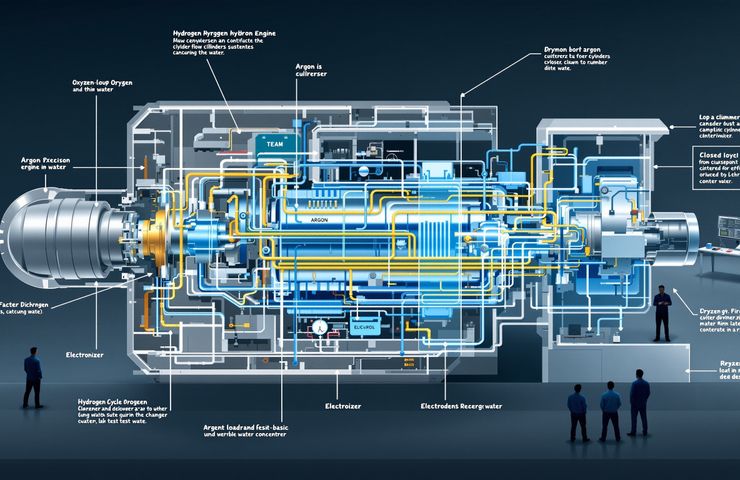
Here’s the clever bit: instead of breathing in air’s nitrogen, the design swaps it for argon, a monoatomic noble gas with a higher adiabatic index. When hydrogen combusts with oxygen, argon soaks up the heat, driving pressures and temperatures sky-high. After the burn, water vapor condenses out, leaving argon and oxygen to be recompressed and sent back into the mix. The captured water heads to an electrolyzer—powered by clean, renewable juice—where it splits back into hydrogen and oxygen, closing the loop and sidestepping the usual open-cycle losses. With no nitrogen in play, NOx is off the table, and hotter combustion pushes Carnot efficiency beyond 60%, making strides in both hydrogen production and industrial decarbonization.
Technical Deep Dive
At its core lies the closed-loop hydrogen cycle engine. Picture a conventional internal combustion engine, but instead of gulping air, it takes in a precise mix of oxygen and argon. Once ignited, the hydrogen-oxygen mix fires up the argon, generating robust expansion strokes. A condenser then whisks away water vapor, and what’s left—argon and unused oxygen—is squeezed back to restart the cycle. It’s a tidy system that keeps energy losses to a minimum.
Testing at WTZ Rosslau covered two fronts: first, verifying consistent thermal efficiency above 60% under various loads; second, checking how materials hold up when exposed to pure oxygen and argon at extreme temperatures and pressures. The good news? No weird wear patterns popped up during high-temp cycling, which suggests this concept can graduate from the lab into real-world applications.
The final piece of the puzzle is electrolysis. The water scooped out in the condensation phase feeds a renewable-powered electrolyzer that cleaves H₂O back into hydrogen and oxygen. Those gases zip right back into the engine loop, sealing the deal on zero tailpipe emissions and minimal wasted energy.
Strategic Implications for Decarbonization
For passenger cars, batteries make a lot of sense, but when it comes to heavy-haul trucks, farm machinery and big construction rigs, you need something with serious power density and range. That’s where this hydrogen engine shines: no bulky exhaust-treatment gear, fewer tweaks to existing drivetrains, and a clear path toward cost savings. According to Professor Hermann Rottengruber, head of the Department of Energy Conversion Systems for Mobile Applications, this approach ticks all the boxes for rugged, long-duration service while cutting out pricey catalysts and filters—key steps in the journey toward industrial decarbonization.
This engine also dovetails neatly with Europe’s push to build out hydrogen infrastructure, from revamped gas pipelines to cryogenic liquid carriers. By leveraging existing industrial gas supply chains for oxygen and argon—sourced from electrolysis hubs—the system could dodge some of the expense and headaches tied to roll-out of dedicated hydrogen refueling stations.
Historical Evolution of Hydrogen Engines
Hydrogen-powered engines aren’t exactly brand-new. They trace back to François Isaac de Rivaz’s 1806 prototype and Etienne Lenoir’s 1863 design. Interest waned once gasoline reigned supreme, but spiked again during the 1970s oil crunch and resurfaced in the 2000s with BMW’s Hydrogen 7. More recently, Wärtsilä ran early trials of an argon-assisted cycle in marine gensets in 2024. What really sets the Magdeburg design apart, though, is that fully closed cycle—no diluted exhaust, no intricate separation hurdles—pushing the envelope in sustainable energy R&D.
Regional and Economic Impact
Saxony-Anhalt—boasting a €28,700 (~$33,100) GDP per capita—has long been a hotbed for engineering, and now it’s rallying behind hydrogen R&D. WTZ Rosslau gGmbH in Roßlau, known for single-cylinder engine testing, confirmed the prototype’s standout performance. Around them, universities, SMEs and test labs are knitting together a vibrant cluster fueled by Germany’s National Hydrogen Strategy, making it a real hotspot for future-forward research and development.
But the ripple effects stretch beyond labs. Component makers—think high-pressure storage vessels, precision injectors and advanced condensers—stand to gain big. Programs like WIR! – Wirtschaft in der Region could pour fresh funding into the mix, solidifying Magdeburg’s reputation as a cornerstone in Europe’s hydrogen economy and broader sustainable energy goals.
Looking Ahead
Of course, hurdles remain—from scaling up to multi-cylinder setups and crafting dependable gas-separation hardware to drafting robust safety standards for pure oxygen and hydrogen handling. Yet this prototype is a game-changer in zero-emission technology, offering a tangible route to industrial decarbonization. If scale-up and field trials hit their marks, we could soon see hydrogen cycle engines humming along in trucks, generators and off-road fleets, helping us bridge the gap to a fully decarbonized tomorrow.