Ballard Power Systems Outlines Path to Adjusted EBITDA Profitability and Hydrogen Power Unit Expansion
Ballard Power Systems presented a plan targeting adjusted EBITDA profitability by 2027 end and full-year profitability in 2028, with 30% revenue CAGR, improved margins and $80–120 million in Hydrogen Power Unit expansions, according to the company’s release and SEC filing.
Ballard Power Systems Inc. used its recent Ballard Forum in Vancouver to present a forward-looking financial and operational plan that aims to reach adjusted EBITDA profitability by the end of 2027 and sustain full-year adjusted EBITDA profitability in 2028, according to the company’s official release and a Form 6-K filing with the U.S. Securities and Exchange Commission.
Strategic Financial Targets
Ballard’s plan sets out a rapid revenue trajectory. The company calls for corporate revenue to grow at a 30 percent compound annual growth rate over the next two fiscal years, according to Ballard’s announcement. Management has also attached specific margin goals to that growth: gross margins above 20 percent in 2027 and above 25 percent in 2028. Those percentages, the company stresses, are expectations rather than reported outcomes.
Those targets reflect management’s view of both market demand and cost reductions tied to its proton-exchange-membrane (PEM) fuel-cell products. Execution will be the test. Reaching them requires aligning sales, production and cost control across a business already in transition from component supplier to more integrated services provider.
Expanding the Hydrogen Power Unit Fleet
To support broader deployment of stationary fuel-cell power systems, Ballard plans to allocate between US $80 million and US $120 million in capital expenditures for its Hydrogen Power Unit (HPU) fleet, according to Ballard’s release and the SEC filing. The company indicates that this investment is expected to be financed with asset-backed arrangements at greater than 80 percent loan-to-value, while no immediate additional spending is required for manufacturing expansion or hydrogen production capacity.
Those figures outline the company’s near-term balance between capital commitments and financing strategy. By signalling asset-backed financing at greater than 80 percent loan-to-value, Ballard suggests a heavy reliance on external credit secured by deployed hardware. At the same time, the company says it does not foresee needing incremental capital to expand manufacturing or hydrogen supply right away.
Broadening the Business Model
Ballard’s announcement introduces an integrated model combining equipment sales, services and Energy-as-a-Service offerings, according to Ballard’s release. The company describes a turnkey hydrogen ecosystem—spanning production, logistics, refueling, fuel-cell engines and stationary HPUs—through its wholly owned subsidiary GeoPura Ltd.
Management expects that adding Energy-as-a-Service could create recurring service revenue. That potential comes with new responsibilities, the company notes: financing obligations, utilization management and ongoing maintenance. In short: a move toward recurring revenue, but one that shifts certain operational and financial risks onto Ballard.
Technology Fundamentals
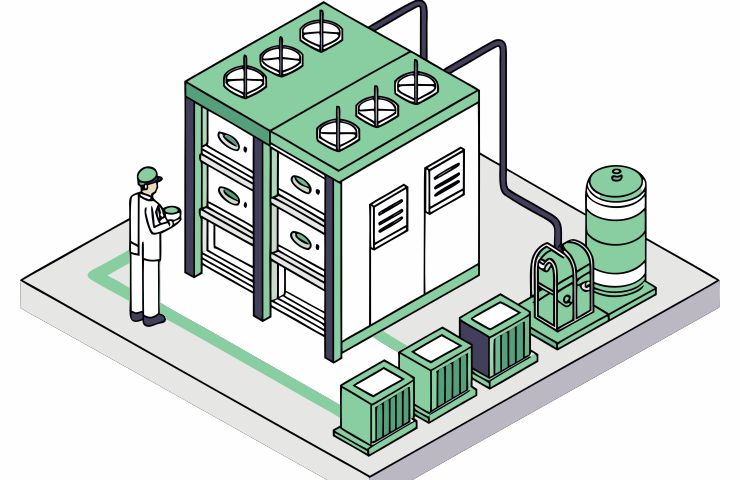
According to the U.S. Department of Energy, PEM fuel cells convert hydrogen’s chemical energy into electricity by splitting hydrogen molecules into protons and electrons at the anode, sending electrons through an external circuit and recombining with oxygen at the cathode to form water and heat. Ballard’s HPUs store or receive hydrogen, feed it to integrated fuel-cell stacks and regulate the electrical output with power electronics, according to Ballard’s release. Unlike battery-only systems, HPUs can run as long as hydrogen is supplied.
The description highlights a core technical contrast between fuel-cell systems and batteries: duration. Where batteries are constrained by stored electrical energy, HPUs can sustain output as long as hydrogen fuel is available and fed to the stacks. Ballard’s documentation positions its HPUs as modular systems that pair hydrogen storage and fuel-cell stacks with the power electronics needed for grid or site integration.
Environmental and Market Context
Lifecycle emissions for PEM fuel-cell systems depend on the carbon intensity of hydrogen production, according to National Renewable Energy Laboratory research. When hydrogen is low-carbon, such systems can deliver electricity with substantially reduced greenhouse-gas emissions and without tailpipe carbon dioxide. Stationary HPUs may also lower local air pollution and noise relative to diesel generators, though the overall benefit depends on hydrogen sourcing, transport and leakage management.
That caveat is important. The environmental advantages Ballard and others cite presuppose low-carbon hydrogen along the full value chain. Sourcing, movement and storage can alter lifecycle emissions materially. The company’s environmental case therefore rests not only on the fuel cell stack itself, but on decisions made upstream and downstream in the hydrogen supply chain.
Forward-Looking Statements and Execution Risks
Ballard’s Form 6-K filing warns that these targets are forward-looking statements subject to risks including economic conditions, regulatory changes, third-party dependencies, market demand and execution challenges. The filing emphasizes that adjusted EBITDA is a non-GAAP measure that excludes interest, taxes, depreciation and amortization, and that it does not represent net income or free cash flow.
The filing reads as a checklist of uncertainties. Economic cycles could depress demand. Regulations could change the economics of hydrogen or fuel cells. Reliance on third parties for financing, hydrogen supply or service could complicate rollout. And, as the company explicitly notes, adjusted EBITDA is an accounting construct that does not equate to reported net income or the cash available to the business.
Potential Impact and Outlook
If realized, the plan could mark a shift in Ballard’s positioning from a component supplier toward an integrated hydrogen services provider. Achieving adjusted EBITDA profitability and revenue-growth targets will depend on commercial acceptance of PEM fuel-cell modules and HPUs, financing arrangements, fleet utilization rates and continued improvements in manufacturing and supply-chain costs, according to Ballard’s release. Investors and industry watchers will be watching execution closely to see whether the company can translate its targets into reported results.
The company has laid out a clear set of milestones and the financing approach it believes will support them. Yet many variables remain outside Ballard’s direct control. Market uptake of HPUs and Energy-as-a-Service offerings, the availability and price of low-carbon hydrogen, and the terms of asset-backed financing at greater than 80 percent loan-to-value will all influence outcomes.
Short-term, the targets provide stakeholders with a timetable: adjusted EBITDA profitability by the end of 2027 and sustained full-year adjusted EBITDA profitability in 2028. Longer-term, the shift toward bundled equipment, services and Energy-as-a-Service positions Ballard to seek recurring revenue streams, while exposing the company to the operational and financing complexities that come with such a model.
For now, the announcement frames a strategy. Execution will determine whether those framed expectations become reported performance.