From Forest Residuals to Hydrogen and Compute: LCH2 Advances a 150-Acre Washington Energy Campus
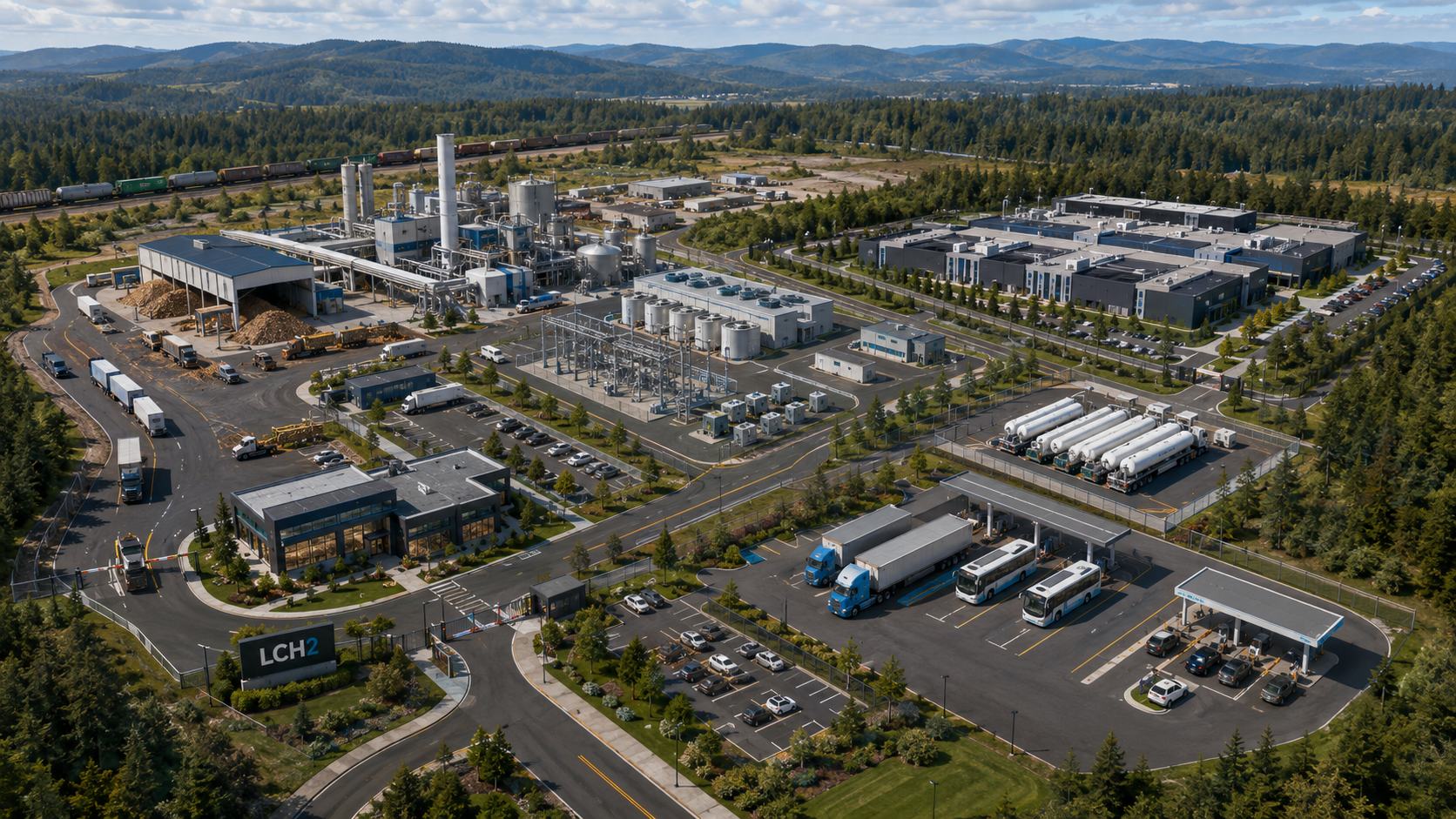
Hydrogen projects are often developed one asset at a time: build a production unit, then look for feedstock, customers, power and logistics. The Lewis County Hydrogen Alliance is taking the opposite approach. LCH2 is advancing a complete industrial campus where the value chain is designed as one system—from the forestry residual arriving at the gate to the hydrogen vehicle, industrial customer, carbon-product buyer and data-center server that ultimately uses the output.
At full buildout, LCH2’s current planning envelope calls for approximately 1,000 tonnes per day of biomass processing, about 100 tonnes per day of fuel-grade hydrogen production, carbon capture and productization, dispatchable clean-power generation and behind-the-meter electricity for a self-sufficient 50 MW Advanced Compute Complex. Organized across approximately 150 acres, the campus is intended to operate as a new regional energy and industrial ecosystem, not simply a stand-alone hydrogen plant.
“Lewis County has the forest resources, the energy-transition need and the industrial know-how to become a national proving ground for clean hydrogen from forest residuals,” said Ken Cavallon, Executive Director of LCH2.
One campus, five connected systems
The plan of record begins with feedstock processing and management. Regional forestry residuals and mill byproducts would be received, stored, prepared and quality-managed to give the conversion plant a dependable, specification-controlled input. Building that capability on site is essential to operating at industrial scale and to creating a durable market for material that is frequently underutilized.
The second system produces, purifies, compresses and stores fuel-grade hydrogen. The campus is being designed to serve mobility customers through on-site dispensing and bulk distribution, while also supplying industrial users that need a reliable regional source of hydrogen.
The third system captures the carbon stream created during conversion and turns it into products. Depending on customer specifications and market demand, pathways can include conditioned or liquefied carbon dioxide, mineralized carbonates and other carbon-based products. Treating carbon as a product platform rather than a disposal stream adds market flexibility and strengthens the project’s economic foundation.
The fourth system converts hydrogen into dispatchable clean power. Fuel-cell generation can support campus operations, hydrogen production infrastructure and critical loads around the clock. The fifth system uses that power behind the meter for a next-generation 50 MW Advanced Compute Complex, creating an anchor customer inside the campus and a direct connection between local biomass resources and high-value digital infrastructure. The data-center power island is being designed for self-sufficient operation, with reliability, redundancy and fuel inventory organized around critical-load requirements.
This integration is the central business strategy. Shared land, utilities, logistics and controls reduce friction between the individual assets. Hydrogen becomes both a saleable fuel and an energy carrier. Captured carbon becomes a marketable material. Clean electricity becomes an on-site service. The Advanced Compute Complex converts dependable power into a long-duration, high-value load. Together, the campus is designed to create revenue from molecules, materials, electrons and compute.
Lewis County brings the resource—and the purpose
Lewis County offers a strong foundation for this model. Its woody-biomass supply basin holds an AA Bioeconomy Development Opportunity Zone rating, with the assessment identifying approximately 600,000 bone-dry tons per year of pulpwood, forest residuals and sawmill residuals within a 75-mile drive zone centered on Centralia as available at low supply-chain risk.
That resource base sits within a community with a deep forestry workforce, industrial operating experience and a long history of energy production. A new, higher-value market for residuals can improve the economics of forest management, support rural suppliers and retain more value in the region. It also gives Lewis County a practical way to connect forest health, wildfire-risk reduction, clean fuel and economic development.
Hydrogen mobility is already part of the regional operating landscape. Lewis County Transit and Intercity Transit have demonstrated hydrogen mass-transit use in the Pacific Northwest, while the LCH2 team brings experience in bus fueling, safe storage and dispensing. That creates a practical starting market for local production and a foundation for freight, municipal and industrial adoption along the I-5 corridor.
The project is equally aligned with the purpose of the Centralia Coal Transition Grants program: helping the community build the durable energy economy that follows coal-fired generation. LCH2’s grant application projects that the full campus could support 140 to 220 direct ongoing jobs and 250 to 500 indirect or supported jobs, in addition to a substantial construction workforce. Those positions span plant operations, maintenance, controls, utilities, feedstock logistics, carbon handling, security, data-center operations and regional service businesses.
Technology centered on hydrogen and carbon value
Ways2H is providing the thermochemical conversion technology and engineering basis for the project. Its RefHynery platform uses steam-enhanced thermochemical conversion in an oxygen-free environment rather than directly burning the feedstock. The resulting gases are conditioned and reacted with steam to maximize hydrogen recovery. A portion of the produced hydrogen can supply process heat and steam, while the remaining hydrogen is purified for mobility, industrial and power applications.
The architecture also creates a concentrated carbon stream that can be separated and directed into the campus’s carbon-product systems. That is a meaningful distinction from conventional combustion, where carbon is carried in a dilute flue-gas stream. For LCH2, hydrogen production and carbon capture are being engineered as two connected product pathways from the outset.
“This project is a powerful fit for the Ways2H platform because it focuses on a real local resource, a real clean-fuel need and a phased pathway to commercial deployment,” said Jean-Louis Kindler, Co-Founder and Director of Ways2H. “Our role is to help translate the technology into a practical, financeable system that can turn underused biomass into hydrogen fuel and carbon products.”
A development sequence built for scale
The Centralia Coal Transition Grants was established by Washington State and TransAlta to fund energy technologies with the potential to create environmental benefits for the state of Washington. Centralia Coal Transition Grants, acting through its Energy Technology Board, awarded LCH2 $400,000 for Gate A project assessment work under the alliance’s broader $3.9 million grant request. The 90-day work program brings together site diligence, feedstock and product logistics, process-flow-level concept engineering, permitting, commercialization and capital readiness in one coordinated package.
Gate A is designed to produce a board-ready development case: a preferred site and control strategy, a project-specific feedstock plan, a scalable process architecture, a permit roadmap, customer and offtake pathways, and a capital plan linked to the next phase of engineering.
Successful completion positions the project for the proposed $1 million Tranche 2, which is structured around finance-grade front-end engineering, permit submissions, vendor engagement, conditional supply and offtake instruments and a financing term sheet or commitment. The physical development sequence then moves from a one-tonne-per-day conversion research unit to a 30-tonne-per-day first commercial plant and ultimately to the 1,000-tonne-per-day integrated campus.
Each step is intended to generate the operating data, customer commitments and investor confidence required for the next. Just as important, the site plan, utility corridors, product logistics and commercial architecture are being developed to preserve the full hydrogen, carbon, power and data-center vision from the beginning. This is how LCH2 plans to convert an ambitious regional concept into a financeable build program.
Customers and partners can shape the campus now
LCH2 is the coordinating Washington nonprofit and grant recipient. The Devonshire Group is supporting delivery management, biomass supply-chain assessment and stakeholder coordination. Ways2H is providing technology and engineering support. HydrogenXT is leading project-development, commercialization, offtake strategy and customer integration. The project record is reinforced by support from the Economic Alliance of Lewis County, OXARC, Idaho National Laboratory’s Biomass Feedstock National User Facility and Forest Concepts.
For prospective customers, early engagement has direct design value. A transit or freight fleet’s daily fueling profile affects compression, storage and dispensing. An industrial buyer’s purity and delivery requirements shape hydrogen conditioning and logistics. A carbon buyer’s specification determines whether the preferred route is liquefaction, mineralization or another product pathway. A data-center operator’s uptime, redundancy and power-quality requirements define the behind-the-meter power island.
“The commercial opportunity is not just producing hydrogen; it is connecting clean hydrogen fuel to customers who can use it reliably and economically,” said Karl Tussy, Chief Customer Officer of HydrogenXT.
LCH2 is opening discussions with transit and freight fleets, industrial hydrogen users, industrial-gas and carbon-product buyers, forestry suppliers, data-center developers, fuel-cell and equipment providers, engineering and construction firms, workforce partners and project-capital providers. Those conversations can become the specifications, supply arrangements, offtake commitments and delivery partnerships that move the campus from engineering into construction.
A new energy platform for Lewis County
The LCH2 campus is designed to prove a larger proposition: a forest-resource community can convert underutilized residuals into a durable stack of clean-energy products and infrastructure. In Lewis County, that stack is fuel-grade hydrogen for mobility and industry, captured carbon products, dispatchable clean power and behind-the-meter electricity for a 50 MW next-generation Advanced Compute Complex.
The result would be more than a hydrogen plant. It would be a self-contained regional energy platform that strengthens the forest economy, creates family-wage jobs, attracts private investment and gives Lewis County a leading role in the next generation of American energy and digital infrastructure.
Local feedstock in. Hydrogen, carbon products, power and compute out. Long-term value retained in Lewis County.
ABOUT LCH2
Lewis County Hydrogen Alliance, Inc. is a Washington-based nonprofit promoting clean-energy development in Lewis County. LCH2 aligns public, private and nonprofit stakeholders around a regional hydrogen ecosystem that converts locally sourced forestry residuals into fuel-grade hydrogen, carbon products and dispatchable clean power.
Media contact: Ken Cavallon, Executive Director | [email protected] | lch2.org