Green Hydrogen Production Advances with 2.5 MW Electrolyzer Launch in Navarra
Nordex Electrolyzers unveiled the NX2500, a 2.5 MW pressurized alkaline electrolyzer fully designed and tested in Navarra, marking a domestic manufacturing milestone in green hydrogen production.
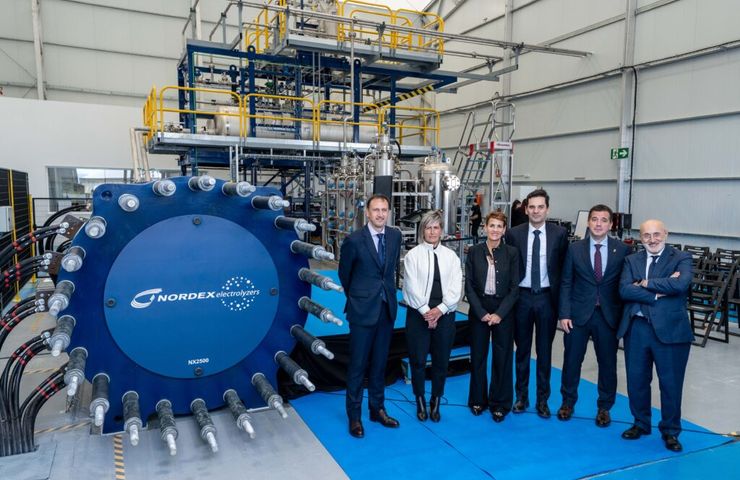
This month at its Lumbier testing facility in Navarra, Nordex Electrolyzers introduced the NX2500, a 2.5 MW pressurized alkaline electrolyzer intended to convert variable wind and solar power into green hydrogen. The company indicates the system can produce more than 45 kg of hydrogen per hour at 15–18 bar gauge while targeting stack-level energy consumption below 50 kWh per kilogram of hydrogen (according to Nordex Electrolyzers). The announcement frames the NX2500 as a device for closer integration with fluctuating renewable generation. It is a step from laboratory validation toward utility-scale use.
A 2.5 MW Pressurized Alkaline Electrolyzer for Renewable Integration
The NX2500 employs pressurized alkaline electrolysis cells that use an alkaline conductive medium and separate electrodes. By operating at up to 18 bar gauge, the design aims to reduce downstream compression energy. Power electronics and advanced controls allow dynamic load following of fluctuating renewable electricity inputs. According to Nordex Electrolyzers, detailed stack metrics include 4.5 kWh per normal cubic metre at the cell level and automated water treatment and recovery systems to optimize performance. The package therefore covers not only the cells but also balance-of-plant features intended to support continuous operation under variable power.
From Pilot Stacks to Megawatt-Scale Systems
Development moved through a clear progression: a 50 kW stack prototype, then a 500 kW pressurized system, and now the NX2500. Nordex Electrolyzers reports that iterative testing phases have refined safety interlocks, remote monitoring and modular assembly processes at its Lumbier facility, laying the foundation for industrial-scale manufacturing. Tests informed both mechanical assembly and software control logic. The result is a design that the company considers ready for factory validation and serial production trials.
The Lumbier Testing Facility: A Regional Innovation Hub
Located in the Polígono Industrial Venta de Judas near the Irati and Salazar rivers, the Lumbier facility supports assembly, commissioning and long-term trials. Lumbier is home to 1,330 inhabitants (regional local-entities database) and provides local engineering talent for cell stacking, balance-of-plant integration and control software. The site previously hosted the 500 kW prototype used in the H2OP demonstration and now serves as the validation center for the 2.5 MW unit (according to Nordex Electrolyzers). In short, the facility combines local workforce capacity with on-site trial capability.
Regional Manufacturing and Supply-Chain Synergies
Final assembly and component fabrication occur at the Barasoain manufacturing location, which also houses the company’s headquarters (according to Nordex Electrolyzers). By concentrating design, assembly and testing within Navarra, the venture aims to retain engineering value locally and support regional suppliers of electrodes, separators and power electronics, in line with European objectives for strategic energy technology supply chains. That concentration is intended to shorten feedback loops between R&D and production while keeping critical value chain steps in the region.
Public-Private Partnerships Accelerating Technology
The project is a joint venture: Nordex Group holds 85 percent and Sodena, the public investment arm of the Government of Navarra, holds 15 percent (according to Nordex Group). It also received €12 million from the IPCEI Hy2Tech programme to support scale-up of strategic hydrogen technologies (European Union IPCEI Hy2Tech programme). Regional officials, including Navarra’s presidency and industry ministry, have endorsed the initiative as part of the region’s energy-transition agenda. That blend of private capital and public backing is presented as a way to move technologies from pilot to production more quickly.
Strategic Impact on Spain’s Hydrogen Roadmap
Navarra has an ambition to deploy 150 MW of green hydrogen capacity by 2030 (Government of Navarra). Nationally, Spain’s roadmap initially targeted 4 GW of electrolyzer capacity by 2030, later revised to 12 GW in the integrated energy plan (Ministry for the Ecological Transition and the Demographic Challenge). The NX2500 adds locally manufactured nominal power to Spain’s pipeline and serves as an early indicator of domestic production capability. Whether this local capacity translates into rapid national deployment will depend on project finance and grid readiness.
Context within Spain’s National Hydrogen Strategy
Spain’s hydrogen roadmap, launched in 2020, framed renewable hydrogen as essential for decarbonization and industrial independence. Subsequent policy updates set ambitious electrolyzer targets that many projects have yet to reach final investment. The NX2500’s factory validation in Navarra provides a tangible milestone amid a broader push to bridge the gap between announcement and commercial operation. Still, the pathway from validation to widespread installation remains contested and contingent on market conditions.
Aligning with European Hydrogen Value Chain Initiatives
The €12 million IPCEI Hy2Tech support highlights the NX2500’s integration within Europe’s hydrogen value chain objectives (European Union IPCEI Hy2Tech programme). IPCEI funding seeks to accelerate the commercialization of electrolyzer technologies within Europe, diversifying supply and supporting strategic industrial capabilities. For manufacturers, that funding is intended to lower technological risk and create competitive domestic supply options across the continent.
Industrial Demonstrations and Early Adopters
In the H2OP project, a 500 kW predecessor electrolyzer supplies renewable hydrogen to an industrial boiler at a food-processing site, integrating water treatment, compression and utility systems (according to Nordex Electrolyzers). Data from that trial informed design improvements for process integration and hydrogen conditioning ahead of the NX2500 rollout. The H2OP example illustrates how on-site use cases can shape equipment specifications and operational procedures before scaling to megawatt-class units.
Workforce Development and Economic Impact
While exact employment numbers are not disclosed, Nordex Group highlights creation of skilled roles in electrochemical engineering, power electronics and operational maintenance. Regional statements indicate the initiative supports an advanced manufacturing cluster in Navarra, promoting research-to-production linkages and attracting technical talent. If the program scales, those workforce effects could broaden to include supply-chain firms and service providers tied to electrolyzer operations.
Navigating Technical and Regulatory Hurdles
Deploying megawatt-scale electrolyzers requires securing grid connection, environmental permits and compliance with hydrogen safety regulations. Operators must manage feedwater quality, recovery streams and renewable electricity sourcing while obtaining guarantees of origin for green hydrogen. Independent analyses cite electricity cost, permitting delays and offtake certainty as key barriers (McKinsey & Company). Overcoming those hurdles will be essential before clusters of NX2500 units can be linked into larger projects.
Future Roadmap: From Prototype to Commercial Scale
Nordex Electrolyzers indicates ongoing development of 5 MW and 10 MW module designs, with plans to parallelize NX2500 units into larger clusters of up to 10 MW nominal capacity (according to Nordex Electrolyzers). Success will depend on securing customer contracts, additional capital and grid infrastructure enhancements. The company frames these next steps as conditional: technical progress alone will not suffice without supporting market and network investments.
Conclusion: A Manufacturing Milestone, Not a Final Destination
The NX2500 launch in Navarra marks a manufacturing and validation milestone for Spain’s renewable hydrogen sector. It demonstrates domestic capability to produce megawatt-class electrolyzers, yet its broader impact on decarbonization and energy security will unfold only if the technology achieves reliable field performance, competitive costs and sufficient market uptake. As Nordex Electrolyzers and regional partners pursue larger systems, this 2.5 MW unit offers a tangible glimpse into the future of green hydrogen production.