High-Entropy Self-Rebuilding Electrode Enhances Green Hydrogen Production in AEM Electrolyzers
Researchers have designed a self-rebuilding high-entropy electrode that transforms its surface into an active oxyhydroxide under OER conditions, sustaining high currents in AEM electrolyzers and advancing durable green hydrogen production.
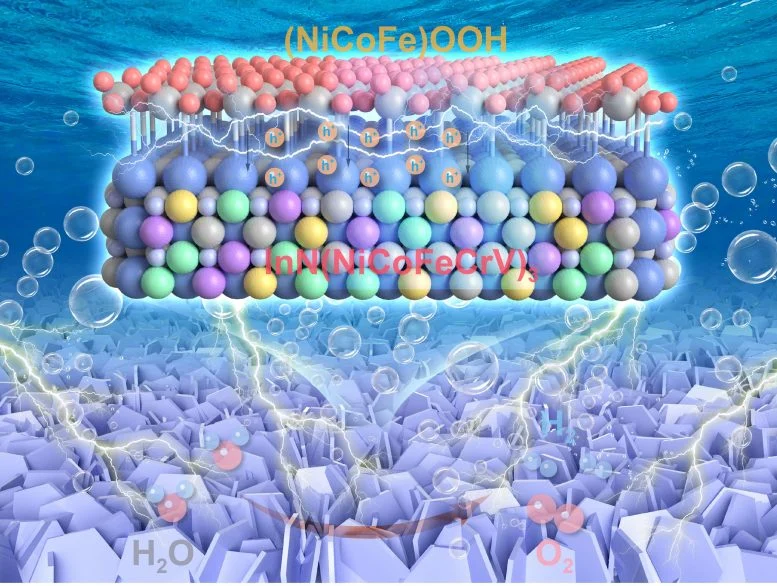
Researchers at the Chinese Academy of Sciences have made a significant leap in the world of green hydrogen production. They’ve developed a self-rebuilding high-entropy antiperovskite oxygen-evolution electrode crafted on porous nickel foam. This innovative electrode can maintain industrially relevant current densities in anion exchange membrane (AEM) electrolyzers for hundreds of hours with just minor performance dips. What sets this apart is how it intentionally uses surface reconstruction instead of merely trying to prevent it, changing the game for hydrogen production.
The project is spearheaded by Guowen Meng and Bin Chen at the Institute of Solid State Physics in Hefei, and their findings are published in ACS Nano. By engineering a lattice made up of five metals, the team allows it to undergo a controlled transformation under oxygen evolution reaction (OER) conditions. This creates an active oxyhydroxide phase on the outer layer, improving charge transfer and enhancing catalytic performance over extended periods.
Diving Deeper into the Mechanism
High-entropy materials are fascinating because they bring together multiple principal elements within a single crystal framework. This results in a dynamic playground of metastable atoms and defects. In this case, certain metal components dissolve when exposed to the intense anodic potentials during the oxygen evolution reaction. This sets off the formation of a conformal oxyhydroxide layer that interacts electronically with the underlying antiperovskite, creating a Mott–Schottky junction. This junction not only speeds up electron transfer but also lowers the energy barriers for OER.
Instead of allowing normal corrosion to take its toll, the electrode design harnesses a nifty process called defect-driven surface reconstruction as a self-replenishing method. The porous nickel foam keeps conductivity high and ensures there's plenty of surface area for reaction. As the less stable elements leach out, the more active species gather at the interface, essentially optimizing the catalyst’s outer layer through a cycle of controlled dissolution, diffusion, and redeposition.
Designing the High-Entropy Antiperovskite
The electrode’s design features a nitrogen-centered cubic lattice, with a random mix of five transition metals—nickel, cobalt, iron, chromium, and vanadium—at the metal sublattice. High-entropy mixing helps maintain a single-phase crystal, allows for lattice distortion, and fosters lots of defects. These traits are key for the controlled leaching of less stable elements, paving the way for dynamic surface restructuring. By tweaking the starting composition and defect levels, researchers can program the active oxyhydroxide layer to evolve during operation, making it a solid method for hydrogen production.
Setting New Records for Stability
This study shows the electrode can reach an overpotential of about 279 mV at 100 mA/cm² in an alkaline electrolyte and keeps stable performance for over 500 hours. When integrated within an AEM electrolyzer, it holds up at 500 mA/cm² at around 1.662 V for more than 400 hours without a significant voltage rise. Those numbers blow past the usual stability tests for advanced transition-metal OER catalysts, which typically only last a few hundred hours.
What This Means for Hydrogen Production
The longevity of OER electrodes directly impacts the levelized cost of hydrogen. When catalysts have to be replaced frequently or when overpotentials rise, it can really hurt electrolyzer efficiency and push up operational costs. By cleverly designing an electrode that gets stronger during use, this new method offers hope for reducing downtime, extending the life of stacks, and cutting both capital and operational expenses.
Looking towards future growth in global green hydrogen production, the focus remains on scalable and cost-effective solutions. Many international studies point out that costs and durability of catalysts are significant hurdles. By moving away from rare noble metals and leaning towards these dynamically self-rebuilding systems made from more abundant metals, we could drive down material costs and lessen supply chain risks.
Advances in Self-Healing Electrocatalysts
Self-healing and self-replenishing catalysts are becoming increasingly promising in addressing the durability challenges faced by OER electrodes. In previous studies, researchers have shown that using Ni-rich stainless-steel meshes could regenerate a catalytic layer through selective dissolution of iron and redeposition of nickel. Similarly, there's evidence that trace amounts of iron in alkaline electrolytes can reattach to nickel substrates, maintaining an active Ni–Fe oxyhydroxide film for over 1,000 hours. The combination of high-entropy mixing, defect engineering, and controlled reconstruction is creating exciting new avenues in clean hydrogen news.
Integrating Electrolyzers for Real-World Use
To fully utilize these self-rebuilding electrodes in commercial setups, system designers will need to adjust module designs to accommodate for dynamic surface changes. Flow fields and gas separators will need to manage these changes in porosity and evolving surface chemistry, all while preventing issues like membrane fouling or gas crossover. Balancing plant operations, like electrolyte management and pH regulation, will be crucial for maintaining a steady rate of surface regeneration and ensuring the material properties stay consistent.
Impact on Hydrogen Infrastructure
The introduction of electrodes that improve with use could have a major effect on deploying hydrogen refueling stations and ammonia synthesis hubs, lowering the lifecycle costs of electrolyzer operations. Consistent high-current performance also means reduced electricity needs per kilogram of hydrogen, making it easier to integrate into the grid and smoothing out high-demand peaks. As renewable energy sources expand, the reliability of electrolyzers operating efficiently under these variable conditions will depend heavily on strong catalysts. Self-rebuilding electrodes seem to align perfectly with ongoing efforts to establish a robust hydrogen infrastructure for both industry and transport.
Challenges Ahead and the Path Forward
Taking lab-scale achievements and scaling them for commercial electrolyzers involves a lot of work to ensure uniform electrode deposition over larger areas, fine-tuning the electrolyte chemistry, and validating the performance over tens of thousands of hours. Future studies will delve into finding the ideal composition ratios to maximize regeneration of the active layer, the role individual metal dopants play in tuning Mott–Schottky interfaces, and how these fit with various membrane chemistries. Collaborative pilot programs will be key in gathering reliable performance data.
The Future Looks Bright
Developing catalysts designed to evolve in situ marks a significant shift in the landscape of hydrogen energy news. If these self-rebuilding electrodes work out at scale, they could expedite the rollout of zero-emission hydrogen systems, support industrial decarbonization efforts, and drive down costs for hydrogen-powered vehicles, data centers, and ammonia production facilities.