Hydrogen Fuel Cell News: Monash’s Water-Free Membrane Hits 250°C
Monash University’s water-free fuel cell membrane runs at 250°C with 166 mS/cm conductivity and 1,011 mW/cm² power, promising simpler, higher-temperature hydrogen systems if it scales.

Hydrogen fuel cell just got a major upgrade! At Monash University in Melbourne, researchers have tackled one of the age-old challenges of PEM fuel cells—dehydration. They've engineered this incredible proton-conducting membrane that can run completely dry at a scorching 250°C (482°F). Say goodbye to humidifiers and complex water loops; this ultrathin composite offers a proton conductivity of 166 mS/cm and tops out at a whopping 1,011 mW/cm² in single-cell tests, all while operating in completely dry conditions.
Core breakthroughs and what they mean
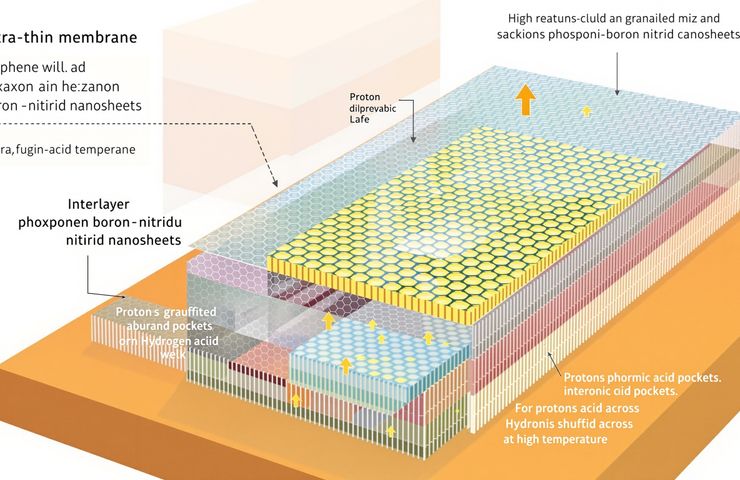
The brilliant minds behind this leap, led by Professor Huanting Wang and postdoctoral researcher Kaiqiang He, stacked up layers of graphene and hexagonal boron nitride to create some nifty two-dimensional nanochannels. They trapped phosphoric acid molecules in these micro chambers. When cranked up to 250°C, the acid chills in its cozy spot, protons slide along the channel walls, and electrons flow through the external circuit—essentially creating water vapor without needing any liquid water to keep the membrane alive.
Internal testing also points to impressive long-term stability. Operating continuously at 250°C, it held steady at 400 mA/cm² for 150 hours with only a tiny bit of acid loss—way better than typical commercial PBI/PA options. And in a separate trial for H₂/CO₂ separation, it showed nearly 100% hydrogen selectivity. This could hint at built-in hydrogen separation and purification capabilities.
So, what does this all mean? Traditional PFSA membranes, like Nafion, kick the bucket above 90°C without hydration, meaning you're stuck with expensive water-management systems and limited operating windows. But with a water-free membrane working at 250°C, you cut down system complexity, boost tolerance to impurities—like CO in reformate—and pave the way for fuel-flexible stacks that can handle hydrogen, methanol, or reformed hydrocarbons right where needed.
How does it work?
Most fuel cells rely on good old hydrated ionic clusters in polymers like Nafion, but when the heat goes up, the water evaporates. Not this Monash membrane! By layering graphene and h-BN alternately, the team created gas-tight, super durable channels. They infused these 2D pathways with phosphoric acid, which refuses to boil off, even at high temperatures thanks to nanoconfinement.
Protons can make their way through this maze via a nifty “proton-shuttling” mechanism—they glide along crystal surfaces and hop between acid sites in a relay race. This clever setup decouples proton transport from bulk water, locking in a conductivity of 166 mS/cm at 250°C. Lab tests showed it hitting 1,011 mW/cm² in a single H₂/O₂ cell, while long-duration runs demonstrated stable currents for 150 hours at 400 mA/cm²—three times longer than the usual PBI/PA membrane. Talk about a game-changer!
Strategic stakes and business angles
From a systems standpoint, ditching those humidifiers and water loops means getting rid of a massive chunk of capital costs, slashing maintenance, and cutting down on failure points. Think about it—this could be a total game-changer for heavy-duty applications. Whether it's mining trucks in scorching deserts, backup generators in dry regions, or stationary power in off-grid setups, this membrane can tolerate CO, allowing you to use reformate from natural gas or methanol without messing up the catalyst.
Plus, simplifying the engineering sets the stage for integrated heat recovery. When at 250°C, the waste heat is actually usable, ramping up overall efficiency for combined heat-and-power setups. Investors and policymakers are definitely keeping an eye on this. Hydrogen infrastructure projects are heavily dependent on the footprint and upkeep of refueling stations; a high-temp, water-free membrane can minimize risks by cutting out extra equipment. For hydrogen cars and heavy-duty trucks, fewer moving parts usually mean less downtime and leaner operating budgets.
Back to basics—why conventional PEMs fall short
The standard low-temperature PEM fuel cells usually operate between 50–90°C and require constant humidification to remain conductive. Push it beyond that threshold, and the polymer starts to dry out, losing conductivity, and can even crack. This leads to a lot of extra baggage with humidifiers, recirculation loops, and all kinds of sensors and pumps, which just adds complexity and weight.
On the other hand, these high-temperature PEMFCs based on PBI doped with phosphoric acid can hit around 150–200°C but often compromise on density and deal with acid leaching over time. What Monash is doing, however, is pushing that envelope to 250°C while still delivering performance under totally dry conditions, effectively sidestepping both dehydration and acid loss. It’s a new benchmark for what a PEMFC membrane can withstand.
Testing and scale-up hurdles
As impressive as the lab results are, we’re still dealing with single-cell proofs-of-concept. The full-stack assemblies could introduce some challenges: making sure that nanosheet layering is uniform, ensuring acid retention over larger areas, keeping the mechanical integrity under heat cycles, and refining manufacturing processes. Plus, creating high-purity graphene and h-BN has its own costs, and finding economical roll-to-roll deposition with nanometer precision remains a pretty hefty hurdle.
There’s some buzz in the industry about potential pilot builds, including trials for mining trucks later this year, but nothing’s set in stone from Monash or big OEMs just yet. Until we see these commercial stacks withstand the rigors of real-world usage over an extended time, it’s only fair to remain cautiously optimistic.
From Gemini to graphene
PEM technology kicked off in the 1960s with Grubb–Niedrach membranes used on NASA’s Gemini missions and took off with Nafion in the ’80s. Then came high-temp variants that used PBI/PA, but they remained in niche markets. What Monash is introducing builds on those past concepts but takes it up another notch: they’ve pushed the temperature another 50°C while enhancing both conductivity and power density. This could totally set the stage for the next wave in hydrogen energy news.
Policy and market momentum
With global strategies aiming for industrial decarbonization and zero-emission transport, there’s a surge in large-scale investments in clean hydrogen news. Governments are getting behind hydrogen hubs and refueling stations, which stokes the demand for solid, high-temperature fuel cell technology that doesn’t need water management. A reliable dry membrane simplifies station design and cuts down on leak risks—super vital for areas that are remote or face harsh conditions.
Fuel cell OEMs and energy firms realize that membrane performance and durability are key factors for adoption. If Monash’s membrane scales successfully and proves its durability, we could see a serious shift toward hydrogen vehicles in sectors where battery electrics struggle, like heavy hauling in deserts or continuous processes in industries.
Final take
Monash’s dry 250°C membrane isn’t just hype—it offers a real glimpse into the future of PEMFCs, liberated from the constraints of water. The real challenge ahead will be scaling up production, proving long-term reliability, and driving costs down to where industries can afford it. If they hit those goals, the hydrogen economy might just find its perfect jetpack, sending hydrogen vehicles soaring past the limits that have kept them grounded for so long.