News
Breakthrough in Protonic Ceramic Fuel Cells Enhances Hydrogen Fuel Cell Technology Efficiency
Breakthrough cathode co-doping boosts protonic ceramic fuel cell performance by 30%, paving the way for more durable, CO2-resistant hydrogen systems—Adaptive Energy moves to commercialize.
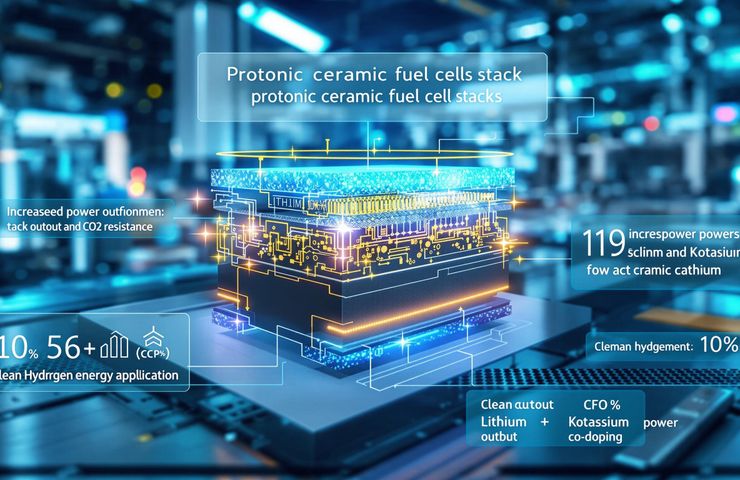
New BCFZYLK Cathode Pushes Forward Fuel Cell Performance at 600°C
A research team led by Kim et al. has pulled off something impressive in the world of hydrogen fuel cells. They've come up with a smarter, tougher cathode material that gives Protonic Ceramic Fuel Cells (PCFCs) a serious performance lift—especially in the kind of real-world conditions these fuel cells need to thrive in.What’s New: Smarter Chemistry for Real-World Performance
Here’s the deal: the team started with BCFZY (that’s BaCo0.4Fe0.4Zr0.1Y0.1O3−δ, for the science fans), a solid performer in fuel cell materials. Then they added a clever twist—introducing lithium (Li+) and potassium (K+) into the mix through a technique called in situ selective phase segregation. What happens next is pretty slick. The smaller lithium ions naturally migrate to the surface, forming a protective layer that shrugs off CO2. Meanwhile, the heavier potassium ions stay tucked inside, helping boost proton conductivity and keeping the material hydrated. The result? A whopping 30% increase in power output and a 5x improvement in resistance to CO2 exposure. In plain terms, these fuel cells aren’t just stronger—they’re more reliable in harsh environments.Why It Matters: Better Fuel Cells, Bigger Possibilities
Unlike their high-temp cousins, solid oxide fuel cells (SOFCs), PCFCs work below 600°C. That means faster startups, less wear and tear, and more options for mobile or off-grid uses. But until now, they’ve had sluggish cathodes that couldn’t really handle CO2 well—limiting their real-world potential. This new material tackles both of those issues head-on. The payoff? Fuel cells that last longer, breathe easier in ambient air, and handle a wider range of fuels. In other words, they’re better equipped to help build a truly sustainable hydrogen infrastructure.Commercial Angle: Adaptive Energy Joins the Game
With these advances, companies like Adaptive Energy (AE) are stepping up. AE has deep roots in solid oxide fuel cell tech, especially in military-grade systems. Now they’re teaming up with researchers at the Colorado School of Mines to take this new cathode chemistry out of the lab and into the real world. They’re building portable, propane-friendly PCFC stacks designed for tough environments—think remote power or defense missions. And they’re not alone: this kind of academic-industry collaboration is popping up more and more, showing just how quickly innovation is turning into usable tech.Market Impact: PCFCs Gaining Serious Momentum
The market’s starting to take notice too. Projections say the PCFC market could skyrocket to over $500 million by 2032, jumping from just $137 million in 2025. That’s more than 20% annual growth—which says a lot about investor confidence in this tech. Of course, challenges remain—building out full-scale hydrogen infrastructure and bringing down costs are big ones. But the industry vibe is shifting, and fast. Innovations like these are bringing us closer to the ultimate goal: cleaner, more efficient, zero-emission technology that scales.Future Outlook: Materials Science Making Hydrogen Happen
At the end of the day, breakthroughs like BCFZYLK aren’t just about better chemistry—they could reshape the future of sustainable energy. If this new design approach gains traction, it might raise the bar on what protonic ceramic fuel cells can do—making them more durable, more versatile, and much more attractive for real-world use. As one energy insider might put it, “This is the kind of leap the hydrogen economy's been waiting for.” When you can solve technical hiccups with smart materials design, the ripple effects across performance, reliability, and commercial usability are huge. Bottom line? If more researchers and companies follow this lead, we might not be far from seeing these once-experimental fuel cells becoming a staple in our clean energy future.Looking Ahead
For anyone keeping tabs on hydrogen fuel cells or the broader sustainable energy landscape, this is a clear signal: progress is revving up. And while hydrogen may be the fuel of the future, it’s the cutting-edge material work happening now that’s going to get us there.How was this article?
Thanks for the feedback!