NewHydrogen Unveils ThermoLoop–SMR Integration for Industrial Hydrogen Production
NewHydrogen plans to integrate its ThermoLoop thermochemical process with SMR heat to produce industrial-scale green hydrogen, leveraging an MOU with NuCube's NuSun microreactor and decades of nuclear-hydrogen research.
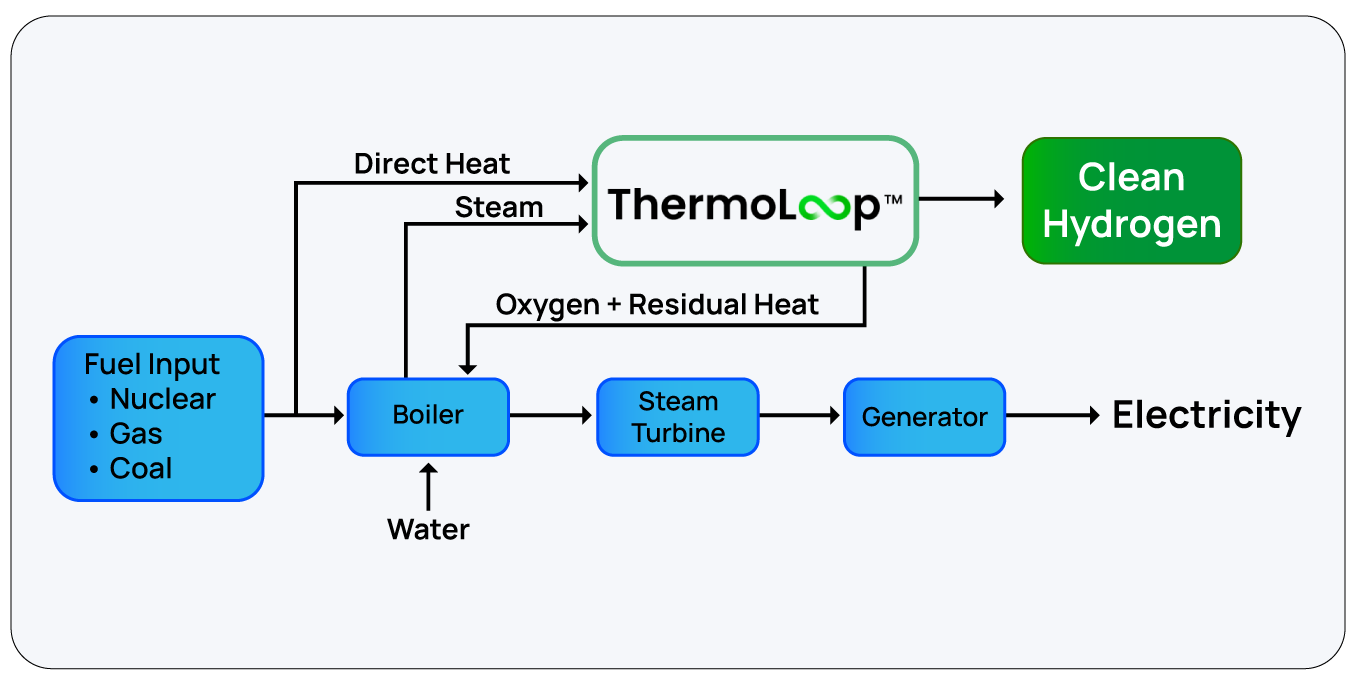
NewHydrogen, Inc., a Santa Clarita, California–based clean energy developer, announced plans to pair its proprietary ThermoLoop thermochemical water-splitting technology with high-temperature heat from small modular reactors and advanced microreactors. This clean hydrogen news marks an effort to drive industrial-scale green hydrogen production while sidestepping the electrical demands of conventional electrolyzers.
Company Background and R&D
Originally founded as BioSolar Labs in 2006, the company rebranded to NewHydrogen in 2021 to pivot from solar components to thermochemical hydrogen technologies. Headquartered in Santa Clarita, California, and trading publicly on the OTCQB market under the ticker NEWH, it remains an early-stage developer with a lean team of roughly two employees. Its core R&D program, established with the University of California, Santa Barbara, has yielded joint patent applications covering advanced solid-state materials and looping methods for ThermoLoop. Bench-scale demonstrations are ongoing to explore material durability, reaction kinetics, and isothermal process control.
ThermoLoop: Thermochemical Hydrogen Production
The heart of the company’s approach is ThermoLoop, a proprietary thermochemical cycle that uses cheap heat and water rather than electricity to split water into hydrogen and oxygen. In practice, a solid looping material is heated to high temperatures, reacts with steam to release hydrogen, then undergoes regeneration under different conditions to restore its original chemical state. NewHydrogen indicates that, by utilizing direct heat inputs—whether from industrial waste streams, concentrated solar, geothermal sources, or nuclear reactors—the process could bypass conversion and efficiency losses associated with first generating electricity then running electrolyzers. While detailed energy balance data remain confidential, the company targets significantly lower levelized costs of hydrogen if ThermoLoop scales successfully.
Small Modular Reactors and the NuSun Microreactor
Small modular reactors (SMRs) are compact fission plants designed for factory fabrication, modular siting, and high capacity-factor output. In April 2026, NewHydrogen announced an MOU with NuCube Energy, Inc. to explore integration with its NuSun solid-state microreactor, which is intended to deliver heat at temperatures up to roughly 1,100°C. Such heat profiles align well with high-temperature thermochemical cycles. The collaboration aims to develop thermal interface designs, isolate nuclear and chemical systems for safety, and validate continuous operation of the combined plant under realistic loading conditions.
Strategic Collaboration and Technical Scenarios
Under the memorandum, both firms will conduct joint feasibility studies, performance assessments, and explore potential commercial applications. NewHydrogen has shared illustrative scenarios—assuming around 50% thermochemical loop efficiency—indicating that a 50 MW SMR could, in theory, produce about 54 metric tons of hydrogen per day. These example figures serve to highlight potential throughput but have not been independently verified and depend heavily on operational assumptions. The companies emphasize that auxiliary systems such as controls, compression, and gas purification will require electrical inputs, meaning ThermoLoop does not completely eliminate electricity use.
Historical Context of Nuclear-to-Hydrogen Research
Coupling nuclear heat with hydrogen production dates back decades, with early government programs investigating both electrolysis and thermochemical cycles. In the United States, the Next Generation Nuclear Plant initiative of the mid-2000s explored high-temperature gas-cooled reactors for hydrogen. International efforts—such as Japan’s HTTR and Germany’s exploratory loops—have also piloted various thermochemical processes. More recently, Department of Energy-backed demonstrations at existing light-water reactors and European Euratom research programs are evaluating integrated nuclear cogeneration of heat, electricity, and hydrogen. Yet no large-scale, commercial nuclear-hydrogen plant has been deployed; most efforts remain in the demonstration or early planning stages.
Policy and Regulatory Landscape
The concept aligns with growing interest in hydrogen hubs and decarbonization pathways, including U.S. DOE-backed initiatives that encourage nuclear-hydrogen demonstration projects. However, siting new nuclear reactors—particularly in states like California—faces political and regulatory headwinds. Licensing frameworks for co-located nuclear and hydrogen facilities will need to address safety, security, and environmental impacts across both domains. Moreover, the cost competitiveness of SMRs remains under scrutiny amid budget overruns and project delays observed for existing nuclear technologies.
Environmental Considerations
Low-carbon hydrogen produced from nuclear heat could substantially reduce greenhouse gas emissions compared to steam methane reforming without carbon capture. However, the full environmental footprint depends on the upstream uranium fuel cycle, radioactive waste management, and water use for both reactor cooling and hydrogen production. Additionally, hydrogen leakage and end-use combustion emissions (including NOx) must be controlled to prevent unintended climate impacts despite the underlying low-carbon production pathway.
Market Implications and Investment Outlook
If ThermoLoop proves effective at scale, it could create new revenue streams for next-generation nuclear plants by co-producing hydrogen and electricity. NewHydrogen often cites external estimates projecting a multi-trillion-dollar hydrogen economy to contextualize growth aspirations. This dual-output model might help nuclear developers secure investment in advanced reactors in regions where electricity-only projects face stiff competition from renewables. On the hydrogen supply side, nuclear-driven thermochemical production could compete with renewable-electrolysis and fossil-based hydrogen with carbon capture, potentially reshaping supply dynamics in industries such as refining, ammonia, steel, and heavy transport.
Challenges and Future Directions
The ambitious plan faces technical, economic, and regulatory uncertainties. Independent techno-economic analyses are still needed to validate cost and efficiency claims. Material performance at high temperatures over long cycles remains to be proven at pilot scale. Meanwhile, licensing and public acceptance challenges for SMRs and microreactors add layers of complexity. Success will hinge on completing integrated pilot demonstrations, refining process controls, and securing clear policy support for nuclear-hydrogen cogeneration.
Conclusion
By integrating ThermoLoop with high-temperature nuclear heat sources, NewHydrogen, Inc. aims to pioneer an industrial-scale, baseload hydrogen production model. While the approach is grounded in decades of nuclear-hydrogen research, its commercial viability awaits demonstration. In the coming months, both NewHydrogen and NuCube plan to outline specific pilot projects, scale-up timelines, and preliminary engineering designs. Stakeholders will watch for demonstration results expected in late 2026 or beyond to gauge readiness for commercial deployment. As policy frameworks evolve and pilot projects advance, the industry will assess whether thermochemical looping powered by SMRs and microreactors can deliver on the promise of cost-effective, large-scale green hydrogen production.