Cryo-Adsorption with MOFs May Extend Liquid Hydrogen Storage to 221 Days
A UNIST-led team modeled that IRMOF-20 could extend vacuum-insulated liquid hydrogen storage from 64 to 221 days while retaining ~97% of volumetric capacity.
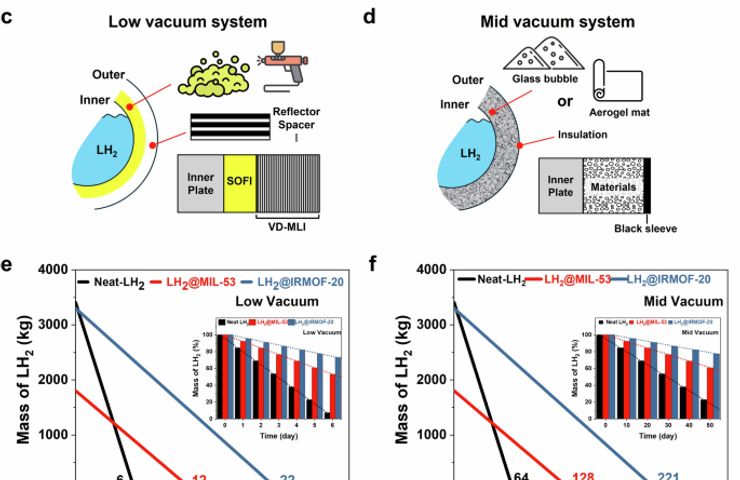
A research collaboration led by Ulsan National Institute of Science and Technology (UNIST) has modeled that integrating porous metal-organic frameworks within a cryogenic liquid hydrogen tank could slow boil-off and extend storage duration (according to an Institut Laue-Langevin news release). The modeling compares a conventional, vacuum-insulated tank holding neat liquid hydrogen with tanks that include a porous solid phase inside the cryogenic volume. Under the conditions the team set for their simulations, a vacuum-insulated tank of neat liquid hydrogen would deplete in about 64 days, while the same system with IRMOF-20 might last around 221 days under mid-vacuum insulation conditions (according to the same release).
Core Findings
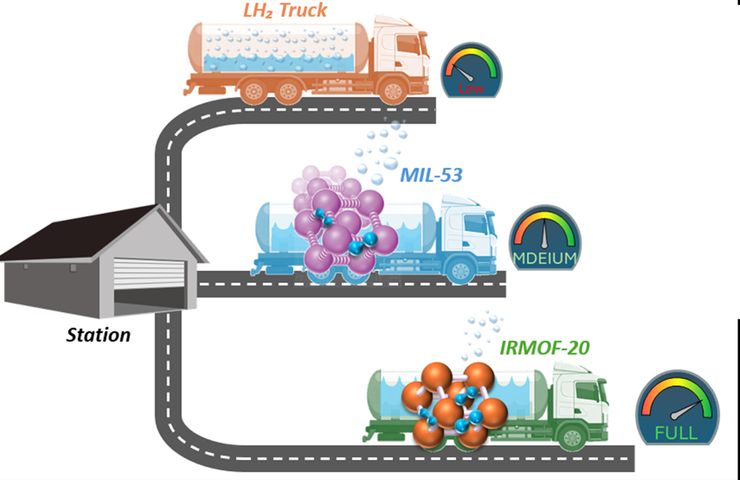
The team examined two metal-organic frameworks, IRMOF-20 and MIL-53(Al), and reported distinct trade-offs between retained density and temperature-dependent performance. After accounting for the framework’s solid volume, IRMOF-20 retained approximately 97% of the volumetric capacity of neat liquid hydrogen (according to the Institut Laue-Langevin release). That near-full volumetric retention suggests IRMOF-20 can densely pack adsorbed hydrogen while occupying only a small fraction of the tank volume. By contrast, MIL-53(Al) showed stronger hydrogen retention as temperature rose but offered only about 53% of the volumetric capacity (according to institutional reporting from Ewha Womans University). The result is a clear performance split: one material preserves liquid-like density, the other extends retention across a broader temperature window.
How Cryo-Adsorption Works
Heat ingress into a liquid hydrogen tank causes some of the liquid to evaporate. At cryogenic temperatures, however, hydrogen molecules can adsorb reversibly onto the internal surfaces of a MOF’s nanoscale pores. This adsorption temporarily stores vaporized hydrogen in a dense, adsorbed state and can delay the buildup of pressure and the onset of boil-off. As temperature continues to increase, the adsorbed hydrogen will desorb back into the vapor phase, so the MOF serves to complement rather than replace vacuum insulation and conventional thermal-management systems (according to the study announcement distributed through EurekAlert). In short: cryo-adsorption acts as a buffer. It holds hydrogen when temperatures tick upward and releases it when conditions change, reducing the immediate need for venting or reliquefaction.
Neutron-Scattering Insight
Microscopic evidence backed the macroscopic modeling. Inelastic neutron scattering measurements at the IN1-Lagrange instrument in Grenoble provided direct insight into how hydrogen interacts with the frameworks (according to the ILL release). Scientists from the Technical University of Munich and the Institut Laue-Langevin observed restricted rotational excitations of hydrogen inside the pores of IRMOF-20. Those spectroscopic signatures support the interpretation of dense hydrogen packing and delayed desorption that the team inferred from gas adsorption data. The neutron results therefore tie a measurable, atomic-scale interaction to the larger storage behavior predicted by the models.
Modeling vs. Demonstration
It is important to note that the 64-day and 221-day figures are outputs of the team’s models, produced under specified mid-vacuum insulation conditions and framed by the authors as an idealized upper bound (according to the ILL news release). No full-scale tank demonstration has been verified, and the work remains at the research and modeling stage rather than a commercial deployment. Models can point the way, but prototypes are required to test how real materials behave under repeated thermal cycling, mechanical stresses and handling conditions encountered in transport.
Strategic Context
Transporting liquid hydrogen currently demands frequent venting or periodic reliquefaction to manage boil-off losses. If the MOF-assisted cryo-adsorption approach is validated in hardware, it could reduce the frequency of venting, lower logistical burdens and improve flexibility for long-distance shipments (according to a 2024 technical assessment published by the American Chemical Society). The study’s authors and external reviewers alike flag engineering hurdles, however. Scaling MOF synthesis, shaping powders into mechanically robust forms and integrating them into certified tanks are all non-trivial tasks that will determine whether the concept moves from laboratory curiosity to operational option.
Key Challenges
Practical implementation must confront several engineering and safety issues before MOF-filled tanks become routine. Among them are mechanical stability under repeated thermal cycling, compatibility with tank liners, ensuring uniform heat transfer through a packed solid phase, safe pressure-relief behavior and the durability of adsorption-desorption cycles over time (according to commentary by the research team). Economic factors also matter: the cost of producing MOFs at scale and the energy expense of hydrogen liquefaction will influence the real-world viability of any storage scheme that relies on cryo-adsorption.
Policy and Regulation
Regulatory frameworks will need to keep pace. Existing codes for liquid hydrogen vessels do not explicitly cover tanks containing solid porous media. That gap means safety standards, venting protocols and certification processes would have to be adapted before MOF-containing cryogenic tanks could enter commercial service (according to the U.S. Department of Energy’s Hydrogen Storage program). Regulators, manufacturers and standards bodies would need to define test methods and acceptance criteria specific to composite liquid-plus-porous systems.
Next Steps
The researchers describe several near-term priorities. They emphasize that further work must validate the modeled performance in prototype tanks, optimize how MOF powders are shaped and fixed in place, and verify long-term durability under realistic operating conditions (according to Professor Hyunchul Oh of UNIST). Only after these steps can the potential 221-day storage projection move from theoretical promise toward engineered reality. For now, the work establishes a scientific basis for MOF-assisted cryo-adsorption and a roadmap of technical questions that will define future experiments and development efforts.