Hydrogen Production from Biogas: Italgas Drives EU’s TITAN Project for Renewable H₂ and Solid Carbon
Italgas leads the EU-backed TITAN demo to convert biogas into renewable hydrogen and solid carbon, testing a circular model for distributed H₂ supply.
In an exciting push that combines waste management with zero-emission ambitions, Italgas is making waves with the EU-backed TITAN project. This initiative is taking a fresh approach by converting biogas into renewable hydrogen and solid carbon. Thanks to the support from the European Union’s pivotal research and innovation program, Horizon Europe, and overseen by the European Climate, Infrastructure and Environment Executive Agency (CINEA), TITAN cleverly links Italgas’s extensive 81,000 km distribution network with cutting-edge reactor tech. The goal? To pave the way for greener hydrogen production while making good use of biogenic carbon within existing gas systems.
Italgas, a leading player in Europe’s gas distribution landscape and a lifeline for millions of homes and businesses in Italy, has been eyeing innovative technology for network digitization and hydrogen blending for quite some time. By setting up TITAN at a working site in northern Italy, they’re all set to show how their pipelines and pressure stations can accommodate renewable gases without breaking a sweat—no major overhauls required! This could serve as a fantastic roadmap for developing regional hydrogen hubs that utilize existing infrastructure.
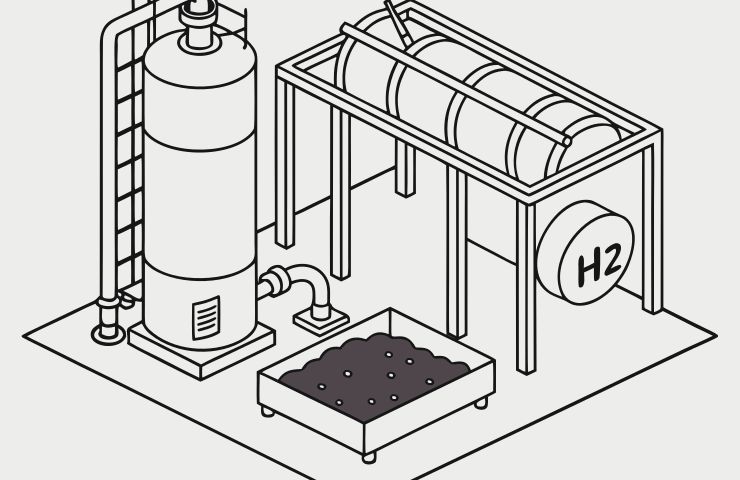
Rather than upgrading biogas to biomethane for grid injection or burning it in combined heat and power systems, TITAN takes a different route. It employs a thermo-chemical conversion process similar to methane pyrolysis right on the biogas feed. This means we can avoid that pesky concentrated CO₂ byproduct, splitting methane into hydrogen and solid carbon right there in the reactor. The idea of capturing biogenic carbon and turning it into a stable material is a game changer compared to traditional methods that either release CO₂ or require costly sequestration.
Process Architecture
So, what makes the TITAN process tick? It’s all about its unique setup for working with raw biogas, which typically has around 50-60% methane and 40-50% CO₂, along with a few trace impurities like water vapor and sulfur compounds. The process starts with a solid pre-treatment stage that kicks out hydrogen sulfide and particulates, ensuring that the sensitive downstream catalysts stay in tip-top shape. Inside the reactor, we’re looking at some serious heat—over 1,000 °C—prompting methane to crack on catalytic surfaces or in conditions that support carbon build-up rather than oxidation.
After that, there’s a gas-solid separation phase to scoop out those solid carbon particles without any hiccups. What’s left, a hydrogen-rich off-gas, goes through a purification stage—think pressure swing adsorption or membrane separation—to meet the strict purity standards required for fuel cells, industrial reductants, or just blending back into gas networks.
Innovation in Carbon Handling
The cool thing about the solid carbon produced through this pyrolytic process is its versatility. It can vary in form, from powdery carbon black to filamentous structures. The TITAN partners are getting creative, looking into ways to mechanically condition the carbon—like milling, sieving, and thermal treatment—to hit just the right particle size and surface area for different markets. Possible uses include being strengthening fillers in rubber and plastics or soil enhancers, but establishing consistent quality specs is still a work in progress.
Technical Challenges and Research Needs
Now, deploying a biogas-to-hydrogen reactor isn’t without its fair share of hurdles. You’ve got the tricky business of carbon fouling on reactor walls, keeping catalyst activity up with those sneaky trace contaminants, and figuring out how to integrate heat recovery systems to keep external energy use low. Behind the scenes, research institutes in the TITAN consortium—whose names remain a bit of a mystery—are playing a crucial role in modeling processes, reducing risks during scale-up, and fine-tuning energy balances. Gathering pilot data on throughput, carbon yields, and hydrogen purity will be essential for future commercial plant designs.
Collaboration and Knowledge Sharing
While Italgas brings the real-world infrastructure to the table, academic and technology partners add their expertise in pyrolysis kinetics and carbon material science. Effective teamwork in this consortium is key to boosting knowledge transfer, avoiding unnecessary duplication of efforts, and developing best practices for pre-treatment, reactor operation, and ensuring product quality. Sharing open-access data and holding joint workshops could really help to standardize methodologies across the wider European hydrogen and biogas sectors.
Strategic and Economic Considerations
The chatter around the project points to a target production cost hovering around €3.90 to €4.50 per kilogram of hydrogen—though this is under serious review. If it hits that target, the biogas-to-hydrogen process might just go toe-to-toe with other competitive low-carbon hydrogen production methods, especially in areas rich in agricultural or agro-industrial biogas. For Italgas, proving the economics could open up a whole new frontier: gas network operators might become off-takers of local biogas plant outputs, effectively hosting distributed hydrogen production right at pressure reduction stations.
And there’s more! Beyond just making money from hydrogen sales, this model has the potential to stabilize biomethane injections into the grid by providing a backup option during peak renewable electricity times or balancing services when demand for power-to-gas dips. The added carbon product offers yet another income opportunity, diversifying revenue streams for biogas operators and boosting project viability.
Policy Alignment and Market Signals
TITAN aligns beautifully with multiple EU policy goals: it’s got the Green Deal’s mission to slash greenhouse gases, it taps into the EU Hydrogen Strategy’s ambition to ramp up renewable hydrogen, and it supports the Circular Economy Action Plan’s focus on turning waste into valuable resources. Projects like this help shape regulatory frameworks by clarifying what's needed for certifying low-carbon hydrogen and creating new guidelines for solid carbon co-products in emissions inventories.
Italy's national decarbonization strategies solidify the project as well, with incentives promoting renewable gas use and setting targets for hydrogen-ready infrastructure throughout distribution networks. Local authorities are keeping an eye on this: hydrogen refueling stations for buses or municipal fleets could easily draw on TITAN’s output, building a localized supply chain that minimizes transport distances and cuts emissions.
Comparative Landscape
While the spotlight shines on large-scale green hydrogen produced by electrolyzers powered by renewables, alternative methods like methane pyrolysis are starting to gain traction, particularly since they leverage existing fossil-gas assets and renewable feedstocks. Germany and the Nordic regions are already testing similar pilot projects focusing on pure methane, but TITAN’s focus on raw biogas—complete with CO₂ and impurities—adds an interesting layer of complexity and the potential to directly integrate waste into hydrogen economies.
Other EU-backed demos, like those looking at biomass gasification or autothermal reforming of biogas, are paving the way for rolling out commercial solutions. However, TITAN stands out as it aims to test carbon capture right at the source, sidestepping the post-combustion capture headaches and providing a clearer narrative on circular carbon use.
Looking Forward
As for what’s next for TITAN? Key milestones include fine-tuning catalyst longevity, achieving steady solid carbon extraction, and making sure grid integration or off-take runs smoothly. Lifecycle carbon assessments will be crucial in demonstrating real net emissions reductions, taking into account energy inputs, any potential methane leaks, and end-of-life scenarios for solid carbon products.
From an investor perspective, having transparent performance data and getting third-party validation on the tech and economics will be crucial for success. If TITAN can prove its cost-effectiveness and performance, it could rapidly scale across Europe’s vast biogas capabilities, unlocking gigawatt-scale green hydrogen supplies without the need for building entire new infrastructures.
In a world that’s steering toward decarbonization, with hydrogen infrastructure still in its early stages, TITAN presents a compelling case for a distributed, waste-based hydrogen model. By transforming local organic waste into a zero-emission hydrogen source and a reusable carbon product, Italgas and its partners are not just experimenting with new tech—they’re crafting a blueprint for the circular hydrogen networks of tomorrow.