Hydrogen production from seawater via integrated desalination and electrolysis at DICP
Researchers at DICP have reported a seawater-to-hydrogen-and-fresh-water system that integrates alkaline electrolysis with low-temperature vacuum-distillation, using electrolyzer waste heat to achieve a 14.4% efficiency gain, according to a Nature Energy paper.
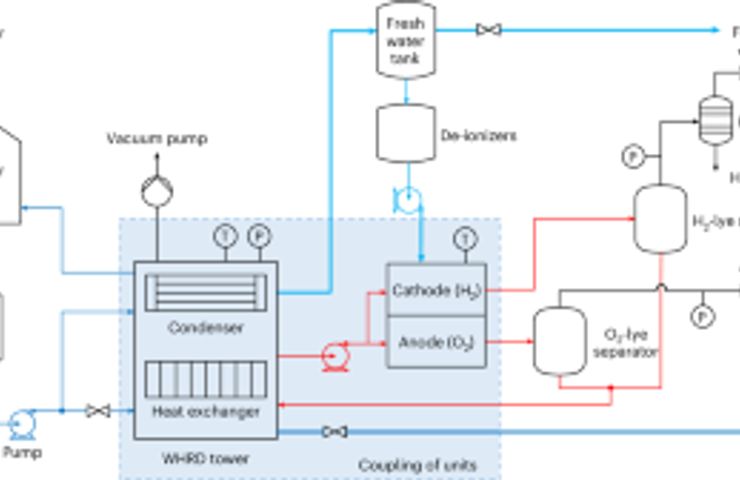
Researchers at the Dalian Institute of Chemical Physics (DICP) of the Chinese Academy of Sciences have reported an integrated seawater-to-hydrogen-and-fresh-water process that couples alkaline water electrolysis with low-temperature vacuum-distillation desalination, according to a study published in Nature Energy. The team names this integrated route the STHW process. It is presented as a single, linked system that converts seawater into two outputs: high-purity hydrogen and distilled freshwater, using technologies that are already established in isolation but novel in this combined layout, the paper indicates.
This system, referred to as the STHW process, uses low-grade waste heat generated by the electrolyzer to drive seawater evaporation under reduced pressure. The distilled freshwater then serves as feedwater for the alkaline electrolyzer while producing additional water for external use. By separating the desalination step from direct electrolysis of untreated seawater, the approach avoids challenges related to chloride corrosion, chlorine evolution, mineral scaling and biofouling, the authors note. The separation also permits the electrolyzer to operate on purified feedstock rather than raw seawater, which the paper argues improves operational stability.
Institutional and team background
Dalian Institute of Chemical Physics is a key institute within the Chinese Academy of Sciences that hosts the State Key Laboratory of Catalysis at its campus on Zhongshan Road in Dalian, Liaoning, according to DICP’s official profile. Its research portfolio covers catalysis, energy conversion, electrochemistry, petroleum chemistry and environmental technologies. The STHW project was led by Professor Dehui Deng and Associate Professor Yanting Liu, with first authorship attributed to Shang Jiang and contributions from Peixin Zhu, as listed in the Nature Energy paper.
DICP’s profile notes that the institute pursues both fundamental and applied research on catalytic materials for hydrogen, water, oxygen and carbon dioxide conversion. That breadth of focus underpins the multidisciplinary approach taken in the STHW work: materials, reaction engineering and system integration all appear as components of the reported study, the authors describe. The paper situates the STHW effort within DICP’s broader mission to link catalysis research with practical energy-conversion devices.
System architecture and operation
The STHW configuration routes incoming seawater to a vacuum-distillation unit powered by heat recovered from the electrolyzer, according to the paper. At reduced pressure, seawater boils at lower temperature, and the vapor condenses into freshwater with salinity below 40 parts per million, the DICP release states. This freshwater is then supplied to an alkaline electrolyzer, which splits water into hydrogen and oxygen. The design leverages waste-heat recovery to reduce external energy input for desalination, the team explains.
A closed-loop heat exchanger connects the electrolyzer’s waste-heat outlet to the evaporator section of the desalination unit. Temperatures are maintained around 65°C under vacuum, enabling efficient seawater evaporation and minimizing thermal losses. After condensation, the freshwater flows by gravity back to the electrolyzer, closing both water and heat loops, the authors describe. The gravity-driven return reduces auxiliary pumping needs, the paper suggests, while the closed-loop arrangement keeps the thermal and mass balances tightly coupled.
Enabling technologies at work
Alkaline water electrolysis splits purified water into hydrogen and oxygen using an alkaline electrolyte, such as potassium hydroxide, as the charge carrier, the paper explains. The process generates low-grade heat alongside gas products. Low-temperature vacuum-distillation desalination exploits reduced pressure to lower seawater’s boiling point so that waste heat from the electrolyzer can drive evaporation. Nonvolatile salts concentrate in the brine, while the vapor condenses into distilled freshwater, the team notes.
In the STHW process, waste-heat recovery captures low-grade thermal energy—typically rejected at temperatures of 50–80°C in alkaline electrolysis—and transfers it to the desalination module, reducing external heating needs by up to 60%, according to the authors. This synergy is central to boosting system-level energy efficiency. It also aligns the thermal profiles of the two subsystems so that one’s byproduct becomes the other’s input, the paper argues.
Pilot-scale demonstration and scale-up
The researchers first assembled a 20-kilowatt STHW pilot that operated stably for 100 days, producing 3.8 normal cubic meters of hydrogen and 1.2 kilograms of freshwater per hour, according to the Nature Energy article. That run tested continuous operation and sought to reveal degradation modes and logistical issues over an extended interval. After this demonstration, the team scaled the system to 250 kilowatts. In the scaled configuration, the process generated 48 normal cubic meters of hydrogen and 31.6 kilograms of freshwater per hour, the paper indicates. The Chinese Academy of Sciences communications further report a hydrogen purity of 99.9999% for the larger system.
Efficiency and techno-economic assessment
By integrating desalination with water electrolysis and reusing electrolyzer waste heat, the STHW process achieved a 14.4% system-level improvement in electrical efficiency relative to conventional alkaline electrolysis using freshwater alone, the article asserts. A preliminary techno-economic analysis presented in Nature Energy suggests that co-producing hydrogen and freshwater in a single plant may offer higher profitability than treating seawater and electrolyzing water separately, the authors conclude. The paper frames this conclusion as preliminary and calls for more complete cost modelling, yet it presents co-production as a potentially more attractive business case under the scenarios examined.
Comparison with direct seawater electrolysis
Direct electrolysis of untreated seawater has long been viewed as an attractive route to green hydrogen, yet it faces hurdles including chloride corrosion of electrodes, competing chlorine-evolution reactions, mineral scaling and biofouling, a critical review of seawater electrolysis challenges points out. Many laboratory-scale studies operate at low current densities and struggle with rapid electrode degradation and gas purity issues, the review indicates. By integrating desalination upstream of electrolysis, the STHW system demonstrates stable operation at industrial currents, according to Nature Energy. The authors position this as an alternative pathway that sidesteps the major material-compatibility problems of direct seawater electrolysis.
Environmental and logistical considerations
Co-production of freshwater and hydrogen could enhance resource utilization in coastal or island regions without easy access to potable water, the paper suggests. Yet the vacuum-distillation unit still produces concentrated brine, which must be handled or discharged under environmental regulations, according to CAS communications. The concentrated brine stream comprises salts and trace elements and may yield coproducts such as salt, uranium or bromine, though recovery rates and market viability remain unproven. These potential coproducts are noted as possibilities rather than demonstrated revenue streams, the authors caution.
Moreover, pumps, heat exchangers and vacuum systems introduce maintenance and operational complexities that will factor into lifecycle greenhouse-gas assessments and cost models before any commercial rollout, the authors caution. Lifecycle performance, ease of maintenance and component longevity are all flagged as items requiring more data from extended real-world testing, the paper states.
Implications for hydrogen infrastructure
The ability to co-produce hydrogen and freshwater from seawater may be particularly relevant for coastal, water-stressed regions and remote islands where both low-carbon hydrogen and water security are priorities, the paper suggests. Local hydrogen infrastructure could integrate with off-grid renewables—solar or wind farms—for sustainable energy supply, the authors note. Modular STHW units might serve industrial facilities or data centers, providing both fuel and water, though matching electrolyzer capacity, distillation throughput and renewable generation profiles will require careful engineering studies.
Future directions
The authors recommend further long-duration testing of the 250-kilowatt system under real-world conditions and independent replication of performance, along with full techno-economic studies that quantify capital expenditure per kilowatt and per cubic meter of freshwater, the paper states. They also suggest assessing operational expenditures for vacuum equipment and heat exchangers, as well as evolving regulatory frameworks for brine discharge and hydrogen safety to accommodate integrated systems.
While the DICP-led team has demonstrated the STHW concept at up to 250 kilowatts, commercial deployment will require additional pilot studies, independent validation and economic review, according to the authors. Nonetheless, this integrated desalination and electrolysis model offers a pragmatic route to tackle two key hurdles—water purification and energy efficiency—in green hydrogen production. Further studies will illuminate cost competitiveness and regulatory requirements for integrated hydrogen-desalination facilities. Industry observers will watch for follow-on pilots in diverse coastal sites.