Modeled Aftissat Wind-to-Hydrogen System Could Yield 510 Tonnes of Green Hydrogen at €2.87/kg
A techno-economic model in the journal Hydrogen explores converting curtailed electricity from Morocco’s Aftissat wind farm into about 510 tonnes of green hydrogen annually at 2.866 euros/kg. The site-specific study outlines a 10.867 MW PEM electrolyzer, compression, storage, and zero residual curtailment, pending real-world feasibility.
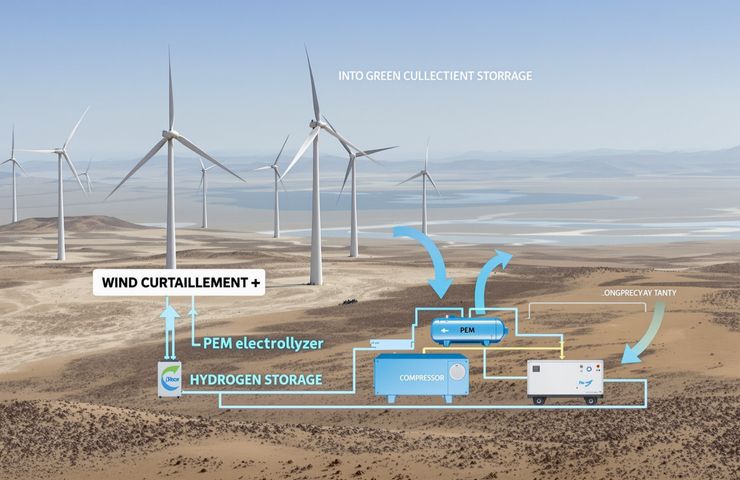
A techno-economic model suggests that surplus wind electricity from the Aftissat I wind farm in Western Sahara could generate approximately 510 tonnes of green hydrogen per year at a levelized cost of 2.866 euros per kilogram, according to a study published in the journal Hydrogen. The authors model a route that repurposes electricity otherwise curtailed under current grid-export constraints. Their intent is to show how variable renewable power might backstop hydrogen production and bolster hydrogen storage capacity without building new dedicated generation capacity.
Techno-Economic Model
The research team from Hassan II University of Casablanca modelled an integrated system made up of a 10.867 MW PEM electrolyzer, a 0.413 MW compression unit and storage tanks sized to hold around 37.782 tonnes of hydrogen, according to the study. They used hourly wind data for Aftissat I—officially recorded by Morocco’s Ministry of Energy Transition and Sustainable Development as a 201.6 MW onshore project connected by a 250-kilometre transmission line to Laayoune—to capture moments when the grid cannot absorb full output. In the authors’ calculations the site would normally see nearly 29.2 GWh of annual curtailment. In the study’s so-called complete-recovery configuration, residual curtailment is reduced to zero by diverting all surplus power to electrolysis and storage.
Operations and Cost Breakdown
According to the published analysis, the modelled system can deliver 509.652 tonnes of hydrogen per year, rounded to 510 tonnes, by operating the electrolyzer in step with wind output. Compression uses a measurable share of energy; a 0.413 MW unit raises H₂ pressure for storage. The study’s levelized cost of hydrogen (LCOH) estimate of 2.866 euros per kilogram reflects assumptions on capital expenditure, financing, stack performance and operating hours. The authors explicitly caution that this figure is theoretical and does not represent a guaranteed market price or an already commissioned facility.
By contrast, a dedicated new renewable plant would require additional land, permitting and grid upgrades. The surplus-based approach leverages an existing asset and, the paper notes, could improve utilization of the wind-farm operator’s investment without major new power-generation permits or grid reinforcements.
Strategic Fit with National Policy
The proposal aligns with Morocco’s green hydrogen production ambitions under the government’s Morocco Offer, which packages renewable generation, electrolysis, derivative fuels such as ammonia, and logistics for investors. The study does not claim that this specific model is an approved project in the Morocco Offer pipeline. Still, it highlights southern regions like Laâyoune-Sakia El Hamra as policy priorities.
Framed as a grid-flexibility tool, the model could appeal to developers wanting to optimise existing wind-farm assets and to mitigate export constraints. Integrating hydrogen systems at wind farms could also supply zero-emission hydrogen for domestic ammonia plants, local transport or export—provided a bankable offtake is secured and renewable electricity certification issues are addressed. The study’s emphasis on curtailed energy recovery sets it apart from case studies that size electrolyzers around 100% dedicated new capacity.
Environmental and Technical Considerations
While green hydrogen avoids direct CO₂ emissions from steam methane reforming, it is not impact-free. Electrolysis consumes water, and Morocco faces water-stress considerations. The study does not address water sourcing, treatment or desalination. In practice, an industrial-scale electrolyzer would require reliable and responsibly managed water supplies.
Frequent start-stop cycling of a PEM electrolyzer to follow wind surpluses can affect stack durability and maintenance schedules. Tank design, leak prevention and safety controls for gaseous hydrogen storage introduce capital and operational challenges. Technical integration with grid operations is another hurdle. Hydrogen systems must respond to dispatch signals, verify that electricity used qualifies as renewable, and coordinate with grid operators to maintain stability. The research’s linear-programming optimization offers a blueprint but cannot by itself guarantee real-world availability factors or warranty on stack performance over multi-year lifetimes.
Political Context in Western Sahara
Aftissat is located in a territory administered by Morocco but listed by the United Nations as a Non-Self-Governing Territory. Morocco’s Ministry of Energy Transition and Sustainable Development describes Aftissat I in the Boujdour Province’s Jraifia commune, while civil-society groups raise concerns about consent and benefit sharing with the Sahrawi people. Those legal and ethical debates are not addressed in the engineering model, but they form essential context for project development in the region, especially for investors mindful of international standards for resource-development in disputed areas.
At present, no construction, financing or commercial operation of the modelled hydrogen plant is verified. The study represents a quantified scenario—a simulation—rather than evidence of investment or commissioning. Prospective developers would need to secure water, permits, compression and storage equipment, certification of renewable electricity, grid-access agreements, offtake contracts and insurance before moving from model to reality.
Business and Market Outlook
Investors evaluating green hydrogen projects often compare LCOH estimates across geographies. The modelled 2.866 euros per kilogram cost at Aftissat falls within the range cited for other North African initiatives by IRENA and the EBRD Policy Academy. Repurposing curtailed wind power could lower the effective cost of electricity input—provided curtailment penalties or lost generation are significant under current grid rules.
True competitiveness, however, depends on several variables: the negotiated electricity price, financing terms, carbon pricing and local demand for clean hydrogen or ammonia. Transport logistics from the Boujdour coastline to domestic or export markets also add complexity to project economics. As of now, the Aftissat case remains an academic exercise. Project promoters would need to align with grid operator ONEE for suitable off-peak export arrangements, and secure offtake agreements that underwrite both hydrogen price and volume. Offtake could include local fertilizer plants or emerging hydrogen fuel cell transport schemes, but no buyer is publicly confirmed. Certification schemes for guaranteeing renewable origin would add time and cost to any commercial rollout.
Looking Ahead
Despite the caveats, the study illustrates one pathway to make an existing wind asset more flexible by treating hydrogen as both an energy storage medium and an industrial feedstock. If investors or the Moroccan Agency for Sustainable Energy (MASEN) judge the scenario bankable, they could advance feasibility studies that refine water-use, environmental impact assessments, grid-connection details and commercial negotiations.
The authors’ optimization framework may also be adapted to other wind facilities facing curtailment, offering a repeatable template for combining hydrogen infrastructure development with renewable energy portfolios. Ultimately, translating a model into a functioning plant requires a multi-stakeholder effort: wind-farm owners, electrolyzer suppliers, compression and storage vendors, grid operators, regulators and offtakers. Each must navigate technical specifications and contractual frameworks to ensure that hydrogen production remains truly green—running on surplus renewable power—while delivering competitive pricing and meeting safety standards. The Aftissat simulation is a reminder that smart integration, rather than simply adding capacity, can unlock value from existing infrastructure and support industrial decarbonization.