China Breaks Barrier in Hydrogen Production with 5.1% STH Efficiency Artificial Leaf
China's Tianjin University just hit 5.1% STH efficiency in solar hydrogen using a transparent photoanode. No wires. No voltage. Just a clear shot toward scalable green fuel.
Hydrogen Production Just Got Smarter—and Transparent
For years, hitting 5% solar-to-hydrogen efficiency in real-world conditions felt like chasing a mirage. Not anymore. China just crossed the threshold with a 5.1% breakthrough, and it’s not just a lab trick—it’s a real step toward practical, scalable, green hydrogen production with no external power hookup. Game officially on.
The Breakthrough
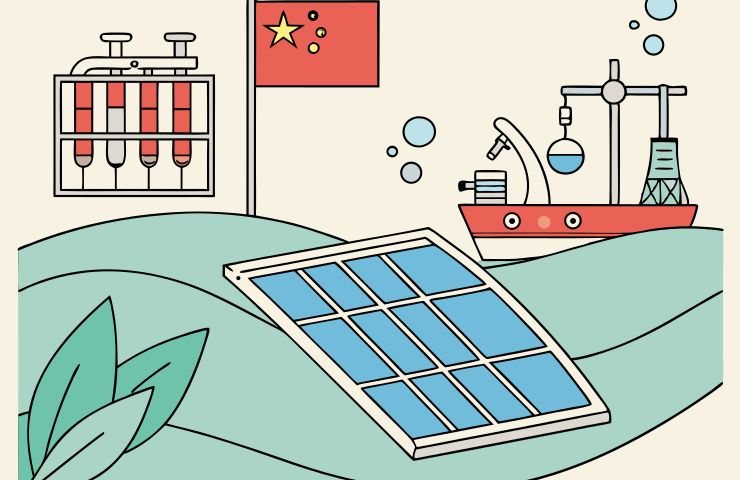
On June 17, 2025, a research team at Tianjin University led by Professor Wang Tuo dropped the curtain on a new kind of semi-transparent indium sulfide (In₂S₃) photoanode. Not only did it hit the elusive 5.1% solar-to-hydrogen efficiency, but it did it with no extra electricity. That’s more than a lab milestone—it’s a real-world pivot point for sustainable hydrogen.
What It Means
This moment puts artificial leaf technology in the spotlight—not as a cool science trick, but as a legit contender for the future of clean energy. No wires, no grid, no bias. Just smart materials that work together: conductive, light-permeable, and ready for prime time. Imagine a solar leaf that pulls hydrogen from water like nature does—only built for industrial use.
How It Works
The secret sauce is the semi-transparent photoanode. It lets visible light through so it can reach a silicon photocathode below, while still oxidizing water on its own surface. The result? Solar energy and chemical reaction working in sync. Think of it as a nature-inspired setup, fine-tuned for maximum payoff.
Why the Market Should Care
If this kind of system can be scaled up, we’re looking at a real pathway to zero-emission hydrogen fuel. It's a perfect fit for the growing push toward hydrogen infrastructure—especially in off-grid applications and clean industrial processes. From trucking to fertilizers, the possibilities stretch far and wide—assuming costs and durability don’t throw a wrench in the works.
Strategic Implications
Tianjin wasn’t exactly under the radar before, but this puts the city squarely in the lead for clean tech innovation. With this win, China’s push for energy independence and carbon neutrality just got a technology boost. And it adds heat to the global hydrogen race, nudging Western labs and policy makers to step it up. Silicon is already part of most toolkits—this breakthrough could complete the puzzle.
Global Context
Hitting the 5% mark for unbiased solar hydrogen production has been a kind of holy grail in energy circles. Teams in Japan, Europe, and the U.S. have chipped away at it for years. Tianjin just got there first—and with materials that are a lot closer to mass-market readiness than some of the pricey science-lab-only stuff folks have tried in the past.
Challenges Still Standing
Now, before we break out the confetti: it’s still early. These prototypes might shine in the lab but stumble in real-world conditions. Scaling up comes with stress tests—can it stay efficient, keep costs low, and survive long-term use? Those are the big unknowns. But this time, tackling those questions doesn't feel like a moonshot—it feels doable.
The View From Here
This could be a moment we look back on and say, “That’s when it started to click.” Not quite a revolution just yet, but definitely the start of something. The challenge now is less science and more engineering—how to mass-produce it, test it over time, and plug it into working systems. From here on out, it’s about making this tech real outside the lab.
Bottom Line
Tianjin’s 5.1% is more than just a number. It’s proof that green hydrogen made from nothing but sunlight and water isn't just a dream—it’s on the horizon. The question now is: who’s going to run with it?