Hydrogen news
Researchers make critical green hydrogen breakthrough by battling bubbles
New scientific strides have been made that could radically benefit H2 production. Researchers from the University of Twente have revealed in a new study that they have made notable advances in understanding the behavior of tiny bubbles (micro- and nanobubbles) on electrodes during the water electrolysis process; a process that is vital to green hydrogen production. Why does this matter? The tiny bubbles that form on electrodes are a nuisance to the electrolysis process. They block the flow of electricity and lower the efficiency of the overall reaction. These bubbles are problematic because l…
New scientific strides have been made that could radically benefit H2 production.
Researchers from the University of Twente have revealed in a new study that they have made notable advances in understanding the behavior of tiny bubbles (micro- and nanobubbles) on electrodes during the water electrolysis process; a process that is vital to green hydrogen production.Why does this matter?
The tiny bubbles that form on electrodes are a nuisance to the electrolysis process. They block the flow of electricity and lower the efficiency of the overall reaction. These bubbles are problematic because less efficient electrolysis means more waste and higher green hydrogen production costs. The researchers tried to understand exactly how the micro- and nanobubbles form on the electrodes and stick to them. The goal of gaining this understanding was to ultimately get rid of the bubbles to prevent them from impeding the hydrogen process.Improving green hydrogen production through successful predictions.
The University of Twente researchers, led by Detlef Lohse, developed a theory that lets them successfully predict the electric current density that is necessary to allow the nanobubbles to grow uncontrollably and detach, thereby freeing the electrode to produce more hydrogen. [caption id="attachment_64839" align="aligncenter" width="1280"]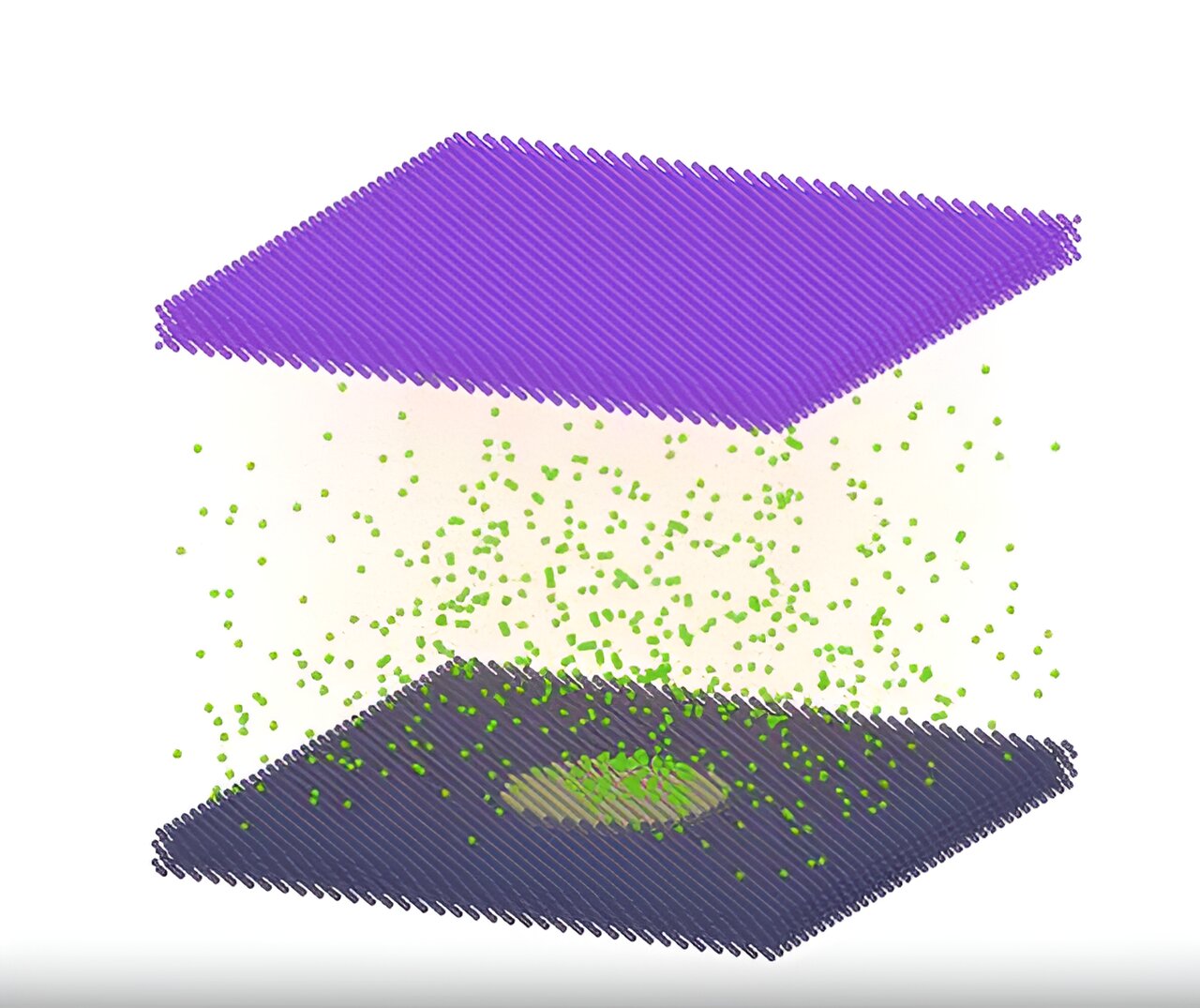 Nanobubble Research - Image Credit: Proceedings of the National Academy of Sciences (2024). DOI: 10.1073/pnas.2321958121[/caption]
Their research builds upon the Lohse-Zhang model, an established stability theory for surface nanobubbles. The major difference is that the new research expands to include the electrolytic current density in order to predict the behavior of the tiny bubbles.
With this improved knowledge, the hope is that scientists and engineers can work toward detaching bubbles from electrodes. This is not only good news for water electrolysis for improved green hydrogen production, but also for other systems, such as in catalysis, where gas bubbles can form.
The researchers’ study, “Threshold current density for diffusion-controlled stability of electrolytic surface nanobubbles” has been published in Proceedings of the National Academy of Sciences.
Nanobubble Research - Image Credit: Proceedings of the National Academy of Sciences (2024). DOI: 10.1073/pnas.2321958121[/caption]
Their research builds upon the Lohse-Zhang model, an established stability theory for surface nanobubbles. The major difference is that the new research expands to include the electrolytic current density in order to predict the behavior of the tiny bubbles.
With this improved knowledge, the hope is that scientists and engineers can work toward detaching bubbles from electrodes. This is not only good news for water electrolysis for improved green hydrogen production, but also for other systems, such as in catalysis, where gas bubbles can form.
The researchers’ study, “Threshold current density for diffusion-controlled stability of electrolytic surface nanobubbles” has been published in Proceedings of the National Academy of Sciences.
Final thoughts
It might seem that every other day there is news about some novel hydrogen technology finding that could lead to more efficient and cheaper production of this clean fuel. So, what makes this particular study from the researchers at the University of Twente noteworthy? Gaining knowledge on how the tiny bubbles form and eliminating them from the electrolysis process is a win for achieving greater efficiency. That’s important, because improving the overall efficiency of water electrolysis means that it works with less disruption. In turn, this leads to less waste of materials, energy, time, and money. In short, it potentially brings us one step closer to a green hydrogen economy, which, compared to our current fossil fuel-driven economy, could significantly lower the impact of global warming.How was this article?
Thanks for the feedback!