News
Weifu Drives Hydrogen Fuel Cell Innovation with Voith and Bosch in China's Green Transition
Weifu debuts full-chain hydrogen innovations and partners with Voith and Bosch to build integrated hydrogen infrastructure in China and beyond.
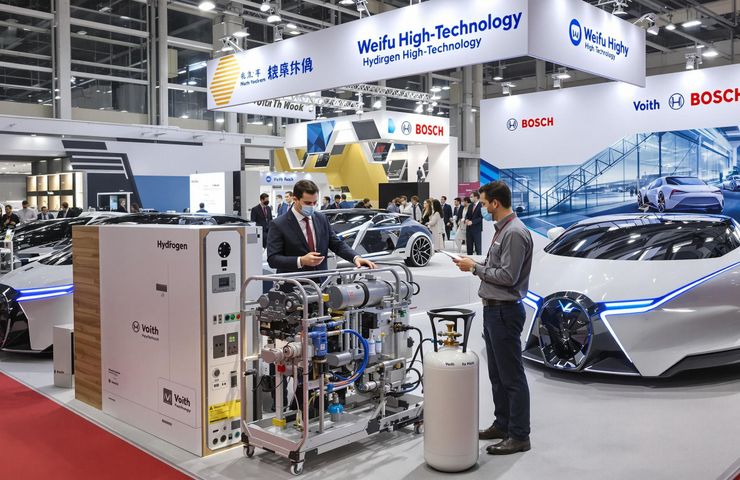
China’s Hydrogen Ascent Gets a Boost from Weifu’s Full-Chain Strategy
The global race toward decarbonization is picking up speed, and Weifu High-Technology Group Co., Ltd. isn't wasting any time. At the Fuel Cell Vehicle Congress (FCVC) 2025 in Wuxi, a city quickly becoming a clean tech hotspot, Weifu didn’t just talk the talk—they showed up with tech that spans the entire hydrogen value chain. Whether it's cutting-edge PEM electrolysis, precision fuel cell components, or next-gen 70MPa hydrogen storage, Weifu’s moving well beyond its roots in traditional automotive parts and diving headfirst into the world of hydrogen. But it’s not just the technology that’s turning heads—it’s the ecosystem behind it. Backed by tight collaborations with Germany’s Voith Group and longtime partner Bosch, Weifu is setting itself up for large-scale success with a vertically integrated strategy built for the long haul.The Technical Leaps: Smarter, Safer, Scalable
Let’s talk breakthroughs. One of the big reveals was a new Hydrogen Fuel Cell Integrated Injection Single Cell system, co-developed with Changan Automobile. The numbers speak for themselves: 30% better production efficiency and a 20% boost in air-tightness. For manufacturing, that means fewer headaches, faster output, and a solid foundation for scaling up fuel cell production. On the hydrogen generation side, Weifu rolled out a modular PEM Water Electrolysis System that’s not just compact—it’s powerful. With current densities above 3A/cm² and energy use as low as ≤4.5kWh/Nm³, this system is built for real-world performance. These numbers aren't just for show—they’re what make hydrogen production cost-effective and ready for integration with renewable energy grids. And then there's storage. Their new 70MPa High-Pressure Hydrogen Storage System uses advanced composite materials, stays lightweight, and meets top-tier EU safety and cybersecurity requirements. It’s a game-changer for anyone looking to move hydrogen safely and efficiently.The Power of Partnerships: Enter Voith
Possibly the biggest strategic move? A new joint venture with Germany’s Voith Group, called Weifu Voith Hydrogen Energy Technology (Wuxi) Co., Ltd.. Set to go live by late 2024 (assuming regulatory thumbs-up), this new entity brings together Voith’s know-how in hydrogen storage innovation and Weifu’s manufacturing strength to create safer, smarter hydrogen systems for the global mobility market. This isn't just another business agreement—it’s part of a much bigger global trend: East-West partnerships that bring the best of both worlds. As one engineer at the event put it, “The days of building in a vacuum are gone. Hydrogen demands speed, collaboration, and alignment.”Stitched into China’s National Hydrogen Fabric
Weifu isn’t just chasing trends—it’s aligning with national priorities. With China aiming for carbon neutrality by 2060, and hydrogen now officially part of the country’s energy blueprint, there’s serious momentum on their side. Wuxi, in particular, where Weifu is based, is fast becoming a key hub for next-gen energy development. And that’s no coincidence—local government incentives and a growing pool of clean tech talent are fueling the growth. Weifu’s push into green hydrogen also fits into China’s broader energy independence goals. As industries like steelmaking, shipping, and freight look for cleaner alternatives, hydrogen is stepping in where electrification can’t quite get the job done.A Strategy That Extends Beyond China’s Borders
Since 2022, Bosch has been deep in the mix—adding R&D grit and financial muscle to help Weifu evolve into a clean energy heavyweight. Together with Voith, Bosch and Weifu form a tri-continental alliance: precision engineering from Germany, advanced manufacturing from China, and deployment strategies spreading across Europe, Asia, and the MENA region. This global setup isn’t just smart—it’s strategic. By spreading knowledge and capabilities across regions, they’re building a hydrogen supply chain that’s resilient, flexible, and future-proof.Long-Term Impact: Why This Matters Now
Weifu’s hydrogen push is more than a good PR moment—it’s a solid business play. With hydrogen fuel cells edging closer to mass commercialization, companies that control the full spectrum—from membrane tech to storage tanks—are going to own the lion’s share of the value. And the impact? It's broad and powerful:- Industrial: Streamlined hydrogen systems mean emissions from heavy transport, industry, and freight could take a nosedive.
- Economic: Cross-border efforts like the Weifu-Voith JV spark innovation, create high-value jobs, and push export-ready solutions.
- Environmental: Efficient hydrogen ecosystems are key to filling the gaps where batteries fall short in the global net-zero race.
Looking Ahead
With global hydrogen policy and industrial momentum finally connecting the dots, Weifu’s latest moves feel more like a call to action than a product release. The signal is clear: scalable, collaborative hydrogen infrastructure isn’t just coming—it’s already underway. And with powerhouse partners and policy backing, Weifu isn’t just jumping on the hydrogen bandwagon. They’re preparing to drive it.About Weifu Group: Established in 1958, Weifu High-Technology Group Co., Ltd. is one of China’s top auto suppliers, known for its work in fuel systems. Today, with 8,000 employees and strategic partnerships with Bosch and Voith, the company is making big moves into the hydrogen production space, carving out a new future in PEM electrolysis, hydrogen storage, and hydrogen fuel cells.
How was this article?
Thanks for the feedback!