Ballard Power Systems Launches HPU Agile-H: A Move Toward Mobile Hydrogen Power Solutions
Ballard Power Systems has unveiled the HPU Agile-H, a towable hydrogen power unit aimed at providing a cleaner alternative to diesel generators. Designed in partnership with Siemens Energy and GeoPura, this innovative solution targets temporary and off-grid energy needs across various industries.
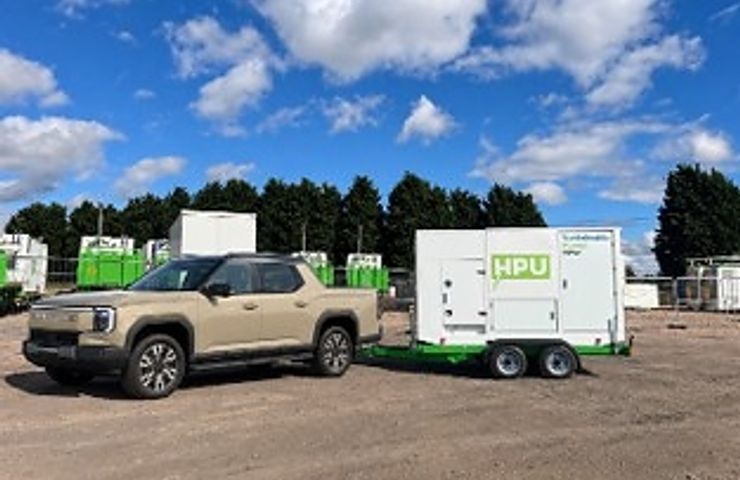
Ballard Power Systems has introduced the HPU Agile-H, a lightweight, towable hydrogen power unit intended as an alternative to diesel generators for a range of temporary and off-grid uses. Manufactured by Siemens Energy and powered by a Ballard fuel cell, the HPU Agile-H is aimed at lower-load, temporary and off-grid energy needs across sectors such as construction, events and emergency services. The company frames the unit as a practical option where traditional generators are impractical or undesirable.
Key Features of the HPU Agile-H
Unveiled on October 28, 2026, the HPU Agile-H is designed to provide 80 kW of continuous power. It integrates a hydrogen fuel cell with a battery storage system that responds quickly to fluctuating demand, pairing steady output with short-term load smoothing. That combination is intended to offer reliability in scenarios where power draw can spike or vary over short intervals.
- Towability: The unit is designed to be towed by an SUV or large van, allowing for swift deployment by a single technician within 20 minutes.
- Clean Operation: The absence of combustion means no carbon dioxide, nitrogen oxides, or particulate emissions at the point of use—ideal for maintaining air quality at worksites.
Its towable form factor makes the HPU Agile-H portable without requiring heavy lifting equipment. A single technician can deploy the unit in 20 minutes, which Ballard positions as a practical advantage for job sites and event locations that need rapid, temporary power. Because the unit produces no exhaust at the point of use, it presents a different emissions profile than diesel generators, which remain common in the same applications.
Strategic Partnerships and Manufacturing
Following the acquisition of GeoPura Limited in September 2026, Ballard has expanded its offerings beyond fuel-cell components to a more integrated hydrogen energy service model, combining production, logistics, and power generation. GeoPura, founded in the UK in 2019, played a pivotal role in the design of the HPU Agile-H and has extensively collaborated with Siemens Energy, which manufactures the units at its facility in Newcastle. The sequence of acquisition, design collaboration and contracted manufacturing underlines Ballard’s move toward supplying not only cells but packaged systems.
The relationship with Siemens Energy places production in a dedicated facility. That setup concentrates assembly and manufacturing at the Newcastle site while leveraging GeoPura’s design input. Ballard’s integration of these pieces—component expertise, a design partner and an established manufacturer—frames the HPU Agile-H as the product of a multi-company effort rather than a single-vendor build.
Positioning in the Market
The HPU Agile-H is presented as a response to a specific market gap: users with modest, temporary power needs who require mobility and cleaner on-site operation. Diesel generators, the incumbent solution, are noisy and produce exhaust; the HPU Agile-H aims to offer quieter, emission-free operation at the point of use. Pre-orders commenced shortly after the announcement, with the first deliveries set for the first quarter of 2027.
Whether the HPU Agile-H can displace diesel in these niches is an open question. Ballard and its partners are positioning the unit where diesel’s noise and emissions are most problematic, but success will depend on day-to-day economics and logistics. Two broad conditions stand out as decisive.
- Hydrogen Supply: The effectiveness of the HPU Agile-H depends largely on reliable access to low-cost, sustainable hydrogen.
- Market Competition: The unit's cost-effectiveness against diesel generators and battery storage systems remains to be tested in real-market conditions.
Access to hydrogen, and to hydrogen delivered at a competitive price, will determine operating economics. If hydrogen is available and affordable, the HPU Agile-H can run without tailpipe emissions. If not, users will weigh fuel costs and logistics against familiar alternatives. Similarly, battery storage systems—already established for many temporary power roles—present a second competitive axis; the HPU Agile-H must prove its lifecycle cost and operational profile against both diesel and battery offerings in the field.
Environmental Impact and Future Prospects
The HPU Agile-H positions itself as a lesser-polluting alternative amid growing calls for cleaner energy solutions. Its emissions profile at the point of use is clear: without combustion, there is no carbon dioxide, nitrogen oxides or particulate output from the unit itself. But the broader environmental case depends on how the hydrogen is produced. The hydrogen production process must utilize renewable energy to ensure minimal lifecycle emissions.
That distinction matters because a zero-emission tailpipe does not automatically equal a low-carbon lifecycle. If hydrogen is supplied from renewable sources, lifecycle emissions can be reduced significantly; if it is supplied from fossil-derived pathways, the net benefits shrink. Ballard’s own strategy, following the GeoPura acquisition, ties product delivery to logistics and supply considerations, which suggests the company is aware that hydrogen sourcing will influence customer decisions.
Technology evolution will also shape the HPU Agile-H’s prospects. Fuel cells, battery systems and hydrogen supply chains are all advancing at different paces. The HPU Agile-H will be evaluated not only on its engineering but on market adoption data, performance metrics and customer feedback from initial deployments—data that Ballard, GeoPura and Siemens Energy will gather once units enter service.
Conclusion
The introduction of the HPU Agile-H is a strategic move for Ballard, GeoPura, and Siemens Energy, signaling a coordinated push into packaged hydrogen power solutions. The unit brings a specific mix of traits—towability, 80 kW continuous output, integrated battery storage and fuel-cell drive—that targets temporary and lower-load applications where diesel generators currently dominate. Ultimately, its ability to gain traction will rest on hydrogen availability, comparative costs versus diesel and batteries, and how early customers rate its performance in the field. Over the next months, pre-orders and the first deliveries in the first quarter of 2027 will start to produce the market signals needed to judge the HPU Agile-H’s practical and environmental impact.