EODev & Baudouin Unveil 600 kW Solid Oxide Fuel Cell for Distributed Power Generation
EODev and Baudouin partner on a modular 600 kW SOFC system for industrial sites, blending fuel flexibility, resilience and a pathway to hydrogen infrastructure.
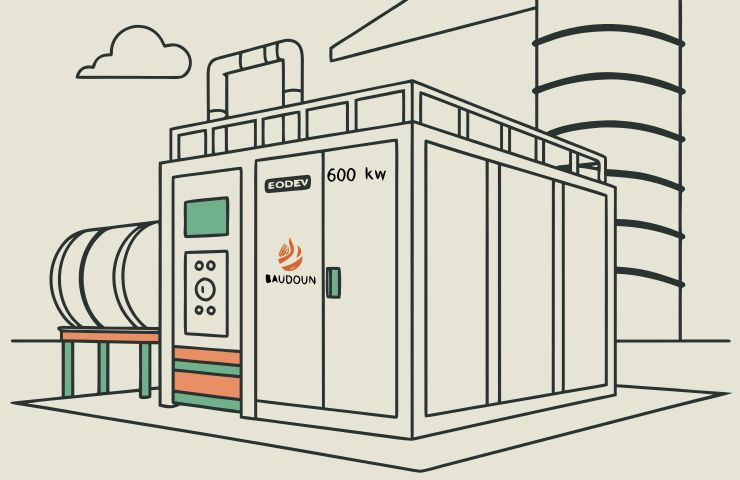
Don’t let that 600 kW label fool you; there’s a lot more going on here than just numbers. French clean-energy innovator EODev has teamed up with engine manufacturer Baudouin to roll out a modular 600 kW solid oxide fuel cell (SOFC) system. These systems are aimed at data centers, industrial sites, and various other essential applications. What’s really cool is that you can stack multiple units to create powerful multi-megawatt arrays, and they can operate on natural gas, renewable gases, or hydrogen. This partnership really pushes EODev's portfolio beyond just hydrogen fuel cell generators and battery storage, marking a big step forward.
At its core, this collaboration enhances EODev’s capabilities in fuel-flexible distributed power generation. Each SOFC module cranks out 600 kW of continuous power by using a ceramic electrolyte to move oxygen ions at high temperatures while also recovering waste heat for combined heat and power systems. With exclusive agreements in France and Poland, they’ve got a clear focus for their launch market, aiming for an unveiling later this year and first customer deliveries lined up for early next year. So, in a nutshell, EODev is transitioning from a hydrogen and battery focus to becoming a full-blown fuel cell technology provider. They’re targeting clients who need reliability and cleaner on-site power without waiting on a fully developed hydrogen infrastructure.
Technical Snapshot
Now, solid oxide fuel cells have been around for a while but are just gaining more traction. They operate at temperatures over 600 °C, using a ceramic electrolyte to shuttle oxygen ions from air at the cathode to the anode, where they oxidize the chosen fuel. This whole electrochemical reaction happens without combustion, cranking out electricity while also providing high-grade exhaust heat that can be used for onsite heating or generating steam. Each module is designed for scalability; by linking several 600 kW units, businesses can easily create multi-megawatt setups that fit snugly within standard industrial containers. Plus, what’s key here is that these units can run on natural gas, biomethane, or hydrogen, giving users the flexibility to navigate today's energy landscape and tomorrow's low-carbon goals.
Strategic Pivot
For EODev, which spun off from the Energy Observer Group, this development isn’t just about adding new products—it’s a deliberate shift in their market strategy. They made a name with hydrogen fuel cell generators like GEH2 and marine range extenders like REXH2, integrating fuel cells with lithium iron phosphate batteries for quick starts and less noise. Now, by adding SOFC modules, EODev can cater to clients who prioritize uptime and modularity over just promoting hydrogen. They can offer a solution that connects to existing natural gas grids now and transitions to renewable gases or green hydrogen when those supplies become more reliable. It’s about selling resilience just as much as it is about promoting decarbonization.
Company Context
Founded in 2019, EODev combines a flair for innovation with practical applications, leveraging its roots in zero-emission generators and battery systems, which align closely with its parent company’s marine ethos. Baudouin, with a hundred years of experience under its belt in engine solutions, brings valuable industrial expertise and production capabilities to the table. Together, they’re on a mission to turn SOFC technology—which has long been seen as promising yet costly—into a commercial success for on-site power solutions. Their exclusivity agreement for France and Poland provides them a little leeway to refine performance, enhance customer support, and develop service networks before they expand further.
This announcement comes at a time when the policy landscape is ready for low-carbon innovation. France’s hydrogen strategy and the European Union’s initiatives for hydrogen and decarbonized gas offer plenty of subsidies, guarantees, and regulatory support for renewable fuels. And with data centers and industrial parks facing grid limitations, skyrocketing carbon prices, and stringent uptime requirements, reliance on diesel generators is becoming less appealing. All of this paves the way for broader industrial decarbonization. SOFC modules promise lower noise levels, reduced start-stop cycles, and a smaller emissions footprint when powered by biomethane or green hydrogen. However, they raise critical questions: should you go for natural gas now and label it as cleaner? Or should you wait for fully renewable operations?
Solid oxide fuel cells aren’t brand new—they’ve been in research since the 1930s, with serious developments kicking in during the 1970s. Technical references and industry documents have long underlined SOFCs’ high efficiency and potential for heat recovery. Yet, challenges like cost, slow startup times, and the stresses of thermal cycling have delayed their widespread adoption. Issues like ceramic electrolyte cracking during heating and cooling cycles can also make stack durability a headache. EODev and Baudouin are claiming advances in materials and modular design can tackle these problems, but until these systems prove reliable over years of real-world use, some customers may hesitate. In a fast-moving world, we’re left wondering if a cutting-edge fuel cell can truly match the plug-and-play convenience of diesel generators.
Let’s cut to the chase: running on natural gas isn’t exactly zero-emission. Upstream methane leaks and the existing CO₂ output are crucial considerations. Marketing SOFCs as “clean” while burning fossil fuels runs the risk of overstating their decarbonization benefits. EODev’s pitch leans heavily on this future-fuel narrative, but they still need to deliver a product that integrates into current gas networks. Critics might say this is a trap: once a location sinks money into gas-fired SOFCs, switching entirely to hydrogen or biomethane could become a costly retrofit. The real test of this technology isn’t just about output per module; it’s about how customers will perceive these units—are they simply temporary solutions, or will they be foundational assets for a hydrogen economy?
So here’s the deal: this partnership isn’t a slam dunk for net-zero ambitions; it’s more of a strategic bet. EODev is looking to generate revenue now while keeping a foot in the hydrogen future, and Baudouin is eager to revamp its product lines. For customers, this collaboration offers a promise of resilience—modular SOFC stacks that can come together like Lego blocks and adapt as fuel supply evolves. But let’s not kid ourselves; resilience comes with its own challenges, like complexity, upfront costs, and the ever-important question of fuel sourcing. If green hydrogen and biomethane remain hard to come by or pricey, most setups are likely to default to natural gas, complicating the environmental case.
We’re expecting to see proof of concept from customer pilots later this year. If these SOFC modules hold their ground in real-world conditions and deliver on economics, we might witness a wave of similar partnerships cropping up. If not, those who firmly believe in hydrogen may use this as proof that fuel cells can’t hack it against simpler options. Either way, we’re on the verge of getting a clearer picture of how durable distributed fuel cell technology really is.