Green Hydrogen Production Breakthrough: Sunlight-Powered Liquid Gallium Splits Seawater
University of Sydney researchers have developed a circular, sunlight-driven liquid gallium process that splits seawater into hydrogen at 12.9% solar-to-hydrogen efficiency, eliminating the need for purified water or grid electricity.
Imagine tapping into sunlight and seawater to churn out clean hydrogen without needing a single watt from the grid. Sounds like a dream, right? But that’s exactly what researchers at the University of Sydney have achieved in a recent study, showcasing solar-to-hydrogen efficiency at an impressive 12.9%. No more worrying about purified water demands or costly electricity inputs!
Turning a headache into an opportunity
We've all been hearing about the potential of green hydrogen for ages, but traditional electrolysis often comes with a laundry list of drawbacks. Desalination plants, the need for purified water, and reliance on grid power can ramp up costs and environmental impacts. Plus, seawater's chloride can corrode electrodes and even produce chlorine instead of oxygen. To top it off, minerals like calcium and magnesium can gunk up membranes. It’s a bit of a tangled web that makes scaling very tricky and tough to justify.
Why this matters now
Now, picture a method that skips desalination entirely, sidesteps clunky electrolyser stacks, and doesn’t rely on the grid at all. For coastal regions and places dealing with water stress, this could mean finally being able to produce green hydrogen on-site, right where it’s needed the most. Forget about giant pipelines or sprawling solar farms feeding electrolysers hundreds of miles away. Distributed production means smaller, modular reactors that are simpler to site and come with lower infrastructure hurdles. This is a huge win for off-grid industries, islands, remote microgrids, and anyone tired of waiting for clean energy to roll in.
The magic ingredient
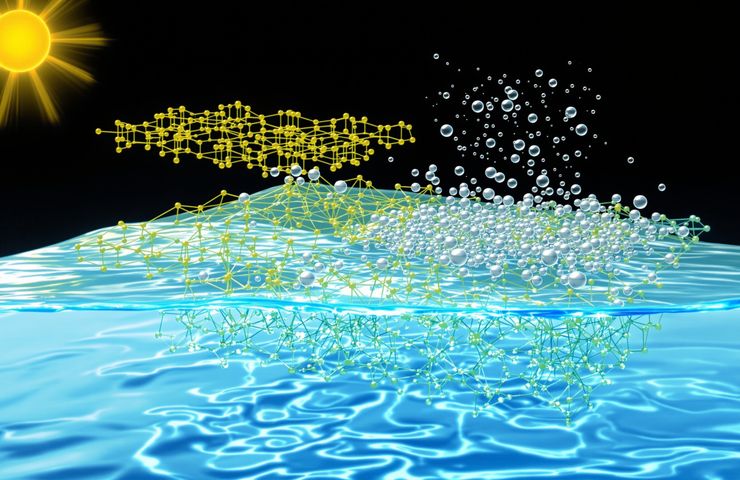
The secret sauce? Tiny droplets of liquid gallium suspended in water. When these little guys absorb sunlight, they heat up and kick off a reaction with the surrounding water. As gallium oxidizes to gallium oxyhydroxide—also known as GaOOH—hydrogen gas bubbles off. Once captured, that oxide layer gets stripped back to pure gallium in a separate electrochemical step, creating a closed-loop system. This groundbreaking pathway, detailed in Nature Communications, has even landed a patent application, showing its commercial promise.
Proof in the water
In lab tests using filtered seawater sourced from the Sydney coast, the team observed sustained hydrogen production while using controlled, concentrated light. Luis Campos, the lead author of the study, emphasizes that this method is just as effective whether using freshwater or seawater. Meanwhile, Professor Kourosh Kalantar-Zadeh notes that achieving 12.9% efficiency rivals the early benchmarks of solar cells. Dr. François Allioux adds that this seawater-friendly, light-driven cycle has the potential to completely change how Australia capitalizes on its coastal advantages.
Looking at Australia’s coast
Australia is blessed with some of the highest solar irradiation levels on Earth, paired with an expansive coastline. National strategies are in place to transform the country into a green hydrogen export powerhouse. This sunlight-soaked seawater process fits perfectly into that vision. It offers coastal reactors that can dodge grid bottlenecks, desalination plants, and debates over freshwater diversion. Plus, it aligns nicely with federal incentives aimed at hydrogen innovation, capitalizing on the nation’s natural strengths.
Roadblocks on the horizon
But let’s keep it real—every breakthrough comes with its fair share of challenges. Current tests depend on concentrated light rather than the standard spotlight of one sun. Scaling these reactors to operate outdoors under full solar conditions is going to require some thoughtful engineering. Plus, the gallium supply chains and material costs should be kept in check, even with its high recyclability. Long-term trials using untreated seawater will also need to assess any corrosion or fouling risks. And we have to balance the energy needed for gallium regeneration against the overall gains. Techno-economic studies and durability assessments are critical next steps here.
Tipping the scales
This isn't just another green hydrogen roadmap—it’s a serious contender for distributed coastal production. Imagine offshore islands or remote research stations generating their own hydrogen loops with minimal heavy infrastructure. Think of industrial parks right by the ports producing fuel on-demand, cutting transport and import costs. By breaking the tie between hydrogen generation and massive solar farms, we’re opening up new site possibilities, fast-tracking deployment in places that often get overlooked.
Zooming out
Globally, teams are looking into all sorts of hybrid solar distillation methods, photocatalytic panels, and membrane-based electrolysers for seawater splitting. Yet, many of these still need desalination, purified water, or struggle to hit above 10% efficiency when put to the test in real-world conditions. The liquid gallium method stands out among many photocatalytic systems, offering a fresh photothermal approach. It opens up the green hydrogen innovation landscape and shows that sometimes, a little creativity can break new ground in energy chemistry.
Final shot
Green hydrogen is edging closer to reality, and sunlight-driven approaches utilizing seawater could be the next big disruptor. The University of Sydney's liquid gallium process has pushed the envelope with impressive lab efficiency and a circular, low-electricity cycle. The journey ahead will involve scaling, outdoor validations, and cost analysis, but the main idea is sound: use local sunlight and seawater to unlock clean energy where it’s needed the most. It’s not just evolution—it could very well be a revolution. So, buckle up!