Innovative TiO2–AgBiS2 Photoelectrode Paves the Way for Eco-Friendly Solar Hydrogen Production
Researchers at South Korea’s DGIST and Kookmin University have developed a TiO2–AgBiS2 photoelectrode for eco-friendly solar hydrogen production. This low-voltage, aqueous process simplifies production and enhances efficiency.
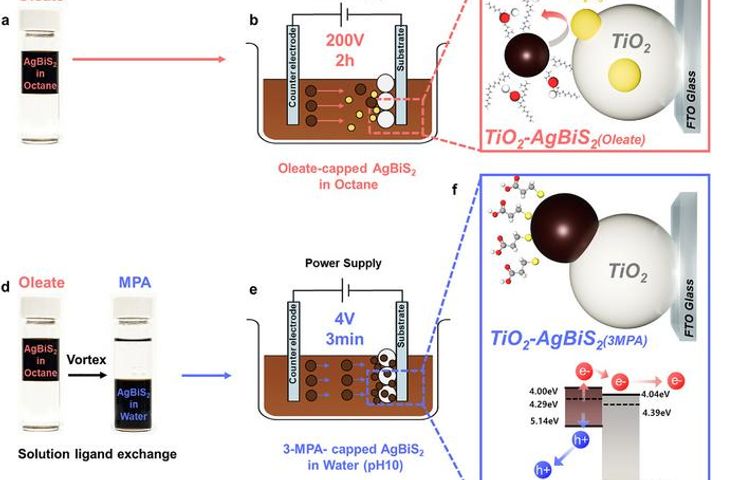
Researchers at Daegu Gyeongbuk Institute of Science and Technology (DGIST) and Kookmin University in South Korea have developed a method to create a solar-hydrogen photoelectrode that uses a low-voltage aqueous process rather than the toxic solvents and higher voltages common in earlier approaches. The change is both chemical and procedural: the team moved away from solvent-based fabrication and toward a waterborne route that operates at far lower driving voltages. The result is a production pathway that reduces reliance on hazardous organic chemicals and cuts electrical demand during fabrication.
The device itself pairs two materials with complementary properties. One is titanium dioxide (TiO2), a stable semiconductor known for its chemical robustness but limited light absorption. The other is AgBiS2 nanocrystals, which can absorb light across the visible and near-infrared part of the spectrum. By combining the two, the researchers sought to overcome bottlenecks that have constrained the performance of photoanodes used in solar-driven hydrogen production. In practice, the heterojunction brings improved light capture to a material platform that already offers long-term stability.
Electrode Design and Fabrication
To prepare the AgBiS2 nanocrystals for processing in water, the team modified their surfaces with 3-mercaptopropionic acid. This surface treatment allowed the nanocrystals to disperse in an aqueous medium, a necessary step for the deposition technique they chose. The researchers then employed aqueous electrophoretic deposition under low voltage. Crucially, this change reduced the required driving voltage from over 200 volts to just 4 volts. That drop in electrical requirement simplifies the manufacturing setup and removes the need for many of the organic solvents traditionally used in nanocrystal deposition, creating a cleaner production environment.
The fabrication route is notable for its simplicity as much as for its chemistry. A water-based dispersion, surface-modified nanocrystals and a low-voltage electrophoretic step — these are the core elements. Together they produce a TiO2–AgBiS2 heterojunction photoanode without resorting to the high-voltage, solvent-heavy processes that have dominated prior work. The protocol therefore targets both environmental and operational gains: fewer hazardous reagents and lower power draw during assembly.
Performance metrics from the study underline the practical effects of the material and process choices. Under standard AM 1.5G sunlight conditions, the photoanode showed a photocurrent density of 3.0 mA/cm² at 0.6 V versus the reversible hydrogen electrode. By the authors’ comparison, this figure is approximately ten times higher than conventional single-material electrodes. It is important to note, as the researchers themselves do, that this “ten times” statement applies specifically to photocurrent measurements rather than to broader solar-to-hydrogen conversion efficiencies.
Significance for Clean Hydrogen Initiatives
The work ties directly into national and sectoral ambitions around low-carbon fuels. This research contributes meaningfully to South Korea's ambitions in clean hydrogen innovation and renewable energy policies. Improved, more easily manufactured photoanodes could become one component in pathways to produce green hydrogen using renewable electricity and sunlight rather than fossil-derived feedstocks. As governments and industry pursue tighter emissions targets, materials advances that lower production and operational barriers for solar-driven hydrogen are part of the broader toolkit for decarbonization.
Material choice was also guided by safety and environmental considerations. Interestingly, AgBiS2 nanocrystals, as highlighted in this study, are free from hazardous materials like lead or cadmium, making them a safer alternative in solar energy applications. That said, the researchers flag that comprehensive lifecycle analyses remain necessary. In particular, the environmental impacts tied to silver and bismuth extraction and processing will need to be examined in follow-up studies before full environmental claims can be substantiated.
The Path Forward: Challenges and Opportunities
Despite the promising measurements and the cleaner fabrication route, the team acknowledges several hurdles that must be cleared before the approach can move from laboratory demonstrations to commercial devices. Durability and long-term stability are chief among these concerns. In extended operation, the TiO2–AgBiS2 heterojunction may face charge recombination and photocorrosion, both of which can erode performance over time. Addressing those failure modes will be key to translating an initially high photocurrent into sustained hydrogen production.
Scale-up is another open question. Laboratory-scale deposition and testing do not directly answer how the process will behave when applied to large-area electrodes or to high-throughput manufacturing lines. The paper notes that rigorous assessments for real-world implementation are needed — covering large-area production, cost dynamics, and extended operational lifetimes — before firms could consider commercial adoption. Economics, as much as materials science, will determine whether the method can be competitive in hydrogen-production markets.
The researchers also point to efficiency limits that remain to be explored in depth. While a higher photocurrent is a positive sign, it does not automatically translate into proportional gains in solar-to-hydrogen efficiency. Loss pathways, interface engineering and the integration of the photoanode with full water-splitting or fuel-generating systems will all influence ultimate device efficiency. Each of these areas will require careful optimization and empirical validation.
In sum, the collaborative efforts by DGIST and Kookmin University represent a technical advance in both material design and fabrication technique: an improved photocurrent in a TiO2–AgBiS2 heterojunction photoanode, achieved via a streamlined aqueous, low-voltage deposition process. The study delivers concrete laboratory results while also mapping the practical challenges that remain — from material longevity to environmental lifecycle considerations — that must be addressed on the path toward zero-emission hydrogen technologies.