First Hydrogen Launches Innovative Unmanned Ground Vehicle: A Milestone in Robotics and Defense
First Hydrogen Corp. has unveiled its innovative unmanned ground vehicle (UGV), showcasing a robot optimized for diverse applications like defense and logistics.
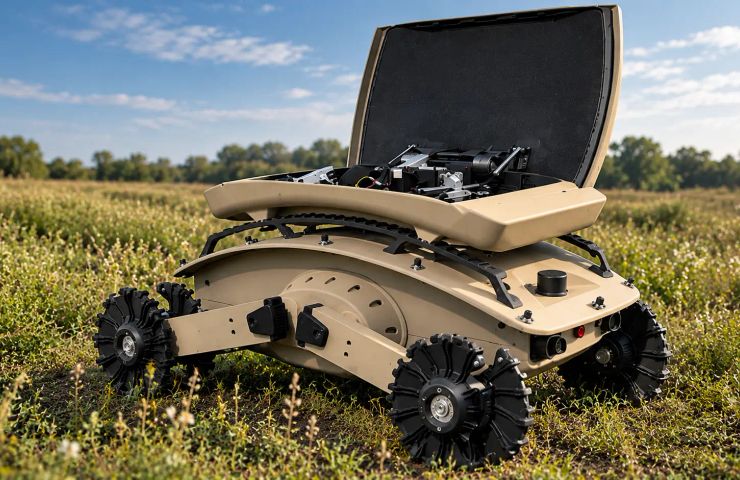
First Hydrogen Corp., a company based in Vancouver and London, has taken a notable step by unveiling a newly completed unmanned ground vehicle (UGV). The announcement arrived recently and describes a robotic platform intended for more than lab demos. It is pitched toward defense, logistics and security operations — practical uses rather than mere curiosities.
Here’s the kicker: the UGV incorporates morphing-wheel technology, a constant-direction drivetrain and a semi-robotic suspension, packaged to address persistent operational challenges in modern robotics. Those three elements are central to the pitch: improved mobility, resilience after damage, and adaptable stability. In short: a vehicle built to keep moving where many current designs would stop.
The company frames the machine as a multi-role system. It is engineered to perform logistics tasks, launch and recover aerial systems, and conduct surveillance missions. Operators, the company says, can swap equipment thanks to a modular payload system, which is intended to make the platform versatile and scalable across different mission sets.
The Technology: The Magic Ingredient
Let’s break down what makes the UGV innovative:
- Morphing-wheel technology: This innovation enables the wheels to change shape, improving traction on different terrains, from smooth pavement to rocky paths.
- Constant-direction drivetrain: Designed for durability, it can continue functioning even after sustaining damage, which is crucial for remote operations.
- Semi-robotic suspension: This feature enhances stability by adjusting the vehicle’s height and attitude to better navigate obstacles.
- Aerial-drone launching module: This unique aspect allows the UGV to carry and deploy drones, offering a combination of ground mobility and aerial reconnaissance.
Each listed feature addresses a distinct operational problem. Morphing wheels aim to reduce the trade-offs between speed on flat surfaces and traction off-road. The constant-direction drivetrain is presented as a resilience measure: if a component fails, motion continues in a usable configuration. Semi-robotic suspension promises finer control over ground clearance and vehicle posture, which matters for both payload stability and sensor performance. And the aerial-drone launching module ties the ground and air domains together, enabling a single platform to support reconnaissance without a separate launch crew.
Strategic Angle: Partnerships and Policy Support
First Hydrogen’s push into robotics is paired with corporate and regulatory moves. Its subsidiary, First Humanoid Corp., has been established to further develop and commercialize these technologies. That formal step positions the program for separate development pathways and, presumably, distinct investment and oversight.
Regulation is already a part of the conversation. Transport Canada asserts that any autonomous operations, particularly those involving aerial drones, must adhere to strict safety and control measures. That assertion introduces an element of external oversight into deployments and trials. It is a reminder that operational ambitions will have to align with national aviation and safety rules.
Beyond national regulation, the company’s timing intersects with wider debates. The draft notes the significance of the United Nations' position on autonomous weapon systems, which complicates how autonomous platforms are viewed internationally. Ethical and legal questions remain central. Technology development, the draft suggests, cannot proceed in isolation from those discussions.
These regulatory and ethical factors are not mere footnotes. They will shape procurement decisions, trial designs and the scope of operations permitted in public spaces. Companies and operators will need to show compliance, and planners will have to balance capability with acceptable risk and oversight.
Zooming Out: A Vision for the Future
This unveiling is presented as more than a product launch. It signals a broader intent: merging ground and aerial robotics into a cohesive operational toolset. If the platform performs as described, it could change how certain missions are executed — particularly those that rely on rapid situational awareness and reduced personnel exposure.
Imagine a logistics convoy supported by a UGV that stages resupply, scouts ahead with a drone, and returns to a logistics node without human drivers. Picture security teams using the same vehicle to extend surveillance reach into terrain that would otherwise require foot patrols. The draft explicitly points to military and tactical use, but the implications extend into civilian sectors that value remote sensing and autonomous logistics.
First Hydrogen is not merely a player in the field of hydrogen-powered transportation but is expanding its reach into crucial robotics areas. That expansion, as described, signals a company pursuing adjacent technologies rather than concentrating on a single product line. The establishment of a dedicated subsidiary underscores that strategic shift.
That said, the draft makes clear that the UGV’s path forward includes more than engineering. Substantial testing, independent evaluations and practical implementations are flagged as necessary next steps. Those stages will determine whether the platform’s theoretical advantages translate into operational benefits under real-world constraints.
Testing will also expose how the modular payload approach functions in practice. Swapping sensors, communications gear or logistics packages under field conditions is often more complex than lab demonstrations. Durability, reliability and ease of maintenance will be decisive factors for any organization considering adoption.
Equally, the interplay between the vehicle’s resilience features and regulatory frameworks will be watched closely. Operators must prove safe control of both the ground vehicle and any aerial systems it deploys, in line with Transport Canada’s stated safety parameters. The United Nations' broader stance will inform international acceptance and potential export controls.
So, what's next? The draft anticipates a sequence: more comprehensive trials, external validation and eventual operational rollouts. Industry watchers will likely look for proof points: logged mission hours, independent test reports and documented compliance with aviation and autonomy standards. Those proofs will be the currency of wider adoption.
In summary, First Hydrogen's latest developments represent a milestone in robotics and defense technology as presented in the announcement. The UGV showcase focuses on practical applications in real-world scenarios, but the release also acknowledges the need for thorough evaluation, regulatory alignment and ethical scrutiny. How quickly this concept moves from demonstration to routine use will depend on testing outcomes, policy trajectories and the answers to questions that go beyond pure engineering.