
AI-Driven Breakthrough in Hydrogen Storage Materials Discovery
February 9, 2026In Sendai, Japan, where centuries-old temples rub shoulders with top-tier labs, a fresh wave of clean energy research is turning heads. Nestled in this city that effortlessly blends tradition with innovation, Tohoku University has been a materials science powerhouse for decades. Just this month, its WPI-Advanced Institute for Materials Research (WPI-AIMR) debuted two game-changing tools—DIVE and DigHyd—and trust me, these aren’t your run-of-the-mill lab updates. Together, they could completely upend how we spot and engineer hydrogen storage materials, turbocharging our march toward a carbon-neutral world and reshaping the landscape of global clean energy research.
Way back in 1907, Tohoku University earned its stripes as one of Japan’s first imperial universities—and it’s kept that pioneering spirit alive ever since. In 2010, the university launched WPI-AIMR under the World Premier International Research Center Initiative, elevating Japan’s profile by encouraging multidisciplinary teamwork. Today, you’ll find chemists, physicists and computer scientists brainstorming side by side in cutting-edge labs, tackling everything from superconductors to solar fuels—and laying the groundwork for next-level AI materials discovery.
A Game-Changer for Hydrogen Storage
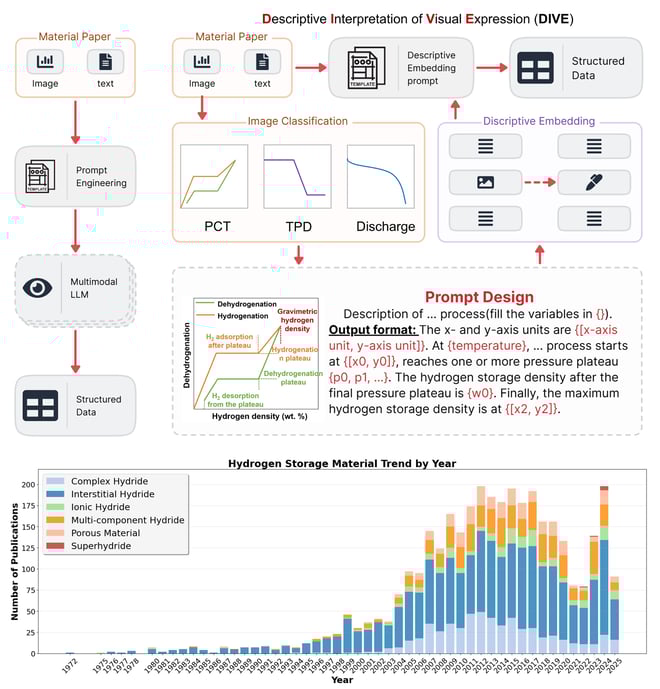
Meet DIVE—short for Descriptive Interpretation of Visual Expression. Led by Distinguished Professor Hao Li, DIVE is a fully multi-agent AI system that slurps up experimental data from over 30,000 figures in more than 4,000 publications, all in a matter of minutes. With its chat-like interface, you’ll forget those tedious weeks of manual data mining. Thanks to the DIVE workflow, it outperforms leading commercial models by 10–15% and leaves open-source tools in the dust by over 30% when it comes to data-extraction accuracy.
Here’s the fun part: you type in something like, “Show me materials with hydrogen capacity above 5 wt% at room temperature,” and DIVE instantly scans, ranks and points you to the original charts and tables. Under the hood, dedicated AI agents handle optical character recognition, figure segmentation, data validation and uncertainty estimation. One agent might extract plateau regions from a metal-hydride phase diagram, while another normalizes those values against standard references. While researchers have toyed with AI for materials prediction before, this end-to-end, hands-off setup is one of the first to bridge published research and lab testing without human babysitting.
DigHyd: The Largest Digital Hydrogen Platform
On the flip side, DigHyd is your all-in-one hub for solid-state hydrogen storage materials. This curated DigHyd database aggregates entries from both experimental and computational studies—over 30,000 data points distilled from thousands of scientific papers. Armed with robust search filters, built-in analytics and interactive visuals, DigHyd makes it a breeze to chart trends in hydrogen uptake versus temperature, screen hundreds of compounds for thermodynamic stability or even brainstorm novel material blends.
Just head over to www.dighyd.org, and you’ll find materials scientists from every corner of the globe collaborating in real time. Next up, the team plans to weave in regional experimental datasets from partners across Europe and North America, and roll out hands-on workshops so everyone can master both the DIVE workflow and the DigHyd database. The aim? Turn these tools into go-to resources, not just lab curiosities.
Collaborations Powering Clean Energy Research
None of this would’ve happened without the collaborative spirit at the heart of Japan’s World Premier International Research Center Initiative. Since day one, WPI-AIMR has been a melting pot where chemists, physicists, data scientists and engineers unite to tackle energy challenges. By pooling expertise and state-of-the-art infrastructure, the institute brought both DIVE and DigHyd to life and put them through rigorous validation. You can dig into the full details in Chemical Science (DOI: d5sc09921h), and Tohoku’s press team has been loud and proud about AI’s pivotal role in turbocharging clean energy R&D.
Broader Impact and Future Promise
Let’s be real: hydrogen’s big draw as a zero-emission fuel hinges on cracking the storage puzzle—making it safe, cost-effective and compact. By automating data extraction and materials suggestions, DIVE could slash the discovery timeline from years down to months, saving research budgets in the millions and fast-tracking pilot projects. Meanwhile, DigHyd champions transparency and data sharing—crucial for sidestepping duplicate efforts and accelerating breakthroughs across both academia and industry.
Of course, real-world validation of AI-suggested compositions is the next critical step, but the paradigm shift is obvious: AI-driven workflows like these could pave the way for lighter, safer hydrogen tanks in vehicles, grid-scale storage systems to smooth out renewable power and portable fuel solutions for off-grid communities—or even backup power in disaster-prone areas without belching CO₂.
A Glimpse into the Future
Imagine city buses hauling twice the fuel or neighborhood energy hubs quietly banking solar power overnight—no hulking cylinders in sight. As research teams worldwide adopt DIVE and DigHyd, we’ll likely see a domino effect: papers published faster, pilot demonstrations kicking off sooner and, ultimately, commercially viable hydrogen storage solutions rolling out on a larger scale.
By marrying AI prowess with deep domain expertise, Distinguished Professor Hao Li and the WPI-AIMR crew are sketching a blueprint for next-level AI materials discovery in the clean energy arena. It’s an exciting preview of what’s on the horizon for the hydrogen economy, and honestly, I can’t wait to see where this momentum takes us.
source: pubs.rsc.org

 With over 15 years of reporting hydrogen news, we are your premier source for the latest updates and insights in hydrogen and renewable energy.