Ammonia-based hydrogen production Breakthrough Verified in Chungju’s Green Hydrogen Zone
December 8, 2025Ever have one of those moments when months of groundwork suddenly pay off? That’s exactly what’s happened at South Korea’s Green Hydrogen Industry Regulation Free Zone in Chungju. The central ministries and the Korea Gas Safety Corporation (KGS) just gave the official thumbs-up to the safety of ammonia-based hydrogen production and utilization systems.
This announcement from the Ministry of SMEs and Startups (MSS) and the Ministry of Climate, Energy and Environment (MCEE) is sending ripples through the power, mobility and industrial sectors. It basically clears the path for using ammonia cracking as a go-to feedstock for hydrogen extraction across the country. No more jumping through hoops for special permits—energy companies and startups can now dive in with confidence. It’s a breakthrough that tears down red tape and revs up commercialization, aligning perfectly with the national drive toward carbon neutrality.
Simple yet powerful technology
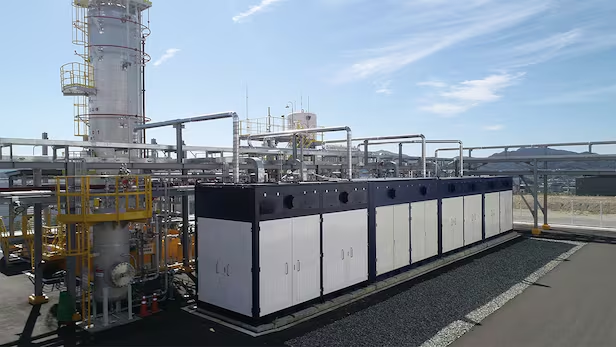
What’s the big deal about ammonia? It’s all about an elegant solution to a nagging problem: storing and transporting hydrogen. With ammonia cracking—sometimes called thermal decomposition—you feed liquid ammonia into a reactor, crank up the heat to around 400–500°C with some custom catalysts, and voilà: hydrogen and nitrogen roll out the other end. The hydrogen gets separated, purified, and is ready to juice power plants, fuel cells or industrial rigs. And the only byproduct is harmless nitrogen. Talk about cutting out pollution without skimping on performance!
Solving real-world problems
For years, national rules only allowed hydrocarbon fuels like city gas or LPG for hydrogen extraction equipment. That left ammonia projects stuck in regulatory limbo, even as the world woke up to clean ammonia’s potential. Cue the Green Hydrogen Industry Regulation Free Zone sandbox in Chungju. Under this experimental framework, North Chungcheong Province, Chungju City and the central ministries handed out special exemptions to set up and run the nation’s first ammonia-based facilities. Over several months of pilot runs, these sites proved their mettle—demonstrating rock-solid safety measures and squeaky-clean performance while handling toxic ammonia.
Legal barriers fall, business doors open
On December 7, 2025, the ministries officially announced that the ammonia-to-hydrogen setups in the Chungbuk zone had passed every safety check. It’s the first time an ammonia-based modular hydrogen production process and its safety framework have been stamped approved through central-local collaboration. Not long after, KGS updated its Hydrogen extraction equipment standards—modernizing the “Standards for facilities, technology, and inspection for manufacturing hydrogen extraction equipment.” As of November 28, those rules explicitly list ammonia as an approved feedstock and lay out detailed requirements for handling toxic gas safely. Just like that, the legal barrier blocking ammonia cracking projects got knocked down, giving developers a clear, nationwide route to greenlight their plans.
Made in South Korea, made for South Korea’s future
Lee Hyeon-jo, Special Zone Innovation Planning Director, believes mixing local trials in Chungju with national standard-setting could be a real game-changer. “Rolling out ammonia-based hydrogen businesses on a commercial scale will turbocharge Korea’s hydrogen industry and our carbon-neutrality goals,” Lee said. By leaning on homegrown R&D and manufacturing, this project underscores a firm commitment to keep hydrogen innovation rooted in Korea, not outsourced abroad. It’s a classic case of national pride meeting practical progress.
And here’s the kicker: under the Clean Hydrogen Power Generation Support (CHPS) scheme, the government plans to auction off 3,000 GWh of electricity from clean hydrogen and ammonia co-firing in 2025. That’s four times the 750 GWh doled out in 2024—proof positive that low-carbon power solutions are in hot demand.
Environmental and economic upside
Picture this: if that ammonia comes from green or blue hydrogen, power plants and factories could slash their carbon footprints compared to coal or conventional gas. And the ripple effects aren’t just environmental. Local manufacturers and engineering firms in Chungju and the wider Chungbuk region stand to benefit—new facilities, fresh job opportunities, and a chance to cement their place in a growing hydrogen supply chain. Universities and research institutes are already crafting training programs to give students and workers the skills they’ll need to run and maintain these ammonia cracking plants, boosting both workforce readiness and innovation capacity.
Chungju’s success story isn’t happening in isolation. Over in Gunsan, Jeonbuk Province is gearing up for its own large-scale ammonia-to-hydrogen demo running from 2025 to 2027. Local officials are teaming up with the Korea Research Institute of Ships and Ocean Engineering (KRISO), Hyundai Motor, Hyundai Rotem and the Korea Testing Laboratory (KTL) to churn out mobility-grade hydrogen from ammonia. By tapping into Jeonbuk’s maritime engineering roots, that project could help stitch together a nationwide network for ammonia cracking.
On a global scale, ventures like these could help lift a still-emerging market. The IEA’s Global Hydrogen Review 2025 reminds us that low-emission hydrogen makes up less than 1% of global production. Unlocking ammonia cracking at scale positions South Korea to move the needle on clean hydrogen availability, dovetailing with international efforts to tame greenhouse gas emissions.
And it doesn’t stop at energy. Equipment manufacturers can now design reactors optimized for ammonia, local fabricators can crank out pressure vessels and heat exchangers, and safety consultants can tailor training programs around toxic-gas handling. In short, the whole value chain—from R&D labs to factory floors—is springing into action around this new technology, driving job creation and industrial growth across regions.
Looking ahead, South Korea’s playbook—trialing technologies in a regulatory sandbox before scaling them through national standards—could be a blueprint for governments worldwide aiming to spark clean energy breakthroughs. We’ve seen what happens when straightforward, powerful ideas meet the right policy environment. Now, it’s time to take those lessons global, ensuring that ammonia-based hydrogen production delivers on its promise: powering industries, decarbonizing our grids, and tackling some of the biggest environmental challenges of our time.

 With over 15 years of reporting hydrogen news, we are your premier source for the latest updates and insights in hydrogen and renewable energy.