Ammonia Power Generator Pilot in Detroit with Neology Hydrogen
February 5, 2026Detroit’s been nicknamed the Motor City for as long as anyone can remember, thanks to its automotive roots. After topping out at about 1.85 million residents in the 1950s, it’s settled around 620,000 today—but don’t count it out. The city’s on a mission to reinvent itself as a tech-savvy, green-energy hotspot. Sure, brutal winters can sap battery life, and many industrial sites still rely on diesel generators belching CO₂ and NOₓ. However, with empty warehouses, buzzing tech incubators, and a fresh drive toward hydrogen solutions, Detroit has become a real-world proving ground for Off-Grid Clean Energy. A $1.5 million prize and hands-on guidance from the Toyota Mobility Foundation’s Sustainable Cities Challenge have city leaders betting big on hydrogen to bolster resilience—especially in neighborhoods that face the most outages.
Historical Context of Ammonia-Powered Systems
The concept of cracking ammonia to get hydrogen isn’t exactly new—it dates back to the early 20th century, right after the Haber-Bosch synthesis revolutionized fertilizer making. Ammonia’s easier to store and ship than pure H₂, which needs super-low temps or sky-high pressures. After the Paris Agreement, EU and U.S. incentives to decarbonize off-grid and heavy-duty applications breathed new life into ammonia as a hydrogen carrier. That renewed focus paved the way for modular Ammonia-to-Hydrogen Systems, and it’s precisely where Neology Hydrogen has stepped up with its game-changing twist on an old idea.
How the Ammonia Power Generator Works
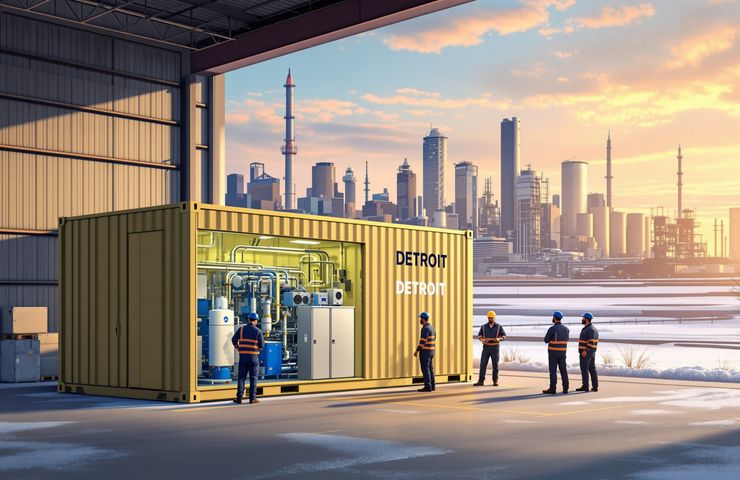
Enter the Ammonia Power Generator: a containerized Ammonia-to-Hydrogen System cranking out 50–200 kW, built to swap in for clunky diesel generators in remote or heavy-duty settings. Inside its compact shell, a low-temperature cracker splits liquid NH₃ into hydrogen (H₂) and nitrogen (N₂). After purification, the hydrogen feeds a fuel cell that delivers clean electricity and nothing but water vapor, while the nitrogen drifts away harmlessly. You get zero CO₂ and NOₓ emissions, and because ammonia packs more energy per liter than hydrogen gas, this setup keeps the lights on longer—especially when cold snaps or long runtimes would drain a battery too fast.
Collaboration and Funding
Bringing this Swiss-born concept to Detroit meant lining up the right backers. Neology Hydrogen SA, founded in March 2023 in Lutry, Switzerland, raised CHF 2.5 million in its first equity round, with support from Roland Bartholet’s group, Kickfund, CoreAngels Climate, and Venture Kick. Add a CHF 250,000 innovation grant from the City of Zurich, and you’ve got a solid war chest. Meanwhile, the Toyota Mobility Foundation didn’t just write a check—they opened up warehouse space for pilot installations. As CEO Aris Maroonian points out, Detroit’s appetite for hydrogen and its available facilities made it a no-brainer compared to Switzerland’s smaller industrial footprint.
Quantifiable Milestones
Neology Hydrogen has sketched out a clear rollout plan. By late 2025, they’ll light up a proof-of-concept pilot. In 2026, look out for a 50 kW demo unit, followed by a 200 kW system in 2027. To make that happen, the current six-person team will grow to 11 by year’s end, beefing up engineering and manufacturing. And the buzz isn’t just internal—letters of intent from clients in Europe and Asia, from construction firms to agricultural operators, are already in hand. Those early deals aren’t just good PR; they show the technology really can stand on its own commercially.
Addressing Challenges and Trade-offs
No technology is perfect. Cracking ammonia eats energy—studies suggest you lose about 25–30% efficiency in the process. Ammonia itself is toxic, so you need strict safety protocols to prevent leaks. And, of course, the green credentials hinge on sourcing genuinely green ammonia—if you make it with fossil-fuel power, you’re back to square one. Still, for anyone chasing Off-Grid Clean Energy, the trade-offs are compelling: a modular, near-silent power source that fits into established ammonia logistics, while sidestepping the carbon footprint of diesel or LNG generators.
Broader Impact and Future Outlook
This pilot isn’t just a one-off showcase—it’s a springboard toward a global network of decentralized clean energy hubs. By tapping into existing ammonia supply chains used in fertilizer and heavy industry, Neology Hydrogen stands ready to scale fast once green ammonia becomes widely available. Imagine mobile EV charging stations, port operations, and rail yards all powered by silent, containerized Ammonia Power Generators. If even a fraction of remote industrial sites swapped diesel gensets for these units, we could save hundreds of thousands of tonnes of CO₂ every year. And let’s not forget the jobs: a boost in manufacturing, operations, and maintenance roles on both sides of the Atlantic.
A Glimpse into the Future
Looking ahead, the Neology Hydrogen team isn’t hitting the brakes. They’re refining their fuel cell stacks, pursuing more certifications, and eyeing partnerships in maritime and heavy transport sectors. The collaboration with the Toyota Mobility Foundation and Detroit’s local ecosystem gives a sneak peek at how an Ammonia-to-Hydrogen System can power zero-emission Off-Grid Clean Energy. It’s living proof that a bit of Swiss ingenuity and some Midwestern grit can turn ammonia—one of industry’s oldest chemicals—into a cornerstone of tomorrow’s clean-energy world.

 With over 15 years of reporting hydrogen news, we are your premier source for the latest updates and insights in hydrogen and renewable energy.