China’s AI-Driven Ammonia Mega-Plants Online
December 23, 2025China just flipped the switch on two colossal green hydrogen and ammonia plants in December 2025. If you’re picturing pilot-scale demos, think again. These are industrial beasts, built to pump out hundreds of thousands of tonnes of clean ammonia and methanol for export—running entirely off-grid without so much as a backup from the national power lines.
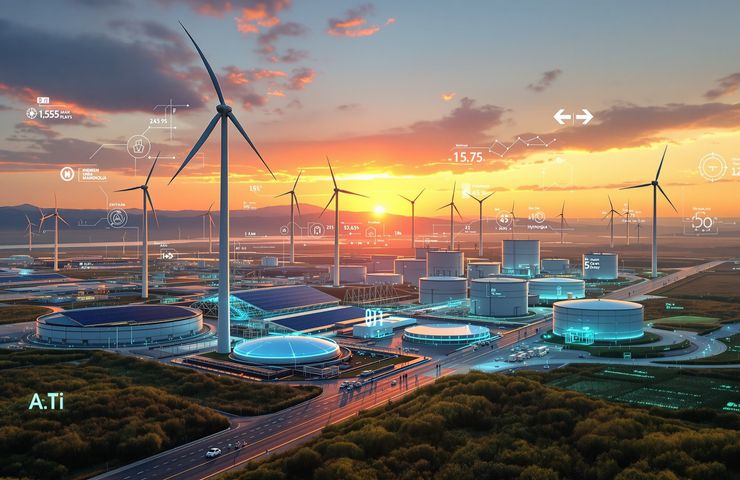
Envision kicked things off at the Chifeng Net Zero Industrial Park in Inner Mongolia earlier this year, launching a 320,000 t/y green ammonia facility with first shipments on deck for Q4. The secret sauce? A standalone microgrid where fat wind turbines, sun-soaking solar arrays, and grid-forming battery banks all feed into an AI brain. Instead of letting extra electrons go to waste, a dynamic air-separation unit chills out nitrogen for system buffering. Meanwhile, an AI-driven control system—powered by hyper-accurate weather forecasts—juggles electrolyzer loads and ammonia synthesis in real time, smoothing out any renewable hiccups. The result? Continuous hydrogen production and ammonia production without ever drawing a single megawatt-hour from the grid.
Not to be outdone, China Energy Engineering Corp. fired up Qingqing No. 1 in Songyuan, Jilin. Touted as the world’s largest green hydrogen-ammonia-methanol integrated project, phase one spits out 200,000 t/y of combined products backed by a CNY 30 billion bet. Just like the Chifeng site, Qingqing No. 1 is an off-grid marvel, blending wind, sun, and AI-enabled load balancing. Early operations are already shaving off 600,000 tonnes of coal and slashing 1.4 million tonnes of CO2 every year. Plus, Envision’s plant snagged ISCC Plus and Bureau Veritas Renewable Ammonia certifications—the first of their kind at this scale—proving the low-carbon creds.
These launches come as China’s green hydrogen capacity tops 220,000 t/y—over half the global total. Add in nearly a million tonnes per year of green ammonia and methanol capacity, and you’ve got a national strategy firing on all cylinders. Beijing isn’t just knocking out climate pledges—it’s building an export juggernaut. Tie together bleeding-edge AI, renewables, and massive scale, and you’re rewriting the playbook for sustainable energy commodities and industrial decarbonization.
Off-Grid AI-Powered Scale
Intermittent renewables are hydrogen’s kryptonite, but Chifeng essentially side-steps the whole problem. Rows of advanced wind turbines, high-efficiency PV fields, and grid-forming batteries feed a central AI system. It taps into predictive meteorological modeling and real-time performance data, dialing electrolyzer load and Haber-Bosch synthesis rates up or down every few seconds. When production spikes, the dynamic air-separation unit liquefies nitrogen at cryogenic temps—think of it as a giant shock absorber for your electrons. The payoff? Zero-grid-dependence, uninterrupted hydrogen production, and seamless ammonia synthesis no matter how fickle wind and sun get.
Integrated Power in Songyuan
Those folks at Qingqing No. 1 are playing three-dimensional chess with their products: hydrogen, ammonia and methanol. They shift capacity on the fly based on market prices, flexing toward whatever brings the biggest margins. It’s the same off-grid microgrid recipe—wind, solar, batteries—only now an AI-Integrated Energy Optimization System coordinates everything from electrolyzers to synthesis reactors. Need more methanol? The AI snips off extra hydrogen feedstock. Prices lean toward ammonia? It cranks up the Haber-Bosch loop. That kind of agility at a 200,000 t/y scale is practically unheard of in legacy chemical plants.
The High Stakes
If green ammonia hits price parity with fossil-derived supply by 2028, the entire ammonia production market is in for a scramble. Conventional plants chained to natural gas and coal suddenly face a competitor with carbon-free feedstock and process heat. And we’re not just talking fertilizer—liquid ammonia doubles as a hydrogen carrier for shipping fuel, power generation, and industrial feedstocks. When cargo ships from Inner Mongolia and Jilin slide into Asia, Europe, and beyond, they’ll be hauling more than molecules; they’ll be carrying the future of global energy security.
Scaling to Multi-Megatonnes
Envision’s roadmap calls for a leap from 320,000 t/y to a whopping 1.5 Mt/y by 2028—a 4.7× jump. Qingqing No. 1 has its sights set on growing from 200,000 t/y to 800,000 t/y in the same time frame. Pulling this off means cloning whole microgrids, laying down electrolyzer farms, building mega ammonia reactors, and stacking more battery banks—all in record time by industrial standards. Combined, we’re talking about 2.3 Mt/y of green hydrogen derivatives. To match that scale, you need shipping terminals, port upgrades, and cross-border regulatory frameworks to roll out just as fast.
Policy & Power Play
Beijing isn’t leaving this to chance. The National Energy Administration has woven green hydrogen into its 14th Five-Year Plan, dangling feed-in tariffs, R&D grants, and tax breaks for home-grown electrolyzers and synthesis units. It’s a textbook home-field advantage: back local champions like Envision and China Energy Engineering Corp., lock down supply chains, and secure export routes before the rest of the world even files patents.
Risks & Uncertainties
Of course, massive stretch targets come with headaches. Producing megatonnes of green hydrogen and ammonia demands metals like nickel and platinum for batteries and electrolyzers, plus specialty catalysts that can see wild price swings or shipping delays. Permitting ports, lining up ammonia carriers capable of –33 °C or pressurized tanks, and navigating cross-border trade rules all add layers of complexity. Twist any one of those screws wrong, and those 2028 goals could slip off the rails.
Global Watch
Meanwhile, competitors in Europe, Australia, and the Middle East are still bootstrapping dozens of pilot projects at tens of thousands of tonnes per year. China just vaulted two massive plants—320,000 t/y and 200,000 t/y—into operation straightaway. Scale isn’t just a number; it’s a moat. As other nations sprint to catch up, China will keep fine-tuning its manufacturing, logistics, and AI ops, cementing a lead few can hope to close by 2030.
Quick Tech Crash-Course
- Off-Grid Renewable Energy System: A standalone microgrid blending wind, solar, and grid-forming batteries.
- AI-Integrated Energy Optimization: Real-time orchestration aligning production with renewable output and market signals.
- Dynamic Air-Separation Unit: Swaps surplus electrons for liquid nitrogen, stabilizing operations.
- Electrolysis & Haber-Bosch Synthesis: Proven pathways for hydrogen production and ammonia production, run with AI precision.
The Money and Market
A CNY 30 billion cheque for Qingqing No. 1 is just the opening act. Envision’s push to 1.5 Mt/y will call for multibillion-dollar injections across thousands of electrolyzers, reactors, and batteries. Plant construction needs to hum like clockwork, from module manufacturing to on-site assembly. Investors, take note: once green ammonia starts undercutting fossil prices, capital will flood in. Policy levers—from tariffs to export credits—will only sweeten the pot.
China’s AI-driven ammonia mega-plants prove one thing: green hydrogen isn’t fringe—it’s a strategic commodity at the heart of sustainable energy and industrial decarbonization. The export lanes are opening—don’t blink, or you’ll miss the wave.

 With over 15 years of reporting hydrogen news, we are your premier source for the latest updates and insights in hydrogen and renewable energy.