
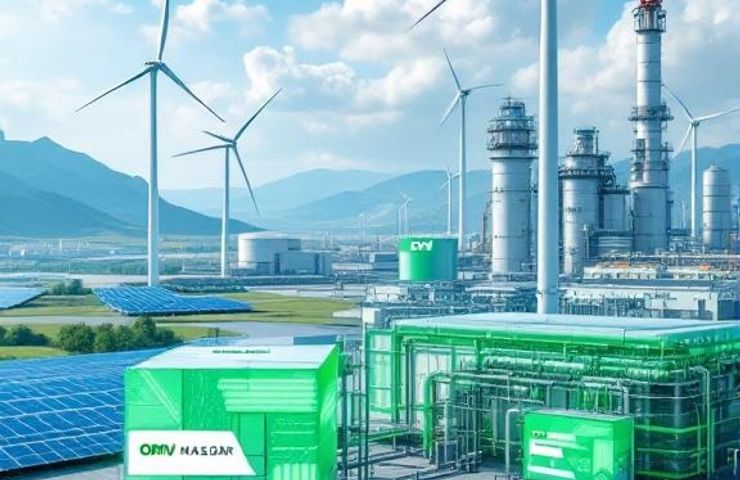
Green hydrogen plant gets €123M boost from Austria for 140 MW electrolyzer
January 8, 2026Imagine slashing 150,000 tons of CO2 each year at one of Europe’s busiest refineries. That’s the payoff OMV is chasing after securing €123 million to build a 140 MW green hydrogen electrolyzer plant in Bruck an der Leitha, Lower Austria. It’s a bold play on electrolysis and Austria’s big dream of fully sustainable energy, and it could be a real game-changer.
On January, 2026, OMV inked a deal with Austrian Wirtschaftsservice GmbH (aws)—the federal development bank steering Austria’s hydrogen strategy—securing up to €123 million for this flagship plant. aws, a key pillar in Austria’s green-tech funding landscape, has already backed initiatives across renewables, grid modernization and green hydrogen, with total commitments topping €1 billion. This has helped kickstart dozens of clean-energy initiatives. And since the European Hydrogen Bank gave its nod, this venture is now on the fast track to drive Europe’s energy transition and turbocharge industrial decarbonization.
Just 22 km down the road from OMV’s Schwechat refinery, the town of Bruck an der Leitha sits at the crossroads of old trade routes and new energy opportunities, a stone’s throw from the Slovak border. With just over 8,000 residents, it’s come a long way from its medieval customs-post roots. Today, wind farms, solar parks and nearby hydropower plants pepper the landscape, generating power and serving as real-world testbeds for blending different sustainable energy sources. It’s now a perfect springboard for green exports.
Scaling hydrogen production for hard-to-abate industries
Once it’s running at full tilt, this 140 MW facility will rank among Europe’s biggest. A 22 km underground pipeline will ferry clean hydrogen straight into OMV’s Schwechat refinery, kicking out fossil-derived gas and shaving off roughly 150,000 tons of CO2 each year—that’s like taking over 60,000 cars off the road. But it’s no small feat: the plant will gulp around 290,000 m³ of water annually, so planners are hashing out catchment and recycling strategies, and it needs a steady supply of renewable juice—about 330 GWh per year. OMV’s plan? Tap into nearby wind and solar parks and even use hydrogen storage as a kind of grid-stabilizer when supply and demand get out of sync.
The heart of electrolysis
At the core of this operation is Proton Exchange Membrane (PEM) electrolysis, the very same tech OMV piloted with a 10 MW unit back in April 2025. Basically, PEM electrolysis splits water into hydrogen and oxygen using renewable electrolysis—no additives, just pure water splitting—so it ticks the box for RFNBO certification under the EU’s Renewable Energy Directive. And because these stacks can ramp up or wind down in minutes, they’re perfect for matching the ebb and flow of wind and solar output—exactly what you need for grid balance. Engineers have already fine-tuned the pilot plant to slow membrane wear-and-tear, and all those lessons are feeding straight into the big 140 MW blueprint, from stack design to maintenance protocols.
Partners fueling the vision
OMV isn’t going solo. It’s teamed up with aws and Abu Dhabi’s clean-energy frontrunner Masdar, after signing a memorandum of understanding in November 2025 to form a joint venture that will handle financing, construction and day-to-day operations. If regulators give the nod in early 2026, Masdar will bring deep pockets and large-scale project chops, sourcing key components from European and Asian suppliers to ensure a diversified supply chain. Under the JV, aws will oversee grant governance, while OMV leverages decades of refinery know-how to integrate the plant with its fuels and chemicals units.
“This marks a milestone in our energy transition,” says Alfred Stern, OMV’s Executive Board Chairman and CEO. And Martijn van Koten, OMV’s Executive Vice President, adds that this electrolyzer will be pivotal in decarbonizing Schwechat, dovetailing nicely with OMV’s Strategy 2030 and its net-zero-by-2050 ambition.
Policy backdrop
Of course, this deal isn’t happening in a vacuum. It’s riding the wave of Austria’s hydrogen strategy and the EU’s push via the European Hydrogen Bank. Under the EU’s Renewable Energy Directive II, there’s a 6 percent RFNBO target for transport and industry by 2030, so investors are zeroing in on electrolyzer projects. Austria’s National Hydrogen Strategy, launched in 2021, earmarked €2 billion to scale up clean hydrogen, with aws steering public-private partnerships alongside the Klima- und Energiefonds through the WIVA P&G initiative. These targets aren’t just numbers—they’re calls to action shaping policy and investment across the continent.
Building on early wins
It’s not OMV’s first rodeo with electrolysis. In April 2025, it flipped the switch on Austria’s largest 10 MW PEM unit at Schwechat, cranking out about 1,500 tons of hydrogen and cutting 15,000 tons of CO2. The pilot taught them a ton—like dialing in the right hydrogen purity for hydrocracking, establishing robust asset-management systems, and gathering crucial data on system integration and remote monitoring. The new plant’s modular design means OMV can slot in more modules or swap in next-gen catalysts down the line, keeping the operation future-proof and flexible.
Broader ripples
But the impact stretches far beyond Schwechat’s fence line. This project sets the stage for OMV’s green-hydrogen ventures in Romania via OMV Petrom—a 55 MW plant slated to produce 8,000 tons per year for sustainable fuels. And it’s a blueprint for other industrial hubs wrestling with tough-to-cut emissions. Local communities are already eyeing green-hydrogen buses and cleaner ammonia production, tapping into the plant’s off-take flexibility and storage potential.
Looking ahead
Procurement kicks off in Q2 2026, with engineering, procurement and construction (EPC) contracts expected to be awarded by year-end. OMV’s already in talks with Siemens Energy and other OEMs for electrolyzer modules, and the pipeline installation will dovetail with Austria’s expanding hydrogen backbone network. Barring delays, the first steel could be in the ground by mid-2026, with the plant up and running by late 2027—after OMV plows in several hundred million euros. Follow that timeline, and you’ll see a prime example of how large-scale hydrogen production can mesh with refineries, mining, steel and chemical industries—fueling a new era of zero-emission technology.
About OMV
OMV Aktiengesellschaft is a Vienna-based integrated energy group operating across exploration, production, refining, fuels and chemicals. With around 23,600 employees and €34 billion in revenues in 2024, it’s traded on the Vienna Stock Exchange and is on track for net-zero operations by 2050.
 With over 15 years of reporting hydrogen news, we are your premier source for the latest updates and insights in hydrogen and renewable energy.
