
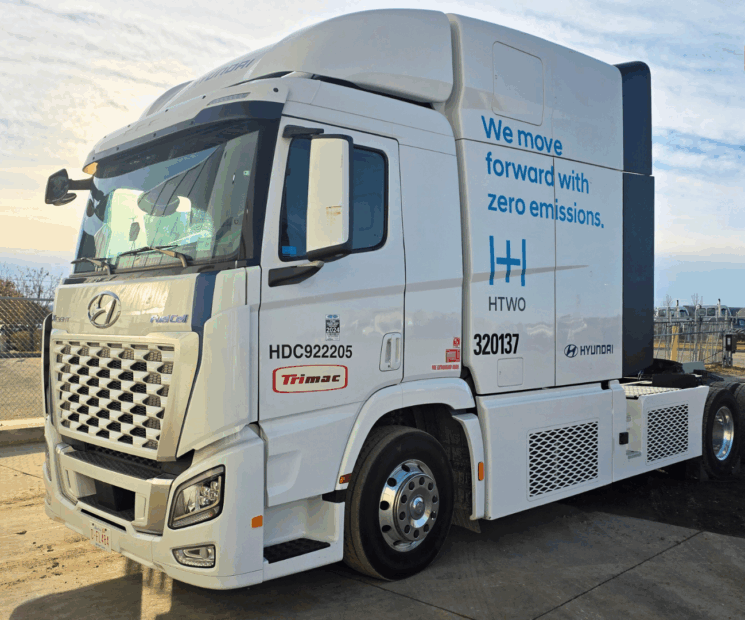
Hydrogen Fuel Cell Trucks: Alberta Pilot Drives Zero-Emission Future
December 16, 2025Imagine zipping across Alberta’s wide-open prairies under a sunset that sets the sky ablaze, the Rockies peeking out in the distance, all while a massive tractor-trailer hums by so quietly, you hardly notice it. It’s December 9, 2025, and Trimac Transportation has just teamed up with the Alberta Motor Transport Association (AMTA) on a pilot destined to shake up zero-emission transportation.
Alberta Takes the Wheel on Hydrogen
Alberta, home to roughly 4.7 million people and renowned as Canada’s resource heartland, is now steering toward Hydrogen transport Alberta. Backed by fields of natural gas and a growing roster of blue and green hydrogen projects, the province’s putting the Hyundai XCIENT Hydrogen Fuel Cell Truck through its paces under real, heavy-duty hauls. Through early 2026, this long-haul warrior will cycle among participating fleets, logging range, refill stops, payload impacts, and overall cost, giving us a crystal-clear view of what hydrogen fuel cell trucks can really do.
A Pioneering Collaboration
No single company could’ve pulled off this experiment alone. Calgary-based Trimac Transportation—a bulk-haul titan with 140 branches since 1945—teams up with Hyundai, the pioneer of commercial heavy-duty fuel cell trucks; the AMTA, which handles driver and mechanic training; and AZETEC, fine-tuning a prototype that promises more than 430 miles on one fill. Since 2022, Trimac has been experimenting with hydrogen retrofits alongside Innovative Fuel Systems and Hydra Energy, ironing out early kinks and setting the stage for today’s breakthrough.
On the Road: Testing Real-World Performance
As the Hyundai XCIENT crisscrosses key corridors—from Edmonton’s industrial zones to Calgary’s freight hubs—a team of engineers and fleet managers will collect data every kilometer, feeding it into a centralized dashboard. They’ll gauge fuel-cell efficiency, uptime, refill times, handling under full load, and candid driver feedback. Early estimates hint at a sweet spot: over 430 miles (700 km) per fill, zero tailpipe emissions, and nothing but water vapor trailing behind.
Driving Decarbonization: Impact and Insights
In Canada, heavy-duty trucking makes up nearly a quarter of on-road emissions. This pilot offers a real-world snapshot of how sustainable logistics and bulk hauling decarbonization might unfold at scale. Stakeholder roundtables—including government agencies, fuel suppliers, and infrastructure developers—are already drafting plans for refueling stations along Alberta’s major routes. What we’re watching grow isn’t just a lone truck; it’s the foundation of a full-fledged ecosystem for hydrogen fuel cell trucks.
A Glimpse into the Future
For Trimac Transportation, this pilot marks a major checkpoint in its 2024 ESG roadmap. If the hydrogen network rolls out as planned, fleets could swap out thousands of diesel rigs, cutting greenhouse gases and operational costs in one fell swoop. Meanwhile, AZETEC will refine its zero-emission prototype ahead of 2026 commercial trials, leveraging insights from this program. Banks, insurers, and investors are already circling, eyeing fresh policy support and funding that could accelerate adoption across North America.
It’s not every day you see an entire industry rally around a single pilot—and feel the buzz as tangibly as you can in Alberta right now. As this program rolls forward, we’re not just crunching numbers; we’re getting a front-row seat to tomorrow’s transportation landscape. The bottom line? With emissions targets tightening worldwide, zero-emission transportation and hydrogen fuel cell trucks are revving up to lead us toward a cleaner, greener horizon.
 With over 15 years of reporting hydrogen news, we are your premier source for the latest updates and insights in hydrogen and renewable energy.